Five AI Research Agents
Building the AI Research OS — A Complete A–Z Product Development Roadmap
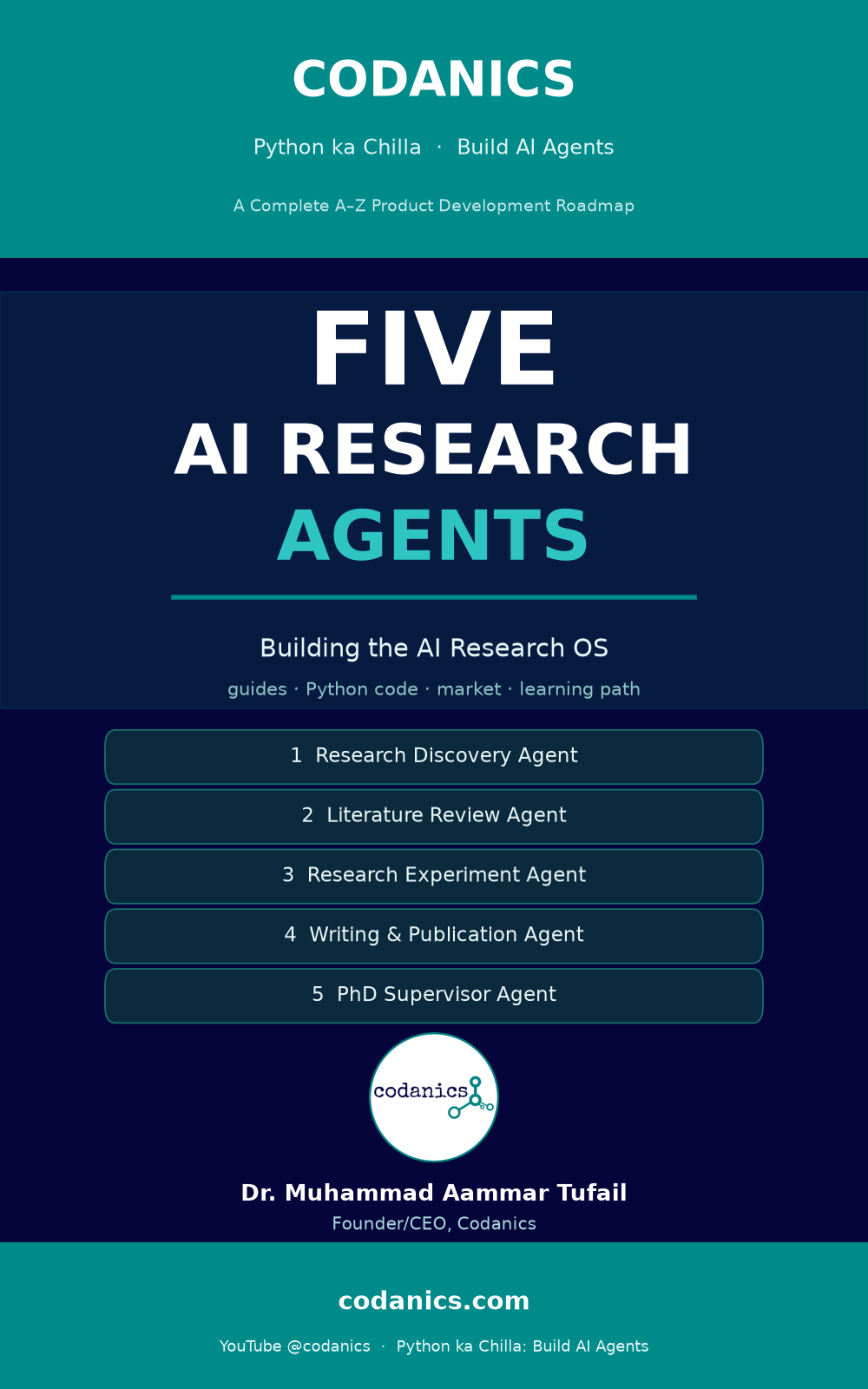
Build the AI Research OS.
For research and academic writing, the biggest opportunity is not another ChatGPT wrapper. It is AI research agents that automate the complete research lifecycle — idea discovery → literature review → experimentation → writing → publication.
This book is the complete product-development kit for five such agents: the guides, the runnable Python code, the market and pricing analysis, and the learning path to build them yourself.
Read it your way — this book is published in three formats: HTML (this site), PDF and EPUB. You can also use the download icon in the top bar at any time.
0.1 The five agents
1AI Research Discovery Agent “Your AI Research Scientist” — mines arXiv, PubMed, Semantic Scholar and Crossref, finds research gaps, generates ranked PhD topics and writes the proposal.
2AI Literature Review Agent “Autonomous Systematic Review Scientist” — PRISMA search → screening → evidence extraction → a full literature review draft, with an audit trail.
3AI Research Experiment Agent “Virtual Research Assistant” — experimental design, QC, statistics, machine learning and a reproducible analysis notebook.
4AI Academic Writing & Publication Agent “From Data to Manuscript” — manuscript drafting, journal matching, simulated peer review and a point-by-point response letter.
5AI PhD Supervisor Agent “Virtual Research Mentor” — a 3-year roadmap, weekly progress evaluation, critical review and defence preparation, backed by long-running memory.
0.2 Who this book is for
- PhD scholars and researchers who want to cut months off literature reviews and manuscripts.
- Python learners who want to build real, sellable AI agents rather than toy chatbots.
- Founders and product people looking for a validated, underserved market.
- Universities, research labs and R&D departments evaluating an institutional AI research platform.
0.3 How the book is organised
- Part I — a five-member expert council debates what to build, for whom and how to sell it; then the market overview.
- Part II — one guide per agent: problem, solution, architecture, build steps, market value, how to sell, risks and a 90-day roadmap; plus the platform vision and the go-to-market playbook.
- Part III — what to learn to build AI agents, a glossary of the major terms, and how these agents actually work.
- Part IV — the complete, commented Python source of all five agents.
0.4 How to run the code
Each agent is a self-contained folder — copy one out and it still runs. All five share one virtual environment.
cd 02_agents_code
.\setup_venv.ps1                 # creates .venv and installs the requirements
notepad .env                      # add your ANTHROPIC_API_KEY
.\.venv\Scripts\Activate.ps1
python agent_01_research_discovery\main.py --topic "AI-based drought prediction in wheat"
Agents 1 and 2 accept --offline (built-in sample papers) and Agent 3 accepts --no-llm (the numeric pipeline only), so you can try the book without an API key.
0.5 The design philosophy
Agents draft; humans decide. Every citation an agent produces comes from a retrieved record, every number comes from code rather than from the model, and every output carries an AI-assistance notice. That principle runs through all five agents in this book.