AI Ethics Quiz: Using ChatGPT and AI Tools Responsibly in Academic Writing
Check whether you use AI in research writing the way journals expect: publisher AI policies, why AI cannot be an author, how to write a disclosure statement, how to catch hallucinated references, what never to upload, AI in peer review, and why AI detectors are not proof. Built from the Scientific Writing Marathon course.
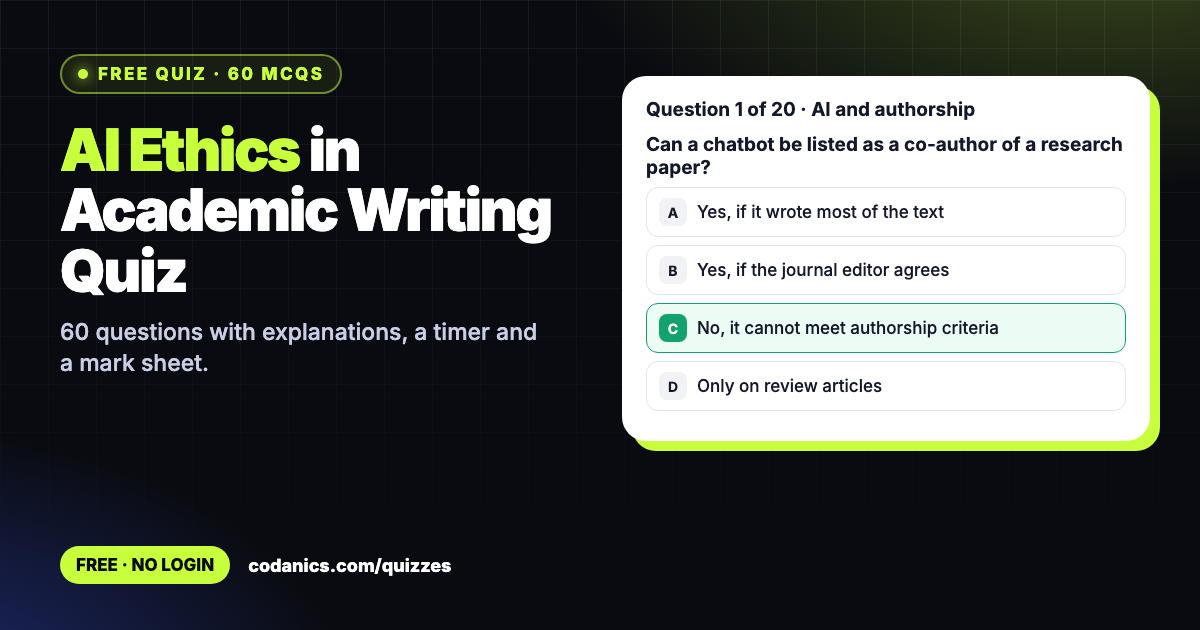
AI Ethics in Academic Writing Quiz
60 questions · 6 topics · timer · instant explanations · printable mark sheet.
- Questions60 in the bank, 10–30 per attempt
- Levels20 easy · 24 medium · 16 hard
- TimeAbout 5–20 minutes
- PriceFree, no login needed
- Made byDr. Aammar Tufail, Codanics
- Updated22 November 2026
In short: the AI Ethics in Academic Writing Quiz is a free online multiple-choice quiz by Codanics with 60 questions on journal AI policies; AI and authorship; disclosing AI use; hallucinated references; confidentiality and peer review; and detectors and safe workflows. You choose the number of questions and the difficulty, answer against a timer, see an explanation after every answer and finish with a printable mark sheet.
What the AI Ethics in Academic Writing Quiz covers
Journals now allow AI for help with language and ideas, but the rules are strict: AI cannot be an author, use must be disclosed, every reference must be real, and you stay responsible for every word. Careless AI use leads to rejection, corrections and even retractions.
This quiz covers the rules from COPE, ICMJE and major publishers and turns them into practical decisions: what to disclose and where, how to verify a reference, what data to keep away from chatbots and how to respond to a detector score. Each explanation teaches the reason behind the rule.
- Journal AI policies 10 questions
- AI and authorship 10 questions
- Disclosing AI use 10 questions
- Hallucinated references 10 questions
- Confidentiality and peer review 10 questions
- Detectors and safe workflows 10 questions
Who it is for: Students, researchers, supervisors and reviewers who use ChatGPT or other AI tools while writing theses, papers, reviews or peer review reports.
How the quiz works
- Type your name if you want it printed on the mark sheet (optional; it never leaves your browser).
- Choose 10, 20 or 30 questions, a difficulty (Easy, Mixed or Hard) and the timer: Standard, Relaxed or none.
- Answer each question before the timer runs out. Press A–D or 1–4 on a keyboard, or tap an option on your phone.
- Read the explanation after every answer, then press Next.
- At the end, get your score, grade, topic-wise breakdown and a full answer review. Print it or save it as a PDF.
- Retake the quiz for a fresh random set, or practise only the topics you found hard.
Free video lessons from Codanics
Score lower than you hoped? These free lessons from the Codanics YouTube channel cover the same topics, explained step by step.
Free on the Codanics YouTube channel, taught in Urdu/Hindi.
Sample questions with answers
Here are 10 questions from the bank, with answers and explanations. The quiz above draws from all 60.
1. Which use of AI do journals usually allow, provided you disclose it where required?
- Improving the grammar and clarity of your own text
- Generating the data reported in the results
- Creating images that show fake experimental results
- Listing the chatbot as a co-author
Answer: A. Improving the grammar and clarity of your own text
Most publishers accept AI help with language, structure and brainstorming, with human checking and disclosure. Fabricated data, fake images and AI authorship are not allowed.
2. Under Elsevier's AI policy, which use typically does NOT need an AI declaration?
- Using a chatbot to draft the discussion section
- Using generative AI to summarise the literature
- Using generative AI to rewrite whole paragraphs
- Basic tools that check grammar, spelling and references
Answer: D. Basic tools that check grammar, spelling and references
Elsevier states that basic grammar, spelling and reference checkers do not need a declaration. Generative AI that drafts or rewrites content does. When in doubt, disclose.
3. Can a chatbot be listed as a co-author of a research paper?
- Yes, if it wrote most of the text
- Yes, if the journal editor agrees
- No, it cannot meet authorship criteria
- Only on review articles
Answer: C. No, it cannot meet authorship criteria
Authors must approve the final version and be accountable for the work. AI tools cannot do either, so COPE, ICMJE and publishers do not accept them as authors.
4. What should a good AI-use disclosure statement name?
- The tool, version, purpose and the authors' responsibility
- The tool's price, the date and the prompt length
- Only the words “We used AI” at the end
- The AI company's address and its logo
Answer: A. The tool, version, purpose and the authors' responsibility
A useful disclosure says which tool and version you used, for what task, and that the authors reviewed the output and take full responsibility.
5. Which AI disclosure is the weakest?
- “We used ChatGPT (OpenAI) to improve readability, then edited the text.”
- “We used AI.”
- “Grammarly was used for language editing; authors checked all changes.”
- “An AI tool helped draft code for Figure 2; all code was verified.”
Answer: B. “We used AI.”
“We used AI” names no tool, no task and no human checking, so readers and editors cannot judge what was done. The other three give specific detail.
6. What is a “hallucinated” reference?
- A real paper that has since been retracted
- A reference with a missing page number
- An AI citation that looks real but does not exist
- A citation to a paper on a preprint server
Answer: C. An AI citation that looks real but does not exist
Chatbots can invent references with real-sounding authors, journals and years. The paper may not exist, or the DOI may point to a different paper.
7. A reference is real, but its abstract does not support the claim you cite it for. What should you do?
- Keep it, since the paper really exists
- Reword the claim slightly so it seems to fit
- Replace it with a source that does support the claim
- Move the citation to the end of the paragraph
Answer: C. Replace it with a source that does support the claim
Misattributed citations are a quieter form of hallucination. A reference must support the exact statement it is attached to, so read the source before citing it.
8. Which of these should you never upload to a public AI chatbot?
- Identifiable patient or participant data
- A published abstract you want summarised
- Your own sentence for a grammar check
- Variable names from a public dataset
Answer: A. Identifiable patient or participant data
Personal data are protected by ethics approval, consent and privacy law. Public tools may store inputs, so identifiable data must never be pasted into them.
9. How reliable are AI-text detectors?
- Fully reliable for all English text
- Reliable once the text exceeds 100 words
- Unreliable: they give false positives and negatives
- Reliable only for scientific papers
Answer: C. Unreliable: they give false positives and negatives
Detectors guess from statistical patterns. They flag human writing as AI and miss edited AI text, so a score is not proof of anything.
10. Iqra's essay is flagged as “80% AI”, but she wrote it herself. What is her best evidence?
- A second detector that gives her a lower score
- Version history, drafts and notes that show her process
- A written promise that she did not use any AI
- Rewriting the essay with deliberate errors
Answer: B. Version history, drafts and notes that show her process
Saved drafts, document version history and notes show how a text developed over time. Another detector score is just another guess.
Free guides and blogs to study
Free tools for your studies and research
Codanics also has 160+ free online tools for students and researchers: statistics calculators, meta-analysis, PDF and writing tools. They run in your browser, with no login.
🖋️ All scientific writing tools and quizzes → Reference checker, APA results sentences, writing checklists and more, all free.
Frequently asked questions
Is the AI Ethics in Academic Writing Quiz free?
Yes. The AI Ethics in Academic Writing Quiz is completely free, with no sign-up, no login and no limit on attempts.
How many questions are in the AI Ethics in Academic Writing Quiz?
The question bank has 60 multiple-choice questions (20 easy, 24 medium and 16 hard) across 6 topics. Each attempt draws 10, 20 or 30 of them at random, so every attempt is different.
How does the timer work?
Each question has its own countdown: about 25 seconds for easy, 40 for medium and 55 for hard questions, plus 15 seconds when there is code to read. Choose Relaxed to double the time or switch the timer off to study at your own pace. Unanswered questions count as skipped.
Can I get a certificate or mark sheet?
Yes. When you finish, you get a mark sheet with your name, score, grade, time, topic-wise performance and every answer explained. Use Print or save as PDF to keep it. It is a self-assessment result, not an official certificate.
Are the answers and explanations correct?
Every question was written and reviewed for one clearly correct answer, and code questions were checked by running the code. If you think an answer is wrong, tell us on the Codanics WhatsApp channel or in the YouTube comments and we will fix it.
Can I use ChatGPT to write my research paper?
You can use it to improve language, brainstorm and get feedback, if your journal allows it and you disclose the use. You cannot list it as an author, use it to create data or images, or cite references it gives without checking them. You stay responsible for everything in the paper.
How do I write an AI disclosure statement?
Name the tool and version, say what you used it for, and state that the authors reviewed and edited the output and take full responsibility. Place it where your target journal asks, often a separate declaration before the references, or in the methods or acknowledgements.
Where can I learn to use AI tools safely in scientific writing?
The Scientific Writing Marathon by Dr. Muhammad Aammar Tufail teaches responsible AI use alongside every stage of writing, from literature search to submission, with live classes and writing tasks on your own manuscript. Recorded lectures stay on the LMS so you can learn at your own pace.
Is my data stored anywhere?
No. The quiz runs entirely in your browser. Your name, answers and score are not uploaded. Your best score and settings are remembered only in this browser so you can track your progress.
More free quizzes


See all Codanics quizzes → · Courses · Free tools · Blog
