Title, Abstract and Keywords Quiz: Write a Paper Editors Want to Read
Check whether your title, abstract and keywords would get your paper read: descriptive, declarative and question titles, hype words to cut, keywords that get indexed, highlights under 85 characters, five-sentence and structured abstracts, desk-rejection traps and graphical abstracts. Built from the Scientific Writing Marathon course.
Title, Abstract & Keywords Quiz
60 questions · 6 topics · timer · instant explanations · printable mark sheet.
- Questions60 in the bank, 10–30 per attempt
- Levels20 easy · 24 medium · 16 hard
- TimeAbout 5–20 minutes
- PriceFree, no login needed
- Made byDr. Aammar Tufail, Codanics
- Updated22 November 2026
In short: the Title, Abstract & Keywords Quiz is a free online multiple-choice quiz by Codanics with 60 questions on title types and rules; keywords and indexing; highlights; abstract structure; desk-rejection traps; and graphical abstracts. You choose the number of questions and the difficulty, answer against a timer, see an explanation after every answer and finish with a printable mark sheet.
What the Title, Abstract & Keywords Quiz covers
Your title decides whether anyone clicks, your keywords decide whether search engines find you, and your abstract decides whether an editor sends the paper for review. These few hundred words are the most-read part of any paper.
This quiz covers the rules that make them work: specific and honest titles, keywords that add new search routes, highlights that state findings, abstracts with a clear gap and real numbers, and the traps that cause desk rejection. Each explanation shows how to fix the weak version.
- Title types and rules 12 questions
- Keywords and indexing 10 questions
- Highlights 7 questions
- Abstract structure 14 questions
- Desk-rejection traps 9 questions
- Graphical abstracts 8 questions
Who it is for: Students, researchers and lecturers preparing a manuscript, conference abstract or thesis summary who want editors and readers to keep reading.
How the quiz works
- Type your name if you want it printed on the mark sheet (optional; it never leaves your browser).
- Choose 10, 20 or 30 questions, a difficulty (Easy, Mixed or Hard) and the timer: Standard, Relaxed or none.
- Answer each question before the timer runs out. Press A–D or 1–4 on a keyboard, or tap an option on your phone.
- Read the explanation after every answer, then press Next.
- At the end, get your score, grade, topic-wise breakdown and a full answer review. Print it or save it as a PDF.
- Retake the quiz for a fresh random set, or practise only the topics you found hard.
Free video lessons from Codanics
Score lower than you hoped? These free lessons from the Codanics YouTube channel cover the same topics, explained step by step.
Free on the Codanics YouTube channel, taught in Urdu/Hindi.
Sample questions with answers
Here are 10 questions from the bank, with answers and explanations. The quiz above draws from all 60.
1. Which of these is a declarative title?
- Zinc priming raises wheat yield under drought
- Effect of zinc priming on wheat yield under drought
- Does zinc priming raise wheat yield under drought?
- A study on wheat under drought conditions
Answer: A. Zinc priming raises wheat yield under drought
A declarative title states the main finding as a sentence. “Effect of…” is descriptive, the one ending in “?” is a question title, and “A study on…” is a vague filler title.
2. Which word in this title is hype: “A breakthrough randomised trial of zinc in drought-stressed wheat”?
- randomised
- drought-stressed
- trial
- breakthrough
Answer: D. breakthrough
“Breakthrough” is a claim about importance that readers and reviewers will judge for themselves. “Randomised” and “trial” describe the design and “drought-stressed” the condition.
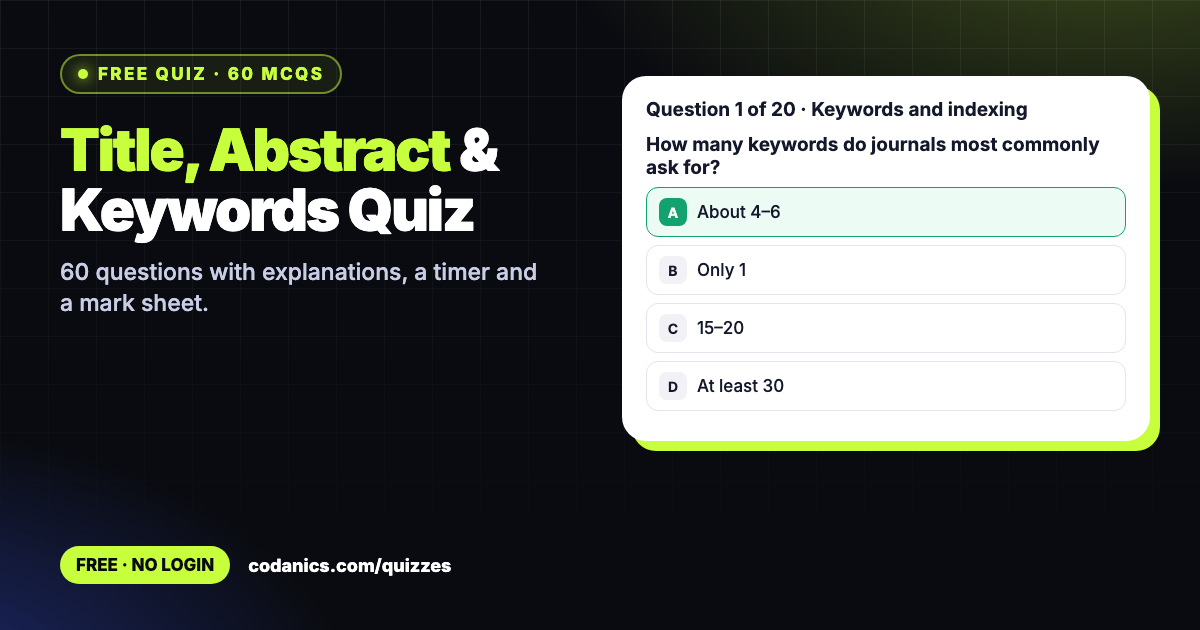
3. How many keywords do journals most commonly ask for?
- About 4–6
- Only 1
- 15–20
- At least 30
Answer: A. About 4–6
Most journals ask for around 4–6 keywords or short phrases. Check your journal's guide for its exact limit.
4. Title: “Biochar raises maize yield in alkaline soils”. Which keyword set is best?
- soil amendment; Zea mays; nutrient uptake; crop productivity
- biochar; maize yield; alkaline soils; maize; yield
- paper; study; results; research; findings
- agriculture; science; Pakistan; farming in general
Answer: A. soil amendment; Zea mays; nutrient uptake; crop productivity
The best set adds new, specific search terms: a broader concept, the scientific name and related outcomes. Repeating the title or using generic words adds nothing.
5. How many highlights do Elsevier journals usually ask for?
- A single sentence
- 10 bullet points
- 3 to 5 bullet points
- A full paragraph
Answer: C. 3 to 5 bullet points
Highlights are 3–5 short bullets giving the key findings, shown with the article so busy readers grasp it in seconds.
6. Which highlight overclaims?
- Zinc priming will end hunger in drought-hit regions
- Zinc priming raised wheat yield by 14% in three trials
- Grain zinc content rose by 22% after priming
- Primed seedlings kept more chlorophyll under drought
Answer: A. Zinc priming will end hunger in drought-hit regions
A field study of one crop cannot show that a treatment will end hunger. The other three report measured results.
7. What is the order of the five-sentence abstract?
- Results, methods, gap, context, references
- Context, gap, aim and method, results, implication
- Title, keywords, aim, methods, references
- Gap, implication, context, methods, results
Answer: B. Context, gap, aim and method, results, implication
The abstract tells the whole story briefly: why the topic matters, what is unknown, what you did, what you found with numbers, and why it matters.
8. In which fields are structured abstracts most common?
- Philosophy and history
- Medicine and health sciences
- Pure mathematics
- Literary studies
Answer: B. Medicine and health sciences
Medical and health journals widely use structured abstracts because they are easy to scan. Basic science journals often prefer one unstructured paragraph.
9. What is desk rejection?
- Rejection after three rounds of review
- Withdrawal of the paper by its authors
- Rejection for late payment of fees
- Rejection by the editor before peer review
Answer: D. Rejection by the editor before peer review
Editors screen every submission and reject many without sending them to reviewers, often because of the title, abstract or scope.
10. What is a graphical abstract?
- One image summarising the main finding
- A table of all the raw data
- A photograph of the author team
- A chart of the paper's citations
Answer: A. One image summarising the main finding
A graphical abstract is one visual summary shown with the article, often in tables of contents, to draw readers in.
Free guides and blogs to study
Free tools for your studies and research
Codanics also has 160+ free online tools for students and researchers: statistics calculators, meta-analysis, PDF and writing tools. They run in your browser, with no login.
🖋️ All scientific writing tools and quizzes → Reference checker, APA results sentences, writing checklists and more, all free.
Frequently asked questions
Is the Title, Abstract & Keywords Quiz free?
Yes. The Title, Abstract & Keywords Quiz is completely free, with no sign-up, no login and no limit on attempts.
How many questions are in the Title, Abstract & Keywords Quiz?
The question bank has 60 multiple-choice questions (20 easy, 24 medium and 16 hard) across 6 topics. Each attempt draws 10, 20 or 30 of them at random, so every attempt is different.
How does the timer work?
Each question has its own countdown: about 25 seconds for easy, 40 for medium and 55 for hard questions, plus 15 seconds when there is code to read. Choose Relaxed to double the time or switch the timer off to study at your own pace. Unanswered questions count as skipped.
Can I get a certificate or mark sheet?
Yes. When you finish, you get a mark sheet with your name, score, grade, time, topic-wise performance and every answer explained. Use Print or save as PDF to keep it. It is a self-assessment result, not an official certificate.
Are the answers and explanations correct?
Every question was written and reviewed for one clearly correct answer, and code questions were checked by running the code. If you think an answer is wrong, tell us on the Codanics WhatsApp channel or in the YouTube comments and we will fix it.
How do I write a good abstract?
Use five parts: the context, the gap, the aim and method, the key results with numbers, and the implication. Keep within the journal’s word limit, usually 150–300 words, avoid references and undefined abbreviations, and make sure every number matches the paper.
How many keywords should a research paper have?
Most journals ask for about 4–6. Choose terms readers would search for, add synonyms and scientific names, use MeSH terms in health fields, and avoid repeating words that are already in your title.
Where can I learn to write titles, abstracts and full papers?
The Scientific Writing Marathon by Dr. Muhammad Aammar Tufail covers titles, keywords, highlights and abstracts as part of writing your own manuscript, review or thesis, with live classes and writing tasks. Recorded lectures stay on the LMS so you can learn at your own pace.
Is my data stored anywhere?
No. The quiz runs entirely in your browser. Your name, answers and score are not uploaded. Your best score and settings are remembered only in this browser so you can track your progress.
More free quizzes



See all Codanics quizzes → · Courses · Free tools · Blog
