# Experimental Design for Viromics {#sec-experimental-design}
A viromics project begins before the first command. In viromics, **experimental design is more important than the pipeline** — a good pipeline cannot rescue a poorly planned virome experiment. The research question controls the sample type, enrichment strategy, sequencing platform, controls, and analysis plan.
::: {.callout-tip}
## Viromics is like fishing in a huge ocean
- Your **sample type** decides *where you fish*.
- Your **enrichment method** decides *which net you use*.
- Your **sequencing platform** decides *how clearly you can see the fish*.
- Your **controls** tell you whether you caught real fish or plastic that fell off your own boat.
Every design choice below is really one of these four decisions.
:::
::: {.chapter-goals}
**Learning objectives** — by the end of this chapter you will be able to:
- turn a vague aim into a strong, testable viromics research question;
- choose a sample type, enrichment strategy, and DNA or RNA workflow for a given goal;
- explain how each enrichment step biases the observed community and how to report it;
- select a sequencing platform and the right set of negative and positive controls;
- plan biological versus technical replication for a defensible study; and
- build and validate a sample metadata sheet and FASTQ manifest on the command line.
:::
## Design workflow
Never start with the software. Start with the biological question and let it drive every downstream choice.
```{mermaid}
flowchart TD
  A[Research question] --> B[Sample type]
  B --> C[Enrichment strategy]
  C --> D[DNA or RNA extraction]
  D --> E[Controls]
  E --> F[Library preparation]
  F --> G[Sequencing platform]
  G --> H[Bioinformatics pipeline]
  H --> I[Biological interpretation]
```
## Start with a strong question
A weak question is too broad to design around:
```text
What viruses are in my sample?
```
A strong question defines the environment, host, comparison, nucleic-acid type, and expected interpretation:
```text
How does nitrogen fertilization change the DNA virome of maize
rhizosphere soil across crop growth stages?
```
The stronger version already tells you the sample type (soil), the host context (maize rhizosphere), the treatment (nitrogen fertilization), the comparison (across growth stages), and the analysis direction (differential DNA virome).
| Field | Good viromics question |
|---|---|
| Human gut | How does antibiotic treatment affect gut bacteriophage diversity? |
| Soil | How do cropping systems change soil viral communities? |
| Plant pathology | Which RNA viruses are associated with symptomatic tomato leaves? |
| Wastewater | Can wastewater viromics detect enteric RNA viruses across seasons? |
| Animal surveillance | Which viruses are present in bat fecal samples from different habitats? |
## Sample types
Different sample types carry different viruses and different problems.
| Sample type | Common viruses detected | Main challenge |
|---|---|---|
| Feces / gut | bacteriophages, enteric viruses | host and bacterial background, inhibitors |
| Soil | phages, plant viruses, fungal viruses | complex matrix, humic acids, low viral recovery |
| Water / wastewater | RNA and DNA viruses, phages | dilution, concentration required |
| Plant leaves | plant RNA viruses, phages, mycoviruses | plant RNA and DNA background |
| Blood / plasma | eukaryotic viruses, phages | very low biomass, contamination sensitive |
| Respiratory swabs | RNA viruses, bacteriophages | host RNA dominance |
| Animal tissues | host-associated viruses | host genome background |
Low-biomass samples such as plasma, respiratory swabs, and some viral-like particle preparations are especially vulnerable to contamination, because even small amounts of reagent or environmental nucleic acid can become a large fraction of the final read set after amplification and sequencing. These samples need strict negative controls.
## Enrichment methods
A virome sample contains far more non-viral than viral material — host cells, bacteria, fungi, archaea, free nucleic acids, and food, soil, or plant particles. Enrichment increases the proportion of viral particles before sequencing.
| Method | Purpose | What it removes or enriches |
|---|---|---|
| Centrifugation | remove large debris and cells | plant tissue, soil particles, host cells |
| Filtration | remove cells larger than viruses | bacteria, eukaryotic cells |
| Nuclease treatment | degrade free DNA/RNA outside capsids | host and bacterial free nucleic acids |
| Viral concentration | increase viral particles | useful for water and wastewater |
| Density gradient | purify viral particles | selective but laborious |
| Random amplification | boost low-input viral nucleic acid | useful but may introduce bias |
### Enrichment is not neutral: what each step loses
Enrichment improves viral signal but changes the original community structure.
A **0.22 µm filter** removes most bacteria, but may also lose:
- giant viruses,
- viruses attached to cells,
- viruses attached to particles, and
- fragile enveloped viruses.
**Nuclease treatment** reduces free host DNA and RNA, but may lose:
- damaged viral particles,
- unprotected viral genomes, and
- fragile RNA viruses.
**Random amplification** raises input from low-biomass samples, but may create:
- uneven genome coverage,
- overrepresentation of short templates,
- chimeric artifacts, and
- artificial abundance bias.
::: {.callout-warning}
Enrichment improves viral signal, but it does not preserve the original community perfectly. Always report the enrichment method clearly so results can be interpreted and compared.
:::
## DNA virome or RNA virome
Choosing DNA or RNA is one of the most important design decisions, because it changes extraction, library preparation, and interpretation.
- A **DNA virome** targets dsDNA and ssDNA phages, archaeal and eukaryotic DNA viruses, and prophage-like sequences when total DNA is used.
- An **RNA virome** targets +ssRNA, -ssRNA, and dsRNA viruses, including most plant, animal, and clinically important viruses.
| Feature | DNA virome | RNA virome |
|---|---|---|
| Starting molecule | DNA | RNA |
| Stability | more stable | less stable |
| Extraction | DNA extraction | RNA extraction |
| Reverse transcription | not required | required |
| Common targets | phages, DNA viruses | plant / animal / human RNA viruses |
| Main risk | host or bacterial DNA background | RNA degradation |
| Library prep | DNA library | cDNA library |
| Bioinformatics | DNA viral contigs | RNA viral contigs / transcripts |
Use **DNA viromics** for phage ecology (soil, gut, marine), DNA viruses, viral dark matter, and prophages from microbial assemblies. Use **RNA viromics** for plant viral disease, respiratory and enteric viruses, zoonotic and wastewater RNA surveillance, and emerging-virus discovery. If you need both, design **separate DNA and RNA workflows** rather than forcing one library to do both jobs.
## Total metagenome versus virus-enriched virome
Total metagenomes keep microbial context and prophages but can have very low viral read fractions, so viral assembly may be poor. Virus-enriched viromes improve viral recovery and low-abundance detection but lose cell-associated viruses, distort abundance, and can amplify contaminants. The right choice follows the question: host–virus association favours total metagenomes; viral community structure favours enrichment.
## Sequencing platform
Illumina gives short, highly accurate reads and is the workhorse for community comparison and abundance. Nanopore gives long reads that can span whole viral genomes and enables rapid field work, at the cost of higher per-read error and less straightforward abundance estimation. Hybrid designs combine both: Nanopore for contiguity, Illumina for accuracy.
| Goal | Recommended platform |
|---|---|
| Many samples, high accuracy | Illumina |
| Complete viral genomes | Nanopore or hybrid |
| RNA virus surveillance | Illumina or Nanopore |
| Low-input clinical virome | Illumina with strong controls |
| Rapid field detection | Nanopore |
| Publication-grade community comparison | Illumina, often with validation |
| Genome closure | Hybrid Illumina plus Nanopore |
## Controls
Controls are not optional; they are part of the bioinformatics interpretation. Clean negative controls should produce very few reads — many reads in a blank signal a major contamination risk.
| Control | Purpose |
|---|---|
| Extraction blank | detect contamination from extraction kit and reagents |
| Library blank | detect contamination from library preparation |
| No-template control | detect PCR and amplification contamination |
| Mock viral community | check pipeline recovery and bias |
| Spike-in control | measure extraction and sequencing performance |
| Positive control | confirm the protocol can detect known viruses |
| Technical replicate | check sequencing and library reproducibility |
| Biological replicate | capture real biological variation |
## Common contamination sources
Viral metagenomics is especially sensitive to contamination, because unknown viral-like sequences may be misread as real biology when controls are missing.
| Source | Example |
|---|---|
| Reagents | extraction kit nucleic acids |
| Lab environment | aerosols, previous PCR products |
| Cross-sample contamination | splashing, pipetting |
| Index hopping | reads assigned to the wrong barcode or index |
| Barcode cross-talk | multiplexing artifact |
| Host DNA / RNA | human, plant, or animal background |
| Bacterial DNA | incomplete filtration or lysis |
| PhiX | Illumina control spike-in |
| Adapter contamination | library-prep artifacts |
## Replication strategy
**Biological replicates** are different biological samples — soil from plot 1, plot 2, plot 3. They answer: *is this pattern real in nature?* **Technical replicates** are repeated processing or sequencing of the same sample — one DNA extract split into two library preps. They answer: *is the method reproducible?*
For small pilot projects:
- **Minimum:** 3 biological replicates per group.
- **Better:** 5 or more biological replicates per group.
- **Always:** include negative controls.
### Minimum design
A defensible small project comparing two soil treatments:
| Component | Count |
|---|---|
| Treatment A biological replicates | 3 |
| Treatment B biological replicates | 3 |
| Extraction blank | 1 |
| Library blank | 1 |
| **Total libraries** | **8** |
That is `3 + 3 + 2 controls = 8 libraries`, sequenced as Illumina paired-end 150 bp, with a mock viral community added if available.
## A decision tree for planning
```{mermaid}
flowchart TD
  A[What is my target?] --> B{DNA or RNA viruses?}
  B -->|DNA viruses| C[DNA extraction] --> D[DNA virome pipeline]
  B -->|RNA viruses| E[RNA extraction] --> F[cDNA synthesis] --> G[RNA virome pipeline]
  B -->|Both| H[Run separate DNA and RNA workflows]
  D --> I{Is viral biomass low?}
  G --> I
  H --> I
  I -->|Yes| J[Add extraction and library blanks, spike-ins, contamination analysis]
  I -->|No| K[Standard controls]
  J --> L{Do I need complete genomes?}
  K --> L
  L -->|Yes| M[Nanopore or hybrid sequencing]
  L -->|No| N{Many samples and abundance comparison?}
  N -->|Yes| O[Illumina is usually practical]
  N -->|No| O
```
## Metadata is part of the design
A viromics project without metadata is weak. Record at least the sample identity, environment, host, treatment, nucleic-acid type, enrichment, control type, platform, read type, and extraction and library batches. First set up the standard project folders you will reuse across the book.
```{=html}
<div class="dl-row">
<a class="dl-btn" href="../scripts/setup_project.sh" download>⬇ setup_project.sh</a>
</div>
```
```bash
# One-time: create the standard project structure used across the book
bash setup_project.sh          # or: bash ~/Downloads/setup_project.sh
```
### Create the Phase 2 workspace
```bash
mkdir -p ~/viromics_course/phase2_experimental_design
cd ~/viromics_course/phase2_experimental_design
mkdir -p raw_reads metadata controls logs reports design_tables
```
### Build the sample metadata sheet
```bash
cat > metadata/sample_metadata.tsv << 'EOF'
sample_id   environment host    treatment   replicate   nucleic_acid    enrichment  control_type    extraction_batch    library_batch   platform    read_type
Soil_A_01   soil    maize   Treatment_A 1   DNA filtration_nuclease biological_sample   batch1  lib1    Illumina    PE150
Soil_A_02   soil    maize   Treatment_A 2   DNA filtration_nuclease biological_sample   batch1  lib1    Illumina    PE150
Soil_A_03   soil    maize   Treatment_A 3   DNA filtration_nuclease biological_sample   batch1  lib1    Illumina    PE150
Soil_B_01   soil    maize   Treatment_B 1   DNA filtration_nuclease biological_sample   batch1  lib1    Illumina    PE150
Soil_B_02   soil    maize   Treatment_B 2   DNA filtration_nuclease biological_sample   batch1  lib1    Illumina    PE150
Soil_B_03   soil    maize   Treatment_B 3   DNA filtration_nuclease biological_sample   batch1  lib1    Illumina    PE150
EXT_BLANK_01    blank   none    none    NA  DNA none    extraction_blank    batch1  lib1    Illumina    PE150
LIB_BLANK_01    blank   none    none    NA  DNA none    library_blank   batch1  lib1    Illumina    PE150
EOF

column -t -s $'\t' metadata/sample_metadata.tsv
```
### Create a FASTQ manifest
A manifest links each sample ID to its read files and prevents sample mix-ups.
```bash
cat > metadata/fastq_manifest.tsv << 'EOF'
sample_id   forward_read    reverse_read
Soil_A_01   raw_reads/Soil_A_01_R1.fastq.gz raw_reads/Soil_A_01_R2.fastq.gz
Soil_A_02   raw_reads/Soil_A_02_R1.fastq.gz raw_reads/Soil_A_02_R2.fastq.gz
Soil_A_03   raw_reads/Soil_A_03_R1.fastq.gz raw_reads/Soil_A_03_R2.fastq.gz
Soil_B_01   raw_reads/Soil_B_01_R1.fastq.gz raw_reads/Soil_B_01_R2.fastq.gz
Soil_B_02   raw_reads/Soil_B_02_R1.fastq.gz raw_reads/Soil_B_02_R2.fastq.gz
Soil_B_03   raw_reads/Soil_B_03_R1.fastq.gz raw_reads/Soil_B_03_R2.fastq.gz
EXT_BLANK_01    raw_reads/EXT_BLANK_01_R1.fastq.gz  raw_reads/EXT_BLANK_01_R2.fastq.gz
LIB_BLANK_01    raw_reads/LIB_BLANK_01_R1.fastq.gz  raw_reads/LIB_BLANK_01_R2.fastq.gz
EOF
```
### Validate that sample IDs match
```bash
cut -f1 metadata/sample_metadata.tsv | tail -n +2 | sort > metadata/ids_metadata.txt
cut -f1 metadata/fastq_manifest.tsv | tail -n +2 | sort > metadata/ids_manifest.txt
comm -3 metadata/ids_metadata.txt metadata/ids_manifest.txt
```
`comm -3` prints lines unique to either file. **No output means the IDs match** — a habit worth keeping before every run.
::: {.time-storage}
**Estimated resources on 12 threads and 32 GB RAM:** metadata validation finishes in seconds and uses under 1 MB of storage. When planning raw-data storage, start at 3x the expected compressed FASTQ size, because SRA download, decompression, and intermediate files can temporarily coexist.
:::
::: {.callout-warning}
## Common mistakes
- **Forgetting negative controls.** In viromics, controls are part of the bioinformatics interpretation, not just wet-lab hygiene. No negative controls means weak contamination interpretation.
- **Mixing DNA and RNA viromes without planning.** They need different extraction, library prep, and interpretation — design them as separate workflows.
- **Treating read abundance as true viral abundance.** Read counts are shaped by genome length, extraction efficiency, amplification bias, library prep, sequencing depth, and enrichment. Use normalized measures such as coverage, RPKM, or TPM, and interpret carefully.
:::
::: {.callout-note collapse="true"}
## Exercise: design a plant RNA virome study
Create a metadata sheet for a wheat leaf RNA virome experiment with 3 healthy leaves, 3 diseased leaves, 1 extraction blank, and 1 positive control, all Illumina PE150 on an RNA workflow. Then count how many biological samples fall in each treatment group.
**One solution:**
```bash
mkdir -p ~/viromics_course/phase2_experimental_design/exercise1
cd ~/viromics_course/phase2_experimental_design/exercise1

cat > plant_rna_virome_metadata.tsv << 'EOF'
sample_id   environment host    treatment   replicate   nucleic_acid    enrichment  control_type    extraction_batch    library_batch   platform    read_type
Leaf_H_01   plant_leaf  wheat   healthy 1   RNA rRNA_depletion  biological_sample   batch1  lib1    Illumina    PE150
Leaf_H_02   plant_leaf  wheat   healthy 2   RNA rRNA_depletion  biological_sample   batch1  lib1    Illumina    PE150
Leaf_H_03   plant_leaf  wheat   healthy 3   RNA rRNA_depletion  biological_sample   batch1  lib1    Illumina    PE150
Leaf_D_01   plant_leaf  wheat   diseased    1   RNA rRNA_depletion  biological_sample   batch1  lib1    Illumina    PE150
Leaf_D_02   plant_leaf  wheat   diseased    2   RNA rRNA_depletion  biological_sample   batch1  lib1    Illumina    PE150
Leaf_D_03   plant_leaf  wheat   diseased    3   RNA rRNA_depletion  biological_sample   batch1  lib1    Illumina    PE150
EXT_BLANK_01    blank   none    none    NA  RNA none    extraction_blank    batch1  lib1    Illumina    PE150
POS_CTRL_01 mock    mock    mock    NA  RNA mock_community  positive_control    batch1  lib1    Illumina    PE150
EOF

# Count biological samples per treatment group
awk -F'\t' 'NR>1 && $8=="biological_sample" {count[$4]++} END {for (t in count) print t, count[t]}' \
  plant_rna_virome_metadata.tsv
```
**Expected:**
```text
healthy 3
diseased 3
```
:::
## Key takeaways
::: {.key-takeaways}
- Experimental design matters more than the pipeline: a sharp, testable question — defining environment, host, comparison, and nucleic-acid type — should drive every downstream choice from sampling to analysis.
- Sample type, enrichment strategy, and the DNA-versus-RNA decision jointly determine which viruses you can detect; design separate DNA and RNA workflows rather than forcing one library to do both jobs.
- Every enrichment step (filtration, nuclease treatment, random amplification) biases the observed community, so the method must be reported clearly to make results interpretable and comparable.
- Negative and positive controls are part of the bioinformatics interpretation, not just wet-lab hygiene — especially for low-biomass samples where reagent contamination can dominate the reads.
- Biological replication (minimum three per group) answers whether a pattern is real, while a validated metadata sheet and FASTQ manifest keep samples traceable and the study reproducible [@minot2011humanvirome].
:::
## Further reading
- @minot2011humanvirome demonstrates how sampling and enrichment choices shape an observed virome, motivating careful experimental design and controls.
- @chen2018fastp documents fastp, a fast all-in-one tool for the read quality control and adapter trimming that follows the sequencing choices planned here.
- The ICTV website provides the standard reference for naming and organizing the viruses your design aims to detect: [https://ictv.global](https://ictv.global).
- The NCBI Sequence Read Archive hosts public raw reads useful for planning storage and benchmarking a design [@ncbi_sra_home]; browse it at [https://www.ncbi.nlm.nih.gov/sra](https://www.ncbi.nlm.nih.gov/sra).
## Chapter figure
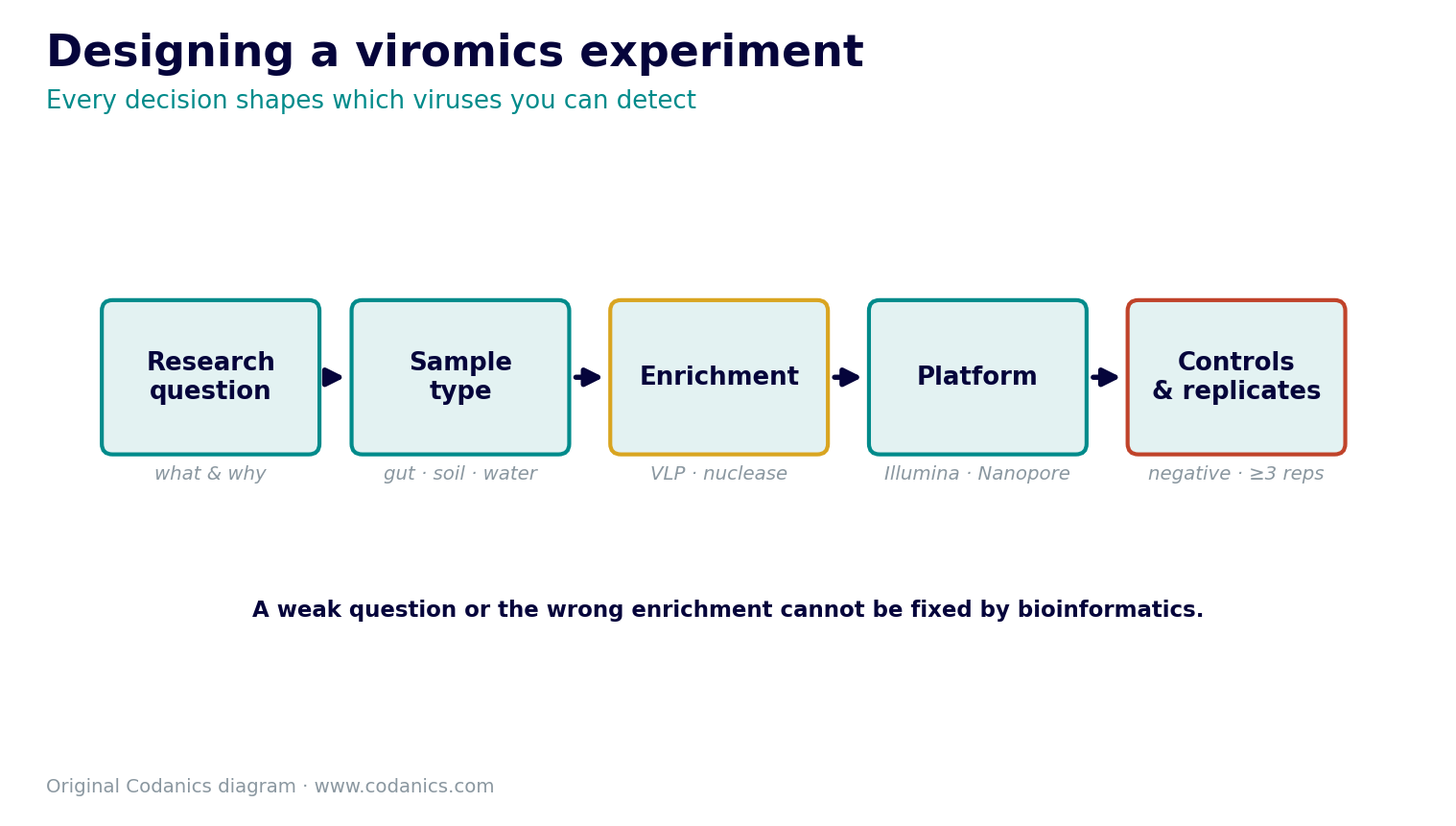{#fig-ch02 fig-alt="Viromics experimental design workflow from question to interpretation"}
::: {.callout-tip collapse="true"}
## 🎨 Generate this figure
**Save as:** `images/ch02-experimental-design.png` · **Aspect ratio:** 16:9 · **Style:** clean flat vector infographic, Codanics palette (teal `#008b8b`, navy `#05043b`, white background), no photorealism.
**Prompt:** Create a clean educational infographic showing the viromics experimental-design workflow as a left-to-right pipeline. Begin on the left with a labelled "Research question" card, then flow through labelled stages: "Sample type" (with small icons for soil, gut, wastewater, plant leaf, and respiratory swab), "Enrichment" (filter and nuclease icons), "DNA or RNA extraction" (two branching arrows, one DNA double helix, one RNA single strand), "Controls" (icons for extraction blank, library blank, and mock community), "Sequencing platform" (Illumina short-read and Nanopore long-read icons), and finally "Bioinformatics pipeline" shown as a Linux terminal leading to "Biological interpretation". Add a subtle recurring fishing motif — a small net over the enrichment stage — to echo the fishing-in-the-ocean analogy. Use teal and navy Codanics branding, clear sans-serif labels, and connecting arrows between every stage.
:::
## Quiz: Experimental Design
**Q1. Why are negative controls important in low-biomass viromics?**
A. they remove the need for sequencing
B. contamination can dominate low-biomass data
C. they increase viral genome length
D. they replace biological replicates
::: {.callout-note collapse='true'}
**Answer:** B. Small contaminant signals can become a large fraction of the data when true biomass is low.
:::
**Q2. Which workflow requires reverse transcription?**
A. DNA virome
B. RNA virome
C. protein annotation only
D. Bowtie2 mapping
::: {.callout-note collapse='true'}
**Answer:** B. RNA viromes are usually converted to cDNA before sequencing.
:::
**Q3. What is a disadvantage of viral enrichment?**
A. it can introduce bias
B. it prevents assembly
C. it removes all viral reads
D. it disables sequencing
::: {.callout-note collapse='true'}
**Answer:** A. Filtration, nuclease treatment, and random amplification can change the observed community structure.
:::
**Q4. Which platform is usually practical for many high-accuracy paired-end samples?**
A. Illumina
B. Sanger only
C. Western blot
D. flow cytometry
::: {.callout-note collapse='true'}
**Answer:** A. Illumina short reads are common for high-throughput community comparison.
:::
**Q5. What is the purpose of a FASTQ manifest?**
A. link sample IDs to read files
B. replace the reference database
C. calculate Shannon diversity
D. infer viral taxonomy
::: {.callout-note collapse='true'}
**Answer:** A. A manifest prevents sample mix-ups and documents input files.
:::
## Interactive quiz: Experimental design
```{=html}
<div class="interactive-quiz-note"><strong>How to use this quiz:</strong> Select one option, click <em>Check answer</em>, and read the explanation. Use the reset button if you want to try again.</div>
<div class="quiz-set">
<div class="quiz-question" data-answer="B">
<p class="quiz-prompt">1. Which comparison is usually most fair when studying treatment effects in viromics?</p>
<label class="quiz-option"><input type="radio" name="02-experimental-design-q1" value="A"> <strong>A.</strong> One treated sample versus one control</label>
<label class="quiz-option"><input type="radio" name="02-experimental-design-q1" value="B"> <strong>B.</strong> Biological replicates with consistent metadata and controls</label>
<label class="quiz-option"><input type="radio" name="02-experimental-design-q1" value="C"> <strong>C.</strong> Only technical replicates</label>
<label class="quiz-option"><input type="radio" name="02-experimental-design-q1" value="D"> <strong>D.</strong> No controls if sequencing depth is high</label>
<div class="quiz-controls"><button type="button" class="quiz-check">Check answer</button><button type="button" class="quiz-reset">Reset</button></div>
<div class="quiz-explanation">Biological replicates and good metadata are central to a defensible study design. Controls are also important for contamination tracking.</div>
<div class="quiz-feedback"></div>
</div>
<div class="quiz-question" data-answer="A">
<p class="quiz-prompt">2. When is virus enrichment most useful?</p>
<label class="quiz-option"><input type="radio" name="02-experimental-design-q2" value="A"> <strong>A.</strong> When you want to increase the viral signal relative to host and microbial background</label>
<label class="quiz-option"><input type="radio" name="02-experimental-design-q2" value="B"> <strong>B.</strong> When you want more ribosomal RNA</label>
<label class="quiz-option"><input type="radio" name="02-experimental-design-q2" value="C"> <strong>C.</strong> When you want to avoid filtration</label>
<label class="quiz-option"><input type="radio" name="02-experimental-design-q2" value="D"> <strong>D.</strong> When you only study proteins</label>
<div class="quiz-controls"><button type="button" class="quiz-check">Check answer</button><button type="button" class="quiz-reset">Reset</button></div>
<div class="quiz-explanation">Enrichment can improve viral signal by reducing non-viral background, though it may also introduce bias.</div>
<div class="quiz-feedback"></div>
</div>
<div class="quiz-question" data-answer="C">
<p class="quiz-prompt">3. Why should extraction blanks be included?</p>
<label class="quiz-option"><input type="radio" name="02-experimental-design-q3" value="A"> <strong>A.</strong> To increase viral diversity</label>
<label class="quiz-option"><input type="radio" name="02-experimental-design-q3" value="B"> <strong>B.</strong> To estimate genome size</label>
<label class="quiz-option"><input type="radio" name="02-experimental-design-q3" value="C"> <strong>C.</strong> To detect contamination introduced during processing</label>
<label class="quiz-option"><input type="radio" name="02-experimental-design-q3" value="D"> <strong>D.</strong> To replace biological replicates</label>
<div class="quiz-controls"><button type="button" class="quiz-check">Check answer</button><button type="button" class="quiz-reset">Reset</button></div>
<div class="quiz-explanation">Extraction blanks and negative controls help detect reagent and workflow contamination, which can be a major issue in low-biomass viromics.</div>
<div class="quiz-feedback"></div>
</div>
<div class="quiz-question" data-answer="A">
<p class="quiz-prompt">4. What is a key difference between DNA and RNA virome workflows?</p>
<label class="quiz-option"><input type="radio" name="02-experimental-design-q4" value="A"> <strong>A.</strong> RNA viromes require reverse transcription before sequencing library preparation</label>
<label class="quiz-option"><input type="radio" name="02-experimental-design-q4" value="B"> <strong>B.</strong> DNA viromes never need QC</label>
<label class="quiz-option"><input type="radio" name="02-experimental-design-q4" value="C"> <strong>C.</strong> RNA viromes cannot be assembled</label>
<label class="quiz-option"><input type="radio" name="02-experimental-design-q4" value="D"> <strong>D.</strong> DNA viromes do not need controls</label>
<div class="quiz-controls"><button type="button" class="quiz-check">Check answer</button><button type="button" class="quiz-reset">Reset</button></div>
<div class="quiz-explanation">RNA genomes need conversion to cDNA before sequencing in most common workflows.</div>
<div class="quiz-feedback"></div>
</div>
<div class="quiz-question" data-answer="B">
<p class="quiz-prompt">5. Why is metadata design important?</p>
<label class="quiz-option"><input type="radio" name="02-experimental-design-q5" value="A"> <strong>A.</strong> It makes FASTQ files smaller</label>
<label class="quiz-option"><input type="radio" name="02-experimental-design-q5" value="B"> <strong>B.</strong> It supports reproducibility and downstream analysis</label>
<label class="quiz-option"><input type="radio" name="02-experimental-design-q5" value="C"> <strong>C.</strong> It replaces all statistics</label>
<label class="quiz-option"><input type="radio" name="02-experimental-design-q5" value="D"> <strong>D.</strong> It avoids all contamination</label>
<div class="quiz-controls"><button type="button" class="quiz-check">Check answer</button><button type="button" class="quiz-reset">Reset</button></div>
<div class="quiz-explanation">Good metadata make samples interpretable and reusable. They also support reproducible analysis and clear reporting.</div>
<div class="quiz-feedback"></div>
</div>
</div>
```
