10 Project Ideas in Viromics
This chapter turns the skills from the book into concrete research directions. Each idea can grow into a short paper, an MSc project, a PhD chapter, or a postdoctoral pilot study. Every project names specific tools introduced earlier, so you can move from question to workflow without guessing which software to run.
Learning objectives — by the end of this chapter you will be able to:
- frame a focused, testable viromics research question tied to a sampling design;
- map a question onto a concrete tool chain from QC through host prediction;
- anticipate the compute and storage a project will need before you start; and
- outline a manuscript that reports viral recovery, quality, taxonomy, function, and abundance honestly.
10.1 Project 1: Soil fertilization and DNA virome shifts
Research question: How does nitrogen fertilization change soil phage diversity and vOTU abundance?
Design: soil DNA virome or total metagenome, treated versus control plots, 3 to 5 biological replicates per treatment.
Core workflow: fastp for QC and trimming, MEGAHIT for assembly, VirSorter2 and geNomad for viral identification, CheckV for quality, CD-HIT or vClust for vOTU clustering, CoverM for coverage, and diversity analysis in R.
Main outputs: a vOTU abundance matrix, CheckV quality tiers, viral taxonomy, and host prediction against soil MAGs or isolate genomes.
Estimated resources: 12 threads, 32 GB RAM, and 500 GB to 1 TB storage for 20 to 40 samples.
10.2 Project 2: Plant RNA virome in symptomatic and healthy leaves
Research question: Which RNA viruses are associated with disease symptoms in crop leaves?
Design: RNA extraction with rRNA depletion, cDNA sequencing, symptomatic versus healthy leaf pairs.
Core workflow: FastQC and fastp for quality control, an RNA-aware assembly, an RdRp marker search, viral classification with geNomad, and phylogenetics with IQ-TREE.
Main outputs: candidate plant RNA viruses, RdRp phylogenetic trees, and symptom-associated abundance.
Estimated resources: 12 threads, 32 GB RAM, and 300 to 800 GB storage depending on sample count.
10.4 Project 4: Host prediction benchmarking
Research question: How consistent are iPHoP, WIsH, CRISPR spacer matching, and taxonomy-based host predictions?
Design: public phage genomes with known hosts plus environmental viral contigs as a novel test set.
Core workflow: run iPHoP, WIsH, and CRISPR spacer matching, then build an agreement matrix and measure precision where the true host is known.
Main outputs: a method comparison table, confidence classes, and a practical host prediction decision framework.
Estimated resources: 12 threads, 32 GB RAM, and 200 to 600 GB, driven mostly by host databases.
10.5 Project 5: Auxiliary metabolic genes in soil or marine viromes
Research question: Which viral auxiliary metabolic genes are linked to nutrient cycling?
Design: soil or marine virome assemblies from an ecosystem of interest.
Core workflow: viral prediction with VirSorter2 and geNomad, CheckV quality control, functional annotation with DRAM-v and VIBRANT, orthology with eggNOG-mapper, and careful AMG filtering.
Main outputs: AMG functional categories, viral contig quality, and an ecosystem-function interpretation.
Estimated resources: 12 threads, 32 GB RAM, and 500 GB to 1 TB with full functional databases.
10.7 Suggested paper outline
Title
Abstract
Introduction
Materials and Methods
Results
  Read quality and assembly
  Viral contig recovery
  CheckV quality
  vOTU clustering
  Taxonomic classification
  Functional annotation
  Abundance and diversity
  Host prediction
Discussion
Limitations
Conclusion
Data and code availability
References
10.8 Key takeaways
- Start every project from a focused, testable question tied to a concrete sampling design and a matching tool chain.
- Scope the study to your compute and storage budget before you commit — replicates, controls, and read depth all drive feasibility.
- Reuse standard building blocks (QC, assembly, viral identification, CheckV quality, clustering, abundance, host prediction) rather than reinventing each pipeline.
- Report viral recovery, quality tiers, taxonomy, function, and abundance honestly, and always include a limitations section.
- Public data lowers the barrier to entry: an SRA-based reanalysis can become a solid first paper without new sequencing.
10.9 Further reading
- Camargo et al. (2024) and Nayfach et al. (2021) — the identification-plus-quality core that anchors most project workflows.
- Roux et al. (2023) — for scoping any project with a host prediction component.
- International Committee on Taxonomy of Viruses (2026) — the reference framework for reporting and interpreting viral taxonomy in a manuscript.
- NCBI SRA for finding public datasets and depositing your own reads: https://www.ncbi.nlm.nih.gov/sra.
10.10 Chapter figure
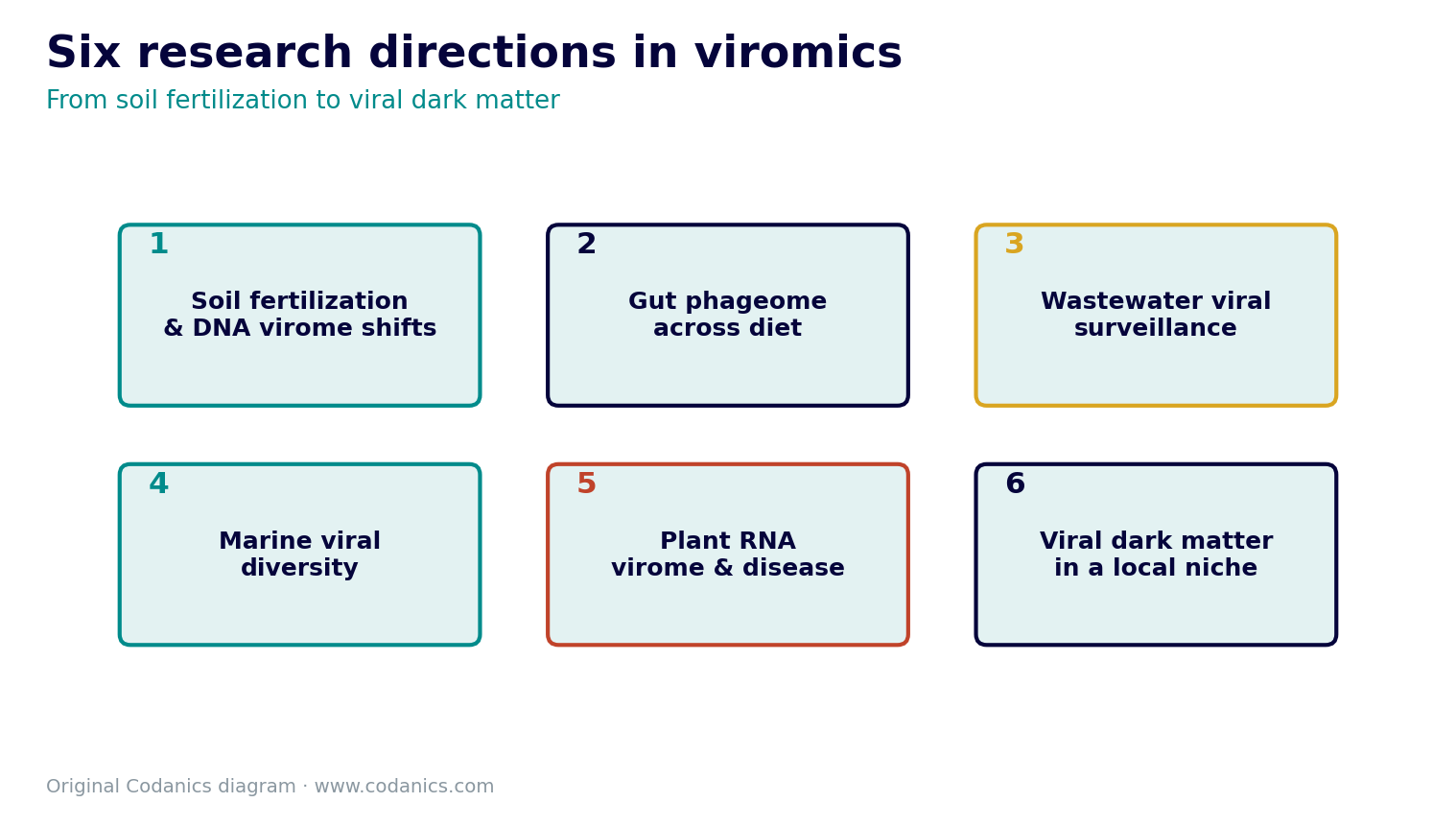
Save as: images/ch08-project-ideas.png · Aspect ratio: 16:9 · Style: clean flat vector infographic, Codanics palette (teal #008b8b, navy #05043b, white background), no photorealism.
Prompt: Create a clean educational infographic laid out as a two-by-three grid of six project cards, each with a simple icon and short label: (1) Soil fertilization DNA virome — soil layers with a fertilizer bag and phage icons; (2) Plant RNA virome — a crop leaf split into healthy and symptomatic halves with virus particles; (3) Wastewater surveillance — a water treatment pipe with a calendar timeline; (4) Host prediction benchmarking — phage particles connecting to bacterial cells with a comparison grid; (5) Auxiliary metabolic genes — a viral contig with highlighted metabolic gene boxes; (6) Viral dark matter — a cluster of unknown contigs with question marks. Give each card a small strip of tool names underneath (for example “VirSorter2 · CheckV · CoverM”). Use teal and navy Codanics branding, clear sans-serif labels, and a white background.
10.11 Quiz: Project Ideas
Q1. Which project is best for crop disease discovery?
A. plant RNA virome B. Bowtie2 benchmarking only C. PDF formatting D. SRA download testing only
Answer: A. Plant RNA viromes are well suited for viral disease discovery.
Q2. Which project focuses on AMGs?
A. auxiliary metabolic genes in viromes B. metadata formatting only C. FastQC comparison only D. PDF rendering
Answer: A. DRAM-v and VIBRANT can help interpret viral functional genes.
Q3. Which project needs host genomes or MAGs most strongly?
A. host prediction benchmarking B. dark mode design C. read compression only D. chapter writing
Answer: A. Host prediction depends on relevant host reference data.
Q4. Which design is best for surveillance?
A. longitudinal wastewater sampling B. one blank only C. one unknown file D. no metadata
Answer: A. Surveillance benefits from repeated sampling over time.
Q5. What section should mention limitations?
A. Discussion B. FASTQ filename only C. title D. logo
Answer: A. Viromics studies need transparent discussion of database and prediction limits.
10.12 Interactive quiz: Project ideas
1. What makes a good viromics project question?
2. Which project is especially suitable for a first research paper?
3. Why are runtime and storage estimates useful in project planning?
4. What is one advantage of proposing a host prediction component in a PhD topic?
5. What should be included in a project outline?