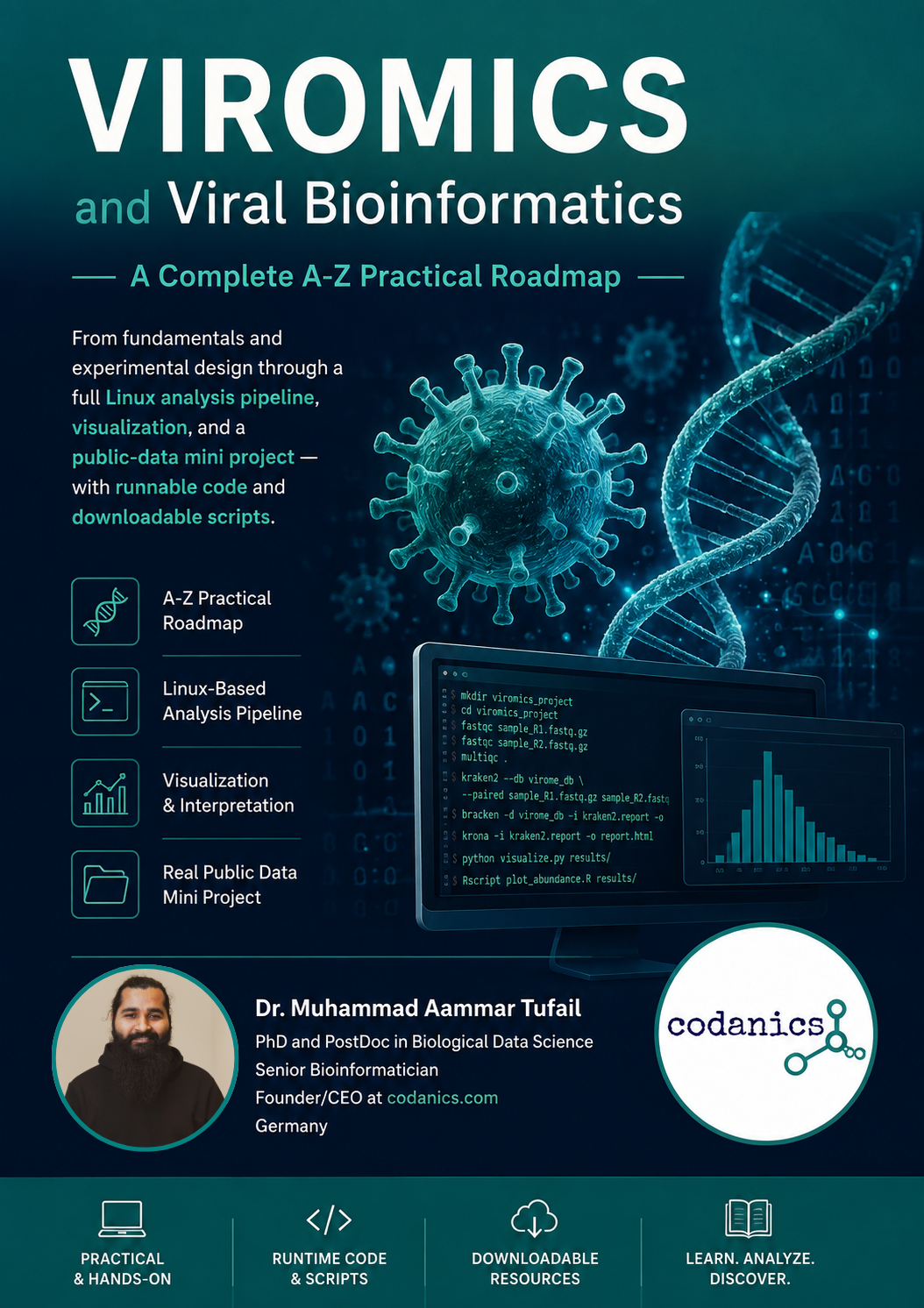
A practical A–Z roadmap to viromics and viral bioinformatics: from fundamentals and experimental design through a full Linux analysis pipeline, visualization, and a public-data mini project — with runnable code and downloadable scripts.
Author
Affiliation
Dr. Muhammad Aammar Tufail
Codanics
Published
August 18, 2026
Viromics and Viral Bioinformatics
A Complete A-Z Practical Roadmap
This book is developed for bioinformaticians who want to move from basic NGS skills to a complete Linux-based viromics workflow.
Dr. Muhammad Aammar Tufail
PhD and PostDoc in Biological Data Science
Senior Bioinformatician
Founder/CEO at codanics.com
Germany
Download option: After rendering the book, use the PDF button in the sidebar or open Viromics-and-Viral-Bioinformatics.pdf.
quarto render
0.1 Dedication 🙏🏻
I dedicate this book to my late father, Ghulam Mustafa(late) — whose dream it was that his son would help change the way education reaches those who cannot afford it.
When I was in ninth grade, there were days we could not arrange the school fee, and I almost left my studies to support the family. My father would not allow it. “Beta, never stop learning — I will find a way,” he said, and through hard labour he kept me in school. That day I promised myself that one day I would build a platform where anyone could learn for free, and only those who could afford it would pay. By the grace of Allah, that platform — Codanics — now teaches hundreds of thousands of learners at no cost. This book is part of that promise, and of his dream.
NotePlease remember my father in your prayers. Allah un ki maghfirat farmaye! Ameen. 🤲🏻
0.2 Who this book is for
This book is for bioinformaticians who already have the basics and want to specialize in viruses. You will get the most from it if you are comfortable with the Linux terminal, FASTQ and FASTA files, paired-end sequencing, conda or mamba environments, and simple plotting in R or Python. General metagenomics experience helps but is not required.
It suits several readers:
bioinformaticians new to viromics building a portfolio-ready workflow from scratch;
wet-lab microbiologists and virologists who want to analyze their own sequencing data;
metagenomics analysts adding virus-aware steps — viral prediction, CheckV quality, vOTUs, host prediction — to an existing pipeline;
instructors who need a tested, reproducible course with quizzes and downloadable scripts.
If you have never opened a terminal, work through a short Linux primer first, then return here.
0.3 Learning path
The book follows one complete workflow, from first principles to a public-data mini project and research ideas. Read it in order the first time; afterwards, treat each chapter as a standalone reference.
flowchart LR
  A[Viromics fundamentals] --> B[Experimental design]
  B --> C[Linux setup]
  C --> V[ViroProfiler: automated pipeline]
  V --> D[Complete manual pipeline]
  D --> E[Visualization and reporting]
  E --> F[Public SRA mini project]
  F --> G[Research project ideas]
flowchart LR
  A[Viromics fundamentals] --> B[Experimental design]
  B --> C[Linux setup]
  C --> V[ViroProfiler: automated pipeline]
  V --> D[Complete manual pipeline]
  D --> E[Visualization and reporting]
  E --> F[Public SRA mini project]
  F --> G[Research project ideas]
0.4 What’s inside
Nine chapters carry the workflow end to end:
Fundamentals of Viromics — what a virome is, viral genome types, Baltimore groups, lytic vs. lysogenic lifestyles, and viral dark matter.
Experimental Design — sampling, VLP enrichment, DNA vs. RNA choices, controls, and how design shapes what you can conclude.
Linux Setup — building reproducible conda environments and the standard project structure used everywhere in the book.
ViroProfiler: an automated A–Z pipeline — install, verify databases, and run a complete containerized pipeline on test and real virome data with one command, then interpret every output.
Complete Analysis Pipeline — the same workflow rebuilt by hand: QC, assembly, viral prediction, CheckV, vOTUs, taxonomy, functional annotation, host prediction, and abundance.
Visualization and Reporting — turning result tables into figures and an honest, reproducible report.
Public SRA Mini Project — a full run on real public data, from accession to results.
Practice Quizzes — self-check questions across the whole workflow.
Project Ideas — research directions to take the skills further.
Five appendices act as quick references:
Appendix A — Linux cheatsheet for the commands used most often.
Appendix B — Tool summary table with purposes, inputs, outputs, and install commands.
Appendix C — Troubleshooting guide in Problem → Fix format.
Appendix D — Glossary of key terms.
Appendix E — Figure generation guide for the book’s illustrations.
0.5 How to use this book
Run the commands in order, and change one thing at a time when something breaks — Appendix C lists the fixes for the most common failures.
You do not have to type everything by hand. Ready-made, reusable scripts live in the scripts/ folder and can be downloaded from the download buttons inside each chapter — for example setup_project.sh to create the standard folders, check_viromics_installation.sh to verify your environments, run_phase4_main_pipeline.sh for the full pipeline, and make_figures.R / make_figures.py for the plots. One-command conda environment files are in envs/, and a tiny synthetic dataset for practicing the commands is in data/toy/.
Small example result tables live in data/example/ (for instance checkv_quality_summary.tsv, votu_abundance.tsv, taxonomy.tsv, and host_prediction.tsv). Use them to test the visualization and reporting steps before you commit hours to downloading databases or assembling your own data.
Read the warnings before downloading large databases — some are hundreds of GB.
The runtime and storage estimates in this book assume a workstation with 12 CPU threads, 32 GB RAM, Ubuntu Linux, and SSD storage. Real runtimes vary with read depth, internet speed, disk speed, and database size.
Source Code
---title: "Viromics and Viral Bioinformatics"subtitle: "A Complete A-Z Practical Roadmap"---::: {.content-visible when-format="html"}```{=html}<p style="text-align:center; margin:0.5rem 0 2rem 0;"> <img src="images/cover.png" alt="Viromics and Viral Bioinformatics — book cover" style="max-width:360px; width:100%; height:auto; border-radius:16px; box-shadow:0 12px 34px rgba(5,4,59,0.22);"></p>```:::```{=html}<div class="hero"> <img src="images/codanics-logo.png" alt="Codanics logo"> <div> <h1>Viromics and Viral Bioinformatics</h1> <p><strong>A Complete A-Z Practical Roadmap</strong></p> <p>This book is developed for bioinformaticians who want to move from basic NGS skills to a complete Linux-based viromics workflow.</p> <p><a href="https://www.codanics.com">www.codanics.com</a> | <a href="https://www.youtube.com/%40codanics">YouTube: Codanics</a></p> </div></div>``````{=html}<div class="author-card"> <img src="images/author.png" alt="Dr. Muhammad Aammar Tufail"> <div> <h3>Author</h3> <p><strong>Dr. Muhammad Aammar Tufail</strong><br> PhD and PostDoc in Biological Data Science<br> Senior Bioinformatician<br> Founder/CEO at <a href="https://www.codanics.com">codanics.com</a><br> Germany</p> </div></div>```::: {.content-visible when-format="pdf"}**Author — Dr. Muhammad Aammar Tufail.** PhD and PostDoc in Biological Data Science · Senior Bioinformatician · Founder/CEO at codanics.com · Germany. Website: [codanics.com](https://www.codanics.com) · YouTube: [Codanics](https://www.youtube.com/%40codanics).:::::: {.download-box}**Download option:** After rendering the book, use the PDF button in the sidebar or open `Viromics-and-Viral-Bioinformatics.pdf`.```bashquarto render```:::## Dedication 🙏🏻I dedicate this book to my late father, **Ghulam Mustafa** *(late)* — whose dream it was that his son would help change the way education reaches those who cannot afford it.When I was in ninth grade, there were days we could not arrange the school fee, and I almost left my studies to support the family. My father would not allow it. *"Beta, never stop learning — I will find a way,"* he said, and through hard labour he kept me in school. That day I promised myself that one day I would build a platform where anyone could learn for free, and only those who could afford it would pay. By the grace of Allah, that platform — Codanics — now teaches hundreds of thousands of learners at no cost. This book is part of that promise, and of his dream.{fig-align="center" width="70%" fig-alt="The author's late father, Ghulam Mustafa"}::: {.callout-note appearance="simple"}### *Please remember my father in your prayers. **Allah un ki maghfirat farmaye!** Ameen.* 🤲🏻:::## Who this book is forThis book is for bioinformaticians who already have the basics and want to specialize in viruses. You will get the most from it if you are comfortable with the Linux terminal, FASTQ and FASTA files, paired-end sequencing, conda or mamba environments, and simple plotting in R or Python. General metagenomics experience helps but is not required.It suits several readers:- **bioinformaticians new to viromics** building a portfolio-ready workflow from scratch;- **wet-lab microbiologists and virologists** who want to analyze their own sequencing data;- **metagenomics analysts** adding virus-aware steps — viral prediction, CheckV quality, vOTUs, host prediction — to an existing pipeline;- **instructors** who need a tested, reproducible course with quizzes and downloadable scripts.If you have never opened a terminal, work through a short Linux primer first, then return here.## Learning pathThe book follows one complete workflow, from first principles to a public-data mini project and research ideas. Read it in order the first time; afterwards, treat each chapter as a standalone reference.```{mermaid}flowchart LR A[Viromics fundamentals] --> B[Experimental design] B --> C[Linux setup] C --> V[ViroProfiler: automated pipeline] V --> D[Complete manual pipeline] D --> E[Visualization and reporting] E --> F[Public SRA mini project] F --> G[Research project ideas]```## What's insideNine chapters carry the workflow end to end:1. **Fundamentals of Viromics** — what a virome is, viral genome types, Baltimore groups, lytic vs. lysogenic lifestyles, and viral dark matter.2. **Experimental Design** — sampling, VLP enrichment, DNA vs. RNA choices, controls, and how design shapes what you can conclude.3. **Linux Setup** — building reproducible conda environments and the standard project structure used everywhere in the book.4. **ViroProfiler: an automated A–Z pipeline** — install, verify databases, and run a complete containerized pipeline on test and real virome data with one command, then interpret every output.5. **Complete Analysis Pipeline** — the same workflow rebuilt by hand: QC, assembly, viral prediction, CheckV, vOTUs, taxonomy, functional annotation, host prediction, and abundance.6. **Visualization and Reporting** — turning result tables into figures and an honest, reproducible report.7. **Public SRA Mini Project** — a full run on real public data, from accession to results.8. **Practice Quizzes** — self-check questions across the whole workflow.9. **Project Ideas** — research directions to take the skills further.Five appendices act as quick references:- **Appendix A — Linux cheatsheet** for the commands used most often.- **Appendix B — Tool summary** table with purposes, inputs, outputs, and install commands.- **Appendix C — Troubleshooting** guide in Problem → Fix format.- **Appendix D — Glossary** of key terms.- **Appendix E — Figure generation guide** for the book's illustrations.## How to use this bookRun the commands in order, and change one thing at a time when something breaks — Appendix C lists the fixes for the most common failures.You do not have to type everything by hand. Ready-made, reusable scripts live in the `scripts/` folder and can be downloaded from the download buttons inside each chapter — for example `setup_project.sh` to create the standard folders, `check_viromics_installation.sh` to verify your environments, `run_phase4_main_pipeline.sh` for the full pipeline, and `make_figures.R` / `make_figures.py` for the plots. One-command conda environment files are in `envs/`, and a tiny synthetic dataset for practicing the commands is in `data/toy/`.::: {.content-visible when-format="pdf"}**Getting the files in the PDF edition.** The clickable download buttons appear in the HTML edition. In this PDF, every script is in the book's `scripts/` folder, every conda environment file in `envs/`, the toy dataset in `data/toy/`, and example result tables in `data/example/` — download them from the source repository at <https://github.com/codanics/viromics-book>.:::Small example result tables live in `data/example/` (for instance `checkv_quality_summary.tsv`, `votu_abundance.tsv`, `taxonomy.tsv`, and `host_prediction.tsv`). Use them to test the visualization and reporting steps before you commit hours to downloading databases or assembling your own data.Read the warnings before downloading large databases — some are hundreds of GB.## Codanics links- Website: <https://www.codanics.com>- Bioinformatics course: <https://codanics.com/courses/bioinformatics-ka-chilla/>- YouTube: <https://www.youtube.com/%40codanics>- Facebook: <https://www.facebook.com/aammar.tufail>- Instagram: <https://www.instagram.com/aammartufail/>- TikTok: <https://www.tiktok.com/%40draammar>::: {.callout-note}## Hardware assumptionsThe runtime and storage estimates in this book assume a workstation with **12 CPU threads, 32 GB RAM, Ubuntu Linux, and SSD storage**. Real runtimes vary with read depth, internet speed, disk speed, and database size.:::