Discussion Section Quiz: Interpret Results, Hedge Claims and Avoid Overclaiming
Test how well you can write the discussion of a research paper: opening with the main finding, comparing with the literature, explaining mechanisms, writing honest limitations, hedging claims, avoiding overclaiming and causal language, writing a conclusion and using AI to critique your draft. Built from the Scientific Writing Marathon course.
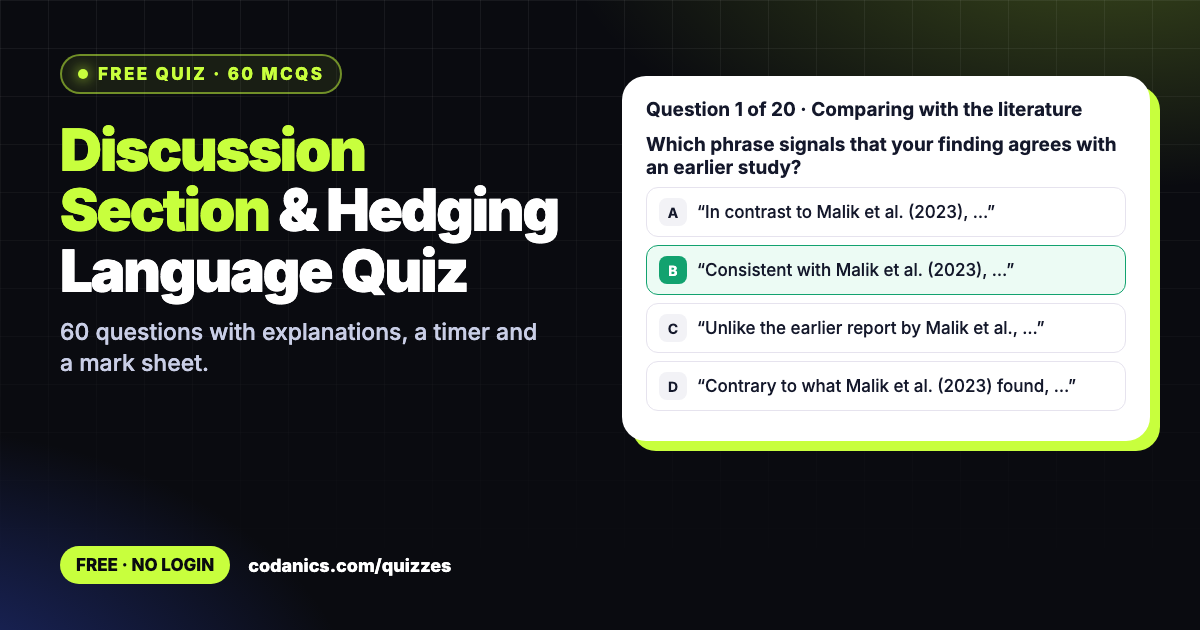
Discussion Section & Hedging Language Quiz
60 questions · 7 topics · timer · instant explanations · printable mark sheet.
- Questions60 in the bank, 10–30 per attempt
- Levels20 easy · 24 medium · 16 hard
- TimeAbout 5–20 minutes
- PriceFree, no login needed
- Made byDr. Aammar Tufail, Codanics
- Updated22 November 2026
In short: the Discussion Section & Hedging Language Quiz is a free online multiple-choice quiz by Codanics with 60 questions on discussion structure and opening; comparing with the literature; mechanisms and implications; writing limitations; hedging language; overclaiming and causation; and conclusions and AI critique. You choose the number of questions and the difficulty, answer against a timer, see an explanation after every answer and finish with a printable mark sheet.
What the Discussion Section & Hedging Language Quiz covers
The discussion is where reviewers judge your thinking. It must say what the results mean, how they fit with other studies, why they might have happened, what limits them and what they change, all in language that matches the strength of the evidence.
This quiz covers each part of a strong discussion, from the first sentence to the conclusion, with special focus on hedging and on the difference between association and causation. Every explanation teaches the rule behind the answer, and weak topics in your mark sheet link to the free scientific writing guide.
- Discussion structure and opening 9 questions
- Comparing with the literature 8 questions
- Mechanisms and implications 7 questions
- Writing limitations 9 questions
- Hedging language 9 questions
- Overclaiming and causation 9 questions
- Conclusions and AI critique 9 questions
Who it is for: BS, MS, MPhil and PhD students, early-career researchers and lecturers writing the discussion and conclusion of a paper or thesis chapter.
How the quiz works
- Type your name if you want it printed on the mark sheet (optional; it never leaves your browser).
- Choose 10, 20 or 30 questions, a difficulty (Easy, Mixed or Hard) and the timer: Standard, Relaxed or none.
- Answer each question before the timer runs out. Press A–D or 1–4 on a keyboard, or tap an option on your phone.
- Read the explanation after every answer, then press Next.
- At the end, get your score, grade, topic-wise breakdown and a full answer review. Print it or save it as a PDF.
- Retake the quiz for a fresh random set, or practise only the topics you found hard.
Free video lessons from Codanics
Score lower than you hoped? These free lessons from the Codanics YouTube channel cover the same topics, explained step by step.
Free on the Codanics YouTube channel, taught in Urdu/Hindi.
Sample questions with answers
Here are 9 questions from the bank, with answers and explanations. The quiz above draws from all 60.
1. What is the main job of the discussion section of a research paper?
- To explain what the results mean and why they matter
- To report every statistical test in full detail
- To describe the study design and sampling plan
- To review the history of the research field
Answer: A. To explain what the results mean and why they matter
The discussion answers “So what?”: it interprets the findings, compares them with other work and states their implications. Test details belong in the results and design in the methods.
2. Which phrase signals that your finding agrees with an earlier study?
- “In contrast to Malik et al. (2023), …”
- “Consistent with Malik et al. (2023), …”
- “Unlike the earlier report by Malik et al., …”
- “Contrary to what Malik et al. (2023) found, …”
Answer: B. “Consistent with Malik et al. (2023), …”
“Consistent with” signals agreement. The other three phrases introduce disagreement, which should be followed by a possible reason for the difference.
3. In a discussion, what does “explaining the mechanism” mean?
- Listing the equipment used to measure the outcome
- Repeating the statistical test used for each result
- Suggesting how or why the observed effect might have occurred
- Describing how the participants were recruited
Answer: C. Suggesting how or why the observed effect might have occurred
A mechanism paragraph proposes the biological, social or physical process that could explain the result, supported by citations. Equipment and recruitment belong in the methods.
4. Why should a discussion include a limitations paragraph?
- To apologise to the reviewers for weak methods
- To fill space before the conclusion begins
- Because journals do not allow authors to mention strengths
- To show how far the findings can be trusted and generalised
Answer: D. To show how far the findings can be trusted and generalised
Limitations help readers interpret results correctly. Honest limitations build trust with reviewers; hidden ones are usually found and weaken the paper.
5. What is hedging in academic writing?
- Using cautious words so claims match the strength of evidence
- Removing all numbers from the discussion section
- Writing every sentence in the passive voice
- Avoiding citations to other studies
Answer: A. Using cautious words so claims match the strength of evidence
Hedges such as “suggests”, “may” and “is associated with” signal how certain a claim is. They keep your claims honest without making them vague.
6. What can a well-done observational study show on its own?
- Cause and effect, as long as the sample is large
- Associations, not proof of cause and effect
- Nothing useful about relationships between variables
- Causation whenever p is below .05
Answer: B. Associations, not proof of cause and effect
Without random allocation, confounders may explain the link. A large sample or a small p-value does not turn an association into causation.
7. What should the conclusion of a research paper contain?
- New results that did not fit in the results section
- A fresh literature review with new citations
- The answer, the main contribution and an implication
- A full repeat of the methods section
Answer: C. The answer, the main contribution and an implication
A conclusion answers the research question, states the main contribution and gives one or two practical implications. No new results and usually no new citations.
8. How should a discussion section usually begin?
- With a broad history of the research field
- With a full list of the study's limitations
- With a word-for-word repeat of the study aim
- With the main finding in one or two sentences
Answer: D. With the main finding in one or two sentences
Lead with your answer to the research question so readers know at once what the study found. A history of the field belongs, briefly, in the introduction.
9. What is the best way to use an AI chatbot on your discussion draft?
- Ask it to write the whole discussion from your abstract
- Ask it to add ten supporting citations automatically
- Paste its rewritten version in without reading it
- Ask it to flag overclaims and missing limitations, then revise yourself
Answer: D. Ask it to flag overclaims and missing limitations, then revise yourself
Use AI as a critical reader, not as the author. Ask where you overclaim or what limitations are missing, then make and check every change yourself.
Free guides and blogs to study
Free tools for your studies and research
Codanics also has 160+ free online tools for students and researchers: statistics calculators, meta-analysis, PDF and writing tools. They run in your browser, with no login.
🖋️ All scientific writing tools and quizzes → Reference checker, APA results sentences, writing checklists and more, all free.
Frequently asked questions
Is the Discussion Section & Hedging Language Quiz free?
Yes. The Discussion Section & Hedging Language Quiz is completely free, with no sign-up, no login and no limit on attempts.
How many questions are in the Discussion Section & Hedging Language Quiz?
The question bank has 60 multiple-choice questions (20 easy, 24 medium and 16 hard) across 7 topics. Each attempt draws 10, 20 or 30 of them at random, so every attempt is different.
How does the timer work?
Each question has its own countdown: about 25 seconds for easy, 40 for medium and 55 for hard questions, plus 15 seconds when there is code to read. Choose Relaxed to double the time or switch the timer off to study at your own pace. Unanswered questions count as skipped.
Can I get a certificate or mark sheet?
Yes. When you finish, you get a mark sheet with your name, score, grade, time, topic-wise performance and every answer explained. Use Print or save as PDF to keep it. It is a self-assessment result, not an official certificate.
Are the answers and explanations correct?
Every question was written and reviewed for one clearly correct answer, and code questions were checked by running the code. If you think an answer is wrong, tell us on the Codanics WhatsApp channel or in the YouTube comments and we will fix it.
How do I start the discussion section of a research paper?
Start with your main finding in one or two sentences, answering the research question directly. Then compare it with previous studies, suggest possible mechanisms, state strengths and limitations, and end with implications and future research.
What is hedging and why does it matter in a discussion?
Hedging means using cautious words such as “suggests”, “may” or “is associated with” so that each claim matches the strength of your evidence. It protects you from overclaiming, especially causation from observational data, without making your writing vague.
Where can I learn to write a full discussion and paper step by step?
The Scientific Writing Marathon by Dr. Muhammad Aammar Tufail takes you from a research question to a finished manuscript, review or thesis chapter, with a writing task on your own paper. Recorded lectures stay on the LMS so you can learn at your own pace.
Is my data stored anywhere?
No. The quiz runs entirely in your browser. Your name, answers and score are not uploaded. Your best score and settings are remembered only in this browser so you can track your progress.
More free quizzes

See all Codanics quizzes → · Courses · Free tools · Blog
