Methods Section Quiz: Reproducible Methods, Ethics and EQUATOR Guidelines
Test how well you can write a methods section that another researcher could repeat: subsections and detail, ethics approval and trial registration, the statistical analysis paragraph, the right EQUATOR checklist, sample size, randomisation and blinding, and active vs passive voice.
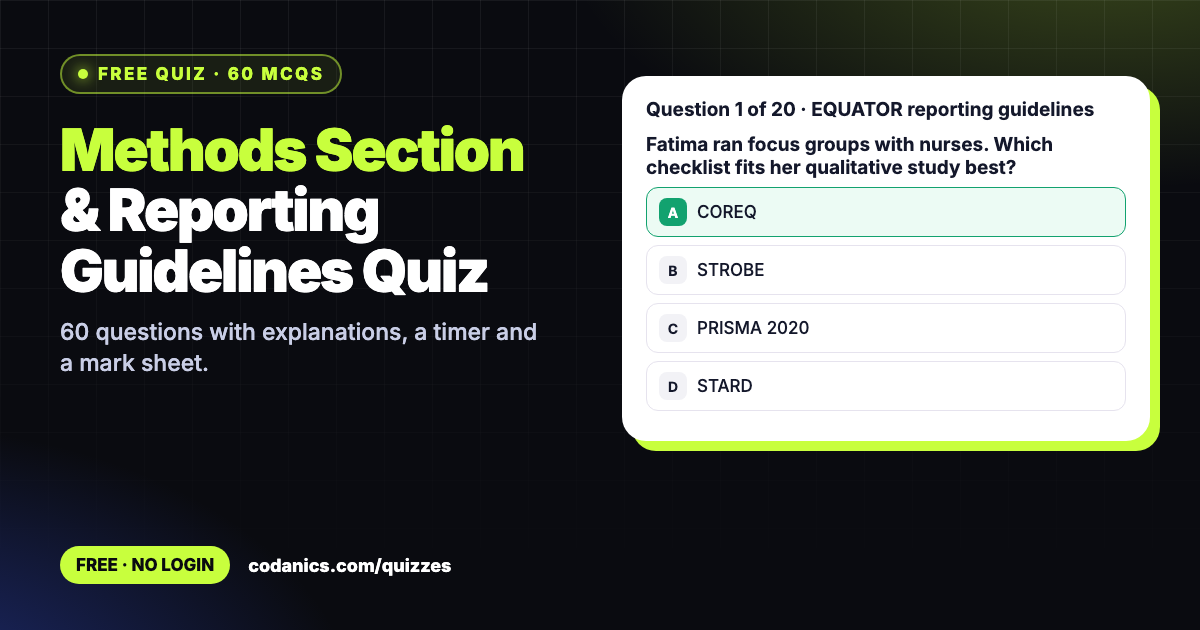
Methods Section & Reporting Guidelines Quiz
60 questions · 6 topics · timer · instant explanations · printable mark sheet.
- Questions60 in the bank, 10–30 per attempt
- Levels20 easy · 24 medium · 16 hard
- TimeAbout 5–20 minutes
- PriceFree, no login needed
- Made byDr. Aammar Tufail, Codanics
- Updated22 November 2026
In short: the Methods Section & Reporting Guidelines Quiz is a free online multiple-choice quiz by Codanics with 60 questions on methods subsections and detail; ethics and trial registration; statistical analysis paragraph; EQUATOR reporting guidelines; sample size, randomisation, blinding; and voice and tense in methods. You choose the number of questions and the difficulty, answer against a timer, see an explanation after every answer and finish with a printable mark sheet.
What the Methods Section & Reporting Guidelines Quiz covers
Weak methods are one of the most common reasons reviewers reject a paper. Reviewers want to know exactly who took part, what was done, how it was measured and analysed, and whether the study was approved and registered. If they cannot repeat it, they cannot trust it.
This quiz covers the details that make methods repeatable and credible, from catalogue numbers and software versions to CONSORT, STROBE, PRISMA 2020, ARRIVE, COREQ, STARD and CARE. Every answer comes with an explanation, and weak topics in your mark sheet link to the free scientific writing guide.
- Methods subsections and detail 11 questions
- Ethics and trial registration 9 questions
- Statistical analysis paragraph 10 questions
- EQUATOR reporting guidelines 12 questions
- Sample size, randomisation, blinding 11 questions
- Voice and tense in methods 7 questions
Who it is for: MPhil and PhD students, medical and life science researchers, and early-career academics writing the methods of a paper, thesis or protocol.
How the quiz works
- Type your name if you want it printed on the mark sheet (optional; it never leaves your browser).
- Choose 10, 20 or 30 questions, a difficulty (Easy, Mixed or Hard) and the timer: Standard, Relaxed or none.
- Answer each question before the timer runs out. Press A–D or 1–4 on a keyboard, or tap an option on your phone.
- Read the explanation after every answer, then press Next.
- At the end, get your score, grade, topic-wise breakdown and a full answer review. Print it or save it as a PDF.
- Retake the quiz for a fresh random set, or practise only the topics you found hard.
Free video lessons from Codanics
Score lower than you hoped? These free lessons from the Codanics YouTube channel cover the same topics, explained step by step.
Free on the Codanics YouTube channel, taught in Urdu/Hindi.
Sample questions with answers
Here are 10 questions from the bank, with answers and explanations. The quiz above draws from all 60.
1. What is the main test a methods section must pass?
- It is shorter than the introduction and discussion
- It cites at least ten earlier methods papers
- Another researcher could repeat the study from it
- It explains why the results are important
Answer: C. Another researcher could repeat the study from it
The methods exist so that others can judge and repeat what you did. Who, what, where, when and how must be clear enough for a replication. Importance belongs in the introduction and discussion.
2. Fatima ran focus groups with nurses. Which checklist fits her qualitative study best?
- COREQ
- STROBE
- PRISMA 2020
- STARD
Answer: A. COREQ
COREQ (Consolidated Criteria for Reporting Qualitative Research) is designed for interviews and focus groups. SRQR is a broader alternative for qualitative research in general.
3. Which item belongs in the statistical analysis paragraph of the methods?
- The p-values and confidence intervals found
- A comparison of the findings with earlier studies
- The software and version used, such as R 4.4.1
- The main conclusion of the whole study
Answer: C. The software and version used, such as R 4.4.1
The statistical analysis paragraph says how the data were analysed: software and version, tests, assumptions and significance level. The numbers you obtained belong in the results.
4. Which two items should an ethics statement for a human study normally include?
- The funder's name and the total budget of the project
- The approving committee with its approval number, and how consent was obtained
- The authors' ORCID iDs and their email addresses
- The journal's impact factor and the submission date
Answer: B. The approving committee with its approval number, and how consent was obtained
Editors check that a named ethics committee approved the study (with the reference number) and that participants gave informed consent, written or verbal as approved.
5. According to ICMJE policy, when must a clinical trial be registered in a public registry?
- After the main results have been analysed
- When the manuscript is first submitted to a journal
- Within five years of the trial being completed
- Before the first participant is enrolled
Answer: D. Before the first participant is enrolled
ICMJE journals require prospective registration, at or before enrolment of the first participant. Registering after seeing data would let researchers change outcomes without anyone noticing.
6. What does 80% power in a sample size calculation mean?
- An 80% chance that the null hypothesis is true
- 80% of participants will complete the study
- An 80% chance of detecting the effect if it truly exists
- The result will be significant in 80% of the sample
Answer: C. An 80% chance of detecting the effect if it truly exists
Power is the probability that the study finds a statistically significant result when the true effect is the size you assumed. It equals 1 − β, so 80% power means a 20% type II error rate.
7. Which procedure description is detailed enough for someone to repeat it?
- Leaves were dried properly and then ground into a fine powder
- Leaves were processed using standard laboratory procedures
- Leaves were dried and ground as is usual in plant studies
- Leaves were dried at 60 °C for 48 h and ground to pass a 0.5 mm sieve
Answer: D. Leaves were dried at 60 °C for 48 h and ground to pass a 0.5 mm sieve
Repeatable methods give amounts, temperatures, times, sizes and settings. Phrases such as 'properly', 'standard procedures' or 'as usual' cannot be copied by another lab.
8. Which sentence is written in the active voice?
- Soil samples were collected from 20 farms
- Samples from 20 farms were collected for soil analysis
- Soil was sampled at 20 farms by the team
- We collected soil samples from 20 farms
Answer: D. We collected soil samples from 20 farms
In the active voice the doer is the subject: 'We collected'. The other three are passive because the samples or soil are the subject and the verb is a form of 'be' plus a past participle.
9. Which reporting guideline is used for randomised controlled trials?
- CONSORT
- STROBE
- PRISMA 2020
- COREQ
Answer: A. CONSORT
CONSORT (Consolidated Standards of Reporting Trials) covers randomised trials, including the participant flow diagram. STROBE is for observational studies.
10. How does allocation concealment differ from blinding?
- Concealment and blinding are two names for exactly the same thing
- Concealment hides the next assignment before allocation; blinding hides it after
- Concealment applies only to outcome assessors; blinding only to doctors
- Concealment is needed only when blinding is impossible
Answer: B. Concealment hides the next assignment before allocation; blinding hides it after
Allocation concealment (for example central randomisation or sealed opaque envelopes) stops recruiters from knowing the next assignment. Blinding keeps people unaware of group after allocation. A trial can have concealment even when blinding is impossible.
Free guides and blogs to study
Free tools for your studies and research
Codanics also has 160+ free online tools for students and researchers: statistics calculators, meta-analysis, PDF and writing tools. They run in your browser, with no login.
🖋️ All scientific writing tools and quizzes → Reference checker, APA results sentences, writing checklists and more, all free.
Frequently asked questions
Is the Methods Section & Reporting Guidelines Quiz free?
Yes. The Methods Section & Reporting Guidelines Quiz is completely free, with no sign-up, no login and no limit on attempts.
How many questions are in the Methods Section & Reporting Guidelines Quiz?
The question bank has 60 multiple-choice questions (20 easy, 24 medium and 16 hard) across 6 topics. Each attempt draws 10, 20 or 30 of them at random, so every attempt is different.
How does the timer work?
Each question has its own countdown: about 25 seconds for easy, 40 for medium and 55 for hard questions, plus 15 seconds when there is code to read. Choose Relaxed to double the time or switch the timer off to study at your own pace. Unanswered questions count as skipped.
Can I get a certificate or mark sheet?
Yes. When you finish, you get a mark sheet with your name, score, grade, time, topic-wise performance and every answer explained. Use Print or save as PDF to keep it. It is a self-assessment result, not an official certificate.
Are the answers and explanations correct?
Every question was written and reviewed for one clearly correct answer, and code questions were checked by running the code. If you think an answer is wrong, tell us on the Codanics WhatsApp channel or in the YouTube comments and we will fix it.
What should a methods section include?
A methods section usually covers study design and setting, participants or materials, procedures, outcomes and measurements, ethics approval and consent, and the statistical analysis. Each part should give enough detail for another researcher to repeat the study.
Which reporting guideline should I use for my study?
Match the guideline to your design: CONSORT for randomised trials, STROBE for observational studies, PRISMA 2020 for systematic reviews, ARRIVE for animal research, COREQ or SRQR for qualitative work, STARD for diagnostic accuracy and CARE for case reports. The EQUATOR Network lists them all.
Where can I learn to write the methods of my own paper?
The Scientific Writing Marathon by Dr. Muhammad Aammar Tufail teaches you to write every section of a research paper, including methods that follow the right reporting checklist, with a writing task on your own manuscript. Recorded lectures stay on the LMS so you can learn at your own pace.
Is my data stored anywhere?
No. The quiz runs entirely in your browser. Your name, answers and score are not uploaded. Your best score and settings are remembered only in this browser so you can track your progress.
More free quizzes

See all Codanics quizzes → · Courses · Free tools · Blog
