Academic English and Plagiarism Quiz: Write Clearly, Paraphrase Correctly
Check how well you write academic English and avoid plagiarism: concise sentences, nominalisations, the right tense for each section, hedging, signposting and consistent terms, the four main types of plagiarism, a reliable paraphrasing method, when to cite, how to read a similarity report and why AI detectors are not proof. Built from the Scientific Writing Marathon course.
Academic English & Plagiarism Quiz
60 questions · 6 topics · timer · instant explanations · printable mark sheet.
- Questions60 in the bank, 10–30 per attempt
- Levels20 easy · 24 medium · 16 hard
- TimeAbout 5–20 minutes
- PriceFree, no login needed
- Made byDr. Aammar Tufail, Codanics
- Updated22 November 2026
In short: the Academic English & Plagiarism Quiz is a free online multiple-choice quiz by Codanics with 60 questions on clarity and concision; tense, hedging and word choice; paragraphs and signposting; types of plagiarism; paraphrasing, quoting and citing; and similarity reports and AI detectors. You choose the number of questions and the difficulty, answer against a timer, see an explanation after every answer and finish with a printable mark sheet.
What the Academic English & Plagiarism Quiz covers
Reviewers reject papers they cannot understand, even when the data are good, and a single copied paragraph can lead to rejection or retraction. Clear, careful English and honest use of sources are two sides of the same skill: showing readers exactly what you did and whose ideas you built on.
This quiz tests both. Each explanation teaches the rule behind the answer, from turning nouns back into verbs to closing the source before you paraphrase, and the mark sheet links your weak topics to the free scientific writing guide.
- Clarity and concision 10 questions
- Tense, hedging and word choice 10 questions
- Paragraphs and signposting 10 questions
- Types of plagiarism 10 questions
- Paraphrasing, quoting and citing 10 questions
- Similarity reports and AI detectors 10 questions
Who it is for: BS, MS, MPhil and PhD students, early-career researchers and lecturers who write papers, theses or proposals in English, especially non-native English writers.
How the quiz works
- Type your name if you want it printed on the mark sheet (optional; it never leaves your browser).
- Choose 10, 20 or 30 questions, a difficulty (Easy, Mixed or Hard) and the timer: Standard, Relaxed or none.
- Answer each question before the timer runs out. Press A–D or 1–4 on a keyboard, or tap an option on your phone.
- Read the explanation after every answer, then press Next.
- At the end, get your score, grade, topic-wise breakdown and a full answer review. Print it or save it as a PDF.
- Retake the quiz for a fresh random set, or practise only the topics you found hard.
Free video lessons from Codanics
Score lower than you hoped? These free lessons from the Codanics YouTube channel cover the same topics, explained step by step.
Free on the Codanics YouTube channel, taught in Urdu/Hindi.
Sample questions with answers
Here are 9 questions from the bank, with answers and explanations. The quiz above draws from all 60.
1. Which sentence is the clearest and most concise version of the same result?
- Biochar increased maize yield by 18%.
- It is worth noting that maize yield was seen to increase with biochar.
- The results of this study clearly show an increase in the yield of maize.
- There was an observed increase in maize yield in the case of biochar.
Answer: A. Biochar increased maize yield by 18%.
The best version names the cause, the effect and the size in one short sentence with a strong verb. The others add filler such as “it is worth noting” and “in the case of” without adding meaning.
2. Which is the best rewrite of “The team carried out an investigation of the effect of salinity”?
- The team investigated the effect of salinity.
- An investigation of salinity effects was carried out.
- The team performed an investigation into salinity effects.
- Salinity's effect was the subject of an investigation.
Answer: A. The team investigated the effect of salinity.
Turning the nominalisation “carried out an investigation of” back into the verb “investigated” makes the sentence shorter and more direct while keeping the actor.
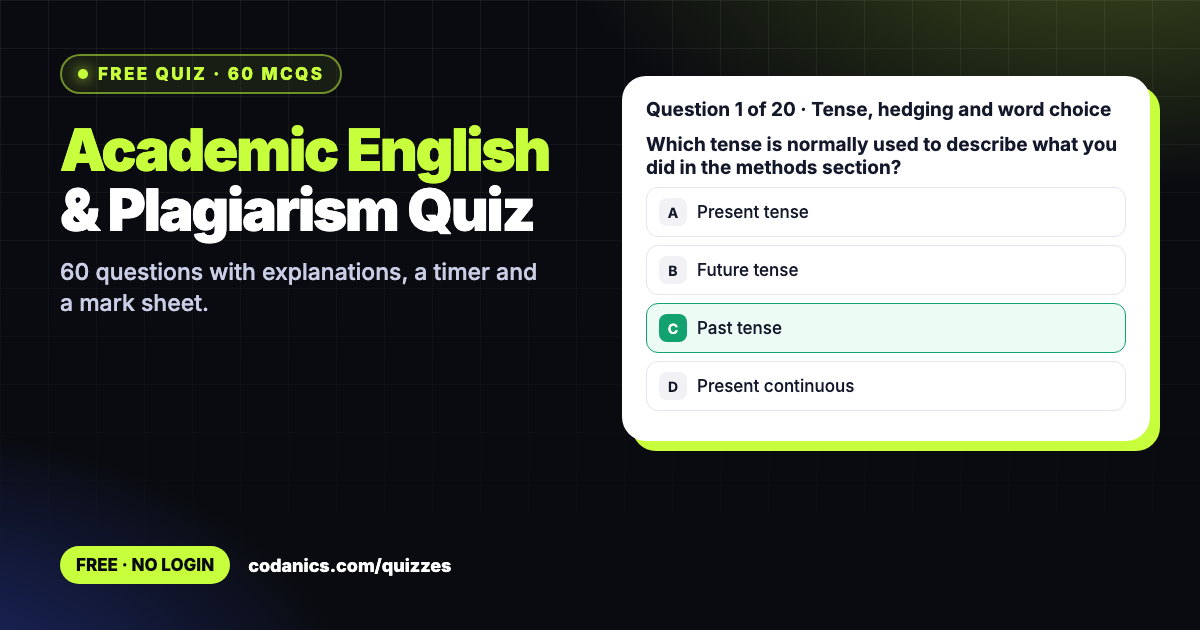
3. Which tense is normally used to describe what you did in the methods section?
- Present tense
- Future tense
- Past tense
- Present continuous
Answer: C. Past tense
Methods report procedures that were already completed, so they use the past tense: “Samples were collected in May.”
4. What is a topic sentence?
- The first sentence that states the paragraph's main point
- The last sentence that lists the references used
- A sentence placed in the title of the paper
- Any sentence that contains a statistical result
Answer: A. The first sentence that states the paragraph's main point
A topic sentence opens the paragraph and tells the reader its point. The other sentences then support or develop it.
5. A paper calls the same variable “yield”, “output” and “productivity” in different paragraphs. What is the risk?
- The paper will be flagged for plagiarism
- Synonyms make the reference list longer
- Reviewers prefer a new word in each paragraph
- Readers may think these are three different variables
Answer: D. Readers may think these are three different variables
In scientific writing a new word suggests a new thing. Pick one term for each variable and use it consistently in text, tables and figures.
6. Which best defines plagiarism?
- Copying exact words only; ideas cannot be plagiarised
- Any text that a similarity checker highlights
- Using others' words, ideas, data or figures without proper credit
- Citing more than ten sources in a paragraph
Answer: C. Using others' words, ideas, data or figures without proper credit
Plagiarism covers words, ideas, data and figures, including your own earlier published work. A highlight in a similarity report is not plagiarism by itself.
7. What is the first step of a sound paraphrasing method?
- Read the passage until you understand it fully
- Replace every third word with a synonym
- Paste the passage into a rewording tool
- Write the citation and leave the text as it is
Answer: A. Read the passage until you understand it fully
You can only restate an idea in your own words once you understand it. Then close the source, write from memory, compare and cite.
8. Original: “Biochar improves soil water retention.” Which version is patchwriting?
- Soils with biochar held more water after irrigation (Khan, 2023).
- Adding biochar may help soils keep moisture longer (Khan, 2023).
- “Biochar improves soil water retention” (Khan, 2023).
- Biochar enhances soil water holding.
Answer: D. Biochar enhances soil water holding.
Swapping improves → enhances and retention → holding keeps the original structure, which is patchwriting. The fourth option is a proper quote and the others restructure the idea.
9. Why are AI-detector scores not proof of misconduct?
- They are always correct but too slow for journals
- They only detect copying from printed books
- They measure grammar errors, not authorship
- They can give false positives and are easy to change
Answer: D. They can give false positives and are easy to change
AI detectors estimate likelihood and are known to produce false positives. Small edits can change the score, so a score alone should not decide a case.
Free guides and blogs to study
Free tools for your studies and research
Codanics also has 160+ free online tools for students and researchers: statistics calculators, meta-analysis, PDF and writing tools. They run in your browser, with no login.
🖋️ All scientific writing tools and quizzes → Reference checker, APA results sentences, writing checklists and more, all free.
Frequently asked questions
Is the Academic English & Plagiarism Quiz free?
Yes. The Academic English & Plagiarism Quiz is completely free, with no sign-up, no login and no limit on attempts.
How many questions are in the Academic English & Plagiarism Quiz?
The question bank has 60 multiple-choice questions (20 easy, 24 medium and 16 hard) across 6 topics. Each attempt draws 10, 20 or 30 of them at random, so every attempt is different.
How does the timer work?
Each question has its own countdown: about 25 seconds for easy, 40 for medium and 55 for hard questions, plus 15 seconds when there is code to read. Choose Relaxed to double the time or switch the timer off to study at your own pace. Unanswered questions count as skipped.
Can I get a certificate or mark sheet?
Yes. When you finish, you get a mark sheet with your name, score, grade, time, topic-wise performance and every answer explained. Use Print or save as PDF to keep it. It is a self-assessment result, not an official certificate.
Are the answers and explanations correct?
Every question was written and reviewed for one clearly correct answer, and code questions were checked by running the code. If you think an answer is wrong, tell us on the Codanics WhatsApp channel or in the YouTube comments and we will fix it.
Is changing a few words of a source enough to avoid plagiarism?
No. Swapping synonyms while keeping the original structure is patchwriting, a form of plagiarism even with a citation. Understand the idea, close the source, write it in your own structure, check it against the original and then cite it.
What similarity percentage is safe in Turnitin or iThenticate?
There is no universal safe percentage. A similarity report shows matching text, not proof of plagiarism. Exclude references and quoted text, then check each remaining match: standard methods phrases are normal, copied sentences in the discussion are not.
Where can I learn academic writing and paraphrasing step by step?
The Scientific Writing Marathon by Dr. Muhammad Aammar Tufail takes you from a research question to a finished manuscript, review or thesis chapter, with live classes and a writing task on your own paper. Recorded lectures stay on the LMS so you can learn at your own pace.
Is my data stored anywhere?
No. The quiz runs entirely in your browser. Your name, answers and score are not uploaded. Your best score and settings are remembered only in this browser so you can track your progress.
More free quizzes

See all Codanics quizzes → · Courses · Free tools · Blog
