Why You Should Write a Review Paper First: A PhD Guide
Your first publication does not have to wait for your data. Learn why a review paper first is the smartest start for most PhD and Master’s students, which review type to choose, and how to write it step by step. With six interactive mind maps, pop-up flash cards and a quiz.
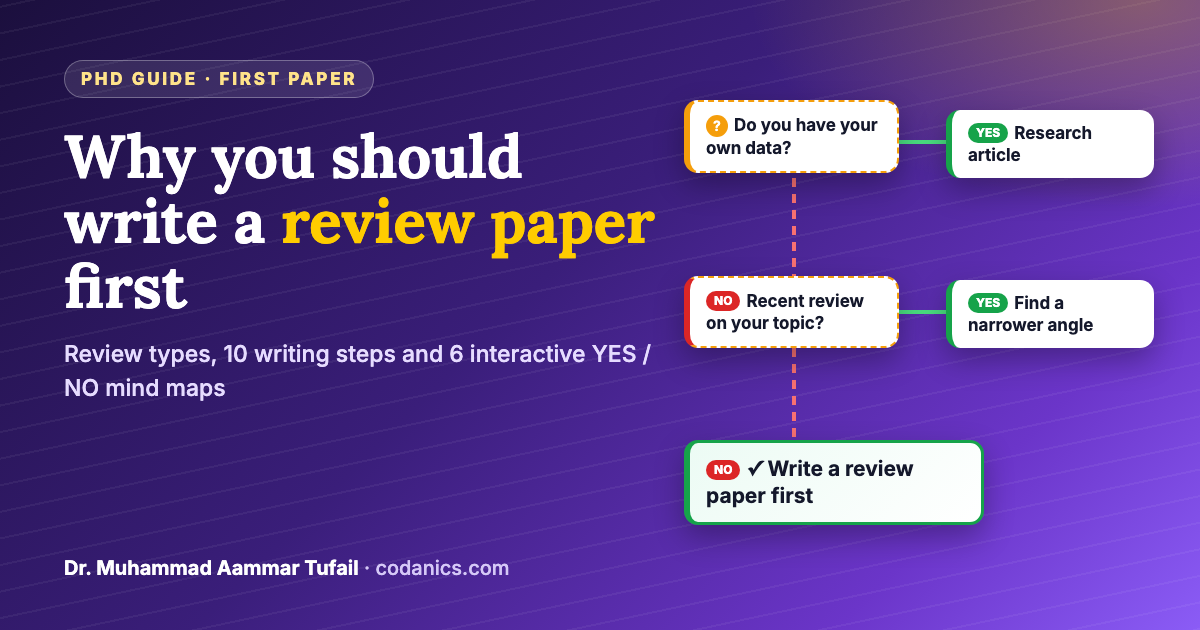
Subscribe on YouTubeFor most PhD students, writing a review paper first is the best start. You must read 100 or more papers in your first year anyway; a review turns that reading into a publication, becomes your thesis literature chapter, and shows you the research gap your own studies will fill. It needs no lab or field data, so you can publish while experiments run. Start with a narrative, mini or systematic review on a focused topic that has no recent review, and co-author it with your supervisor. If you already have a complete dataset, a research article can come first instead.
Your first paper at a glance
Every new PhD student in Pakistan, India and beyond asks the same question: “What should my first paper be?” This guide answers it honestly. First, it explains why a review paper first works so well. Then it shows when it does not, which review type to choose, and how to write it in ten steps. The interactive mind maps let you answer YES or NO questions and find the right first paper for your own situation. Short flash cards pop up as you read, and a quiz waits at the end.
7 reasons to write a review paper first
A review paper collects, compares and critiques the published studies on one topic, then shows what is known, what is debated and what is missing. That is exactly the work a new PhD student has to do anyway. Here is why a review paper first pays off.
- You read 100+ papers anyway. A literature survey is unavoidable in year 1. Publishing it means the reading counts twice.
- It becomes your thesis literature chapter. Chapter 2 of your thesis is largely written once the review is accepted.
- It reveals your research gap. Writing a review is the most reliable way to find a gap, because you must say clearly what is missing.
- No lab or field data needed. You can publish while experiments, field trials or surveys are still running.
- Reviews are cited heavily. Review papers are over-represented among the most cited papers (Miranda and Garcia-Carpintero, 2018), so a good review builds your citations and your Google Scholar profile early.
- You learn the publishing process early. Journal choice, submission, peer review and revision are easier to learn on a review than on your most important data.
- You become known in your field. Supervisors, scholarship committees and future employers see a first-author publication in year 1 or 2.
Interactive mind maps: find your first paper with YES / NO paths
These six mind maps turn the whole guide into a visual path. Map 1 decides whether your first paper should be a review. Map 2 compares a research paper with a review paper. Map 3 explains the hourglass structure, and map 4 the parts of every review type. Finally, map 5 gives examples from economics to AI, and map 6 shows how to find a research gap.
Interactive mind maps: plan your first paper
Six clickable maps for PhD students and early researchers. Click any box to reveal what comes next, or press Next step to explore one branch at a time. Each map starts with a YES / NO decision path: click ✔ Yes (goes right →) or ✘ No (goes down ↓) and the path grows from there. Use ⛶ Full screen to present it like a slideshow in class.
Every map opens with a decision question. Click ✔ Yes and the path grows to the right; click ✘ No and it grows downwards. The panel on the right explains each box and keeps a record of your path, so you can see exactly why a review paper first, or another paper type, suits you.
Which paper should you write first? A quick decision table
Your data decides your first paper. Without data, write a review paper first; with data, consider the other options. In short, use this table, or answer the questions in mind map 1.
| Your situation | Best first paper | Why |
|---|---|---|
| No data yet | Review paper | Use the waiting time to master the literature and publish it. |
| Small or early data | Short communication | Publish one clean finding quickly (2,000–4,000 words). |
| Complete, analysed dataset | Original research article | Go for the full IMRaD paper, your strongest contribution. |
| Fast-moving field (AI, computer science, engineering) | Conference paper | Get early feedback, then extend it into a journal article. |
| A new dataset, protocol or software tool | Data or methods paper | The resource itself is the contribution. |
A realistic PhD publication sequence
- Year 1Review paper: your literature chapter and your gap.
- Year 1–2Conference or short paper: first results and feedback.
- Year 2–32–3 original research articles: the results chapters of your thesis.
- Year 3+Methods paper, meta-analysis or perspective, once you are known in the field.
Not sure whether your work is a research or a review article? Read my review paper vs research paper guide or open mind map 2.
Which review type is best for a first paper?
Not every review is a good review paper first. The first five types below suit beginners; the last three need more experience, statistics or a team.
Good choices for a first review
| Review type | What it is | As a first paper |
|---|---|---|
| Narrative review | An expert-style overview of a topic with a flexible, thematic structure | Easiest start; report how you searched so it stays credible |
| Mini-review | A short, focused review of one narrow question, usually 3,000–5,000 words | Very good: quick to finish and easy to keep focused |
| Systematic review | A transparent, reproducible search, screening and appraisal process reported with PRISMA 2020 | Excellent if you have database access and 6–9 months |
| Scoping review | Maps how much evidence exists on a broad or new question, reported with PRISMA-ScR | Good for new or scattered fields |
| Bibliometric review | A data-driven analysis of publications, citations and keyword networks from Scopus or Web of Science | Good if you like data; learn VOSviewer or Bibliometrix |
Harder: plan these with your supervisor
| Review type | What it is | As a first paper |
|---|---|---|
| Meta-analysis | Statistically pools effect sizes from comparable studies, usually inside a systematic review | Harder: needs statistics and comparable numerical data |
| Umbrella review | A review of existing systematic reviews and meta-analyses | Harder: only when many reviews already exist |
| Critical or integrative review | Critiques the literature and proposes a new conceptual framework | Harder: needs deep field knowledge |
For a full typology, see Grant and Booth’s analysis of 14 review types, or let the free Review Type Selector suggest one for your question.
How to write your first review paper in 10 steps
Choose a focused topic with no recent review, write a short protocol, search two or three databases with a tested search string, screen the papers, extract them into a literature matrix, group the findings into themes, write the review around those themes, end with gaps and a research agenda, then choose a journal and submit.
- Pick a focused topic. Narrow beats broad: “biochar in saline soils”, not “soil health”.
- Check for recent reviews. Search Google Scholar and Scopus for reviews from the last 3–5 years. If one exists, find a narrower angle, a new method or a new region.
- Choose the review type and write a one-page protocol: question, databases, keywords, time window, and inclusion and exclusion criteria.
- Build and test your search string with Boolean operators (AND, OR, NOT) in Scopus, Web of Science or PubMed.
- Screen the results by title, abstract and full text. Record the numbers for a PRISMA flow diagram.
- Extract the papers into a literature matrix: author, year, context, method, data, findings and limitations.
- Group the findings into themes, not paper by paper. Themes become your section headings.
- Write the body first, then the introduction, conclusion, abstract and title.
- End with gaps and a research agenda. Readers value this section most, and it leads into your own studies.
- Choose a journal, check its guide for authors and submit. Many journals accept unsolicited reviews; some publish invited reviews only.
Practise this step free: 🧭 Review Type Selector · 🗃️ Literature Review Matrix · 🔎 Search String Translator · 🧠 Systematic Review & Meta-analysis Quiz All writing tools →
For the systematic version of these steps, follow my systematic review and meta-analysis guide. To find the papers fast, use my Google Scholar for literature search guide.
Structure of a review paper
A review paper uses a thematic structure, not IMRaD. Instead of Methods and Results, it has a review methodology and thematic body sections. The table shows the common skeleton; each review type then adds its own required parts.
| Part | What to write |
|---|---|
| Title | Name the review type, for example “…: a systematic review”. |
| Abstract | Scope, method, main themes, gaps and conclusion. |
| Introduction | The topic, why a review is needed now, and the review questions. |
| Review methodology | Databases, search string, time window, inclusion criteria and the screening flow. |
| Thematic sections | Organised by themes, methods or chronology; compare and critique, do not just summarise. |
| Synthesis and discussion | Patterns, contradictions and an emerging framework. |
| Gaps and future agenda | What is missing and how future studies can fill it. |
| Conclusion and references | The take-home message; a consistent reference style. |
A research article, by contrast, follows the hourglass shape: broad introduction, narrow methods and results, broad discussion. Mind map 3 lets you sort any sentence into the right section with YES / NO questions.
Use your review to find your research gap
A research gap is a question that has not been answered well enough yet. Your review paper is the best place to find it, because the gaps section forces you to name it. Look for seven types of gaps: knowledge, evidence (contradictory results), methodological, empirical, theoretical, population or context, and practical gaps.
Then check the gap with the FINER criteria: is it Feasible, Interesting, Novel, Ethical and Relevant? Use the free FINER Research Question Checker. A real gap matters to science, practice or policy; “not studied in my country” is only a gap when there is a reason the answer could differ.
Mind map 5 shows example review titles and possible gaps in economics, business, finance, life sciences, agriculture, environmental science and AI.
When a review paper should not be your first paper
A review paper first is the right choice for most students, but not for everyone. Be honest about these cases.
- A recent review already covers your topic. If you cannot find a narrower angle, a new method or a new region, do not repeat it.
- You already have a complete dataset. Then an original research article is the stronger first paper.
- Your university does not count reviews. Some PhD programmes require original research articles to graduate. Check your rules first.
- Your target journals invite reviews only. Some journals, such as the Annual Reviews series, publish commissioned reviews from established experts. Choose journals that accept unsolicited reviews.
- Your field publishes at conferences. In AI and computer science, a conference paper is often the natural first step.
Common mistakes in a first review paper
Avoid these mistakes and your review paper first will read like the work of an experienced author. For narrative reviews, the SANRA scale lists six quality items editors look for. For systematic reviews, follow PRISMA 2020.
Flash cards: your first review paper
Revise the key ideas before the quiz. Small flash cards also pop up while you read; switch them off at any time.
Cards 1–5: why and which paper
Cards 6–10: writing the review
Quiz: are you ready to write your first review?
Click an answer to see if you are right and why. Then try the longer Codanics quizzes below.
Part 1: choosing your first paper
1You are a first-year PhD student with no data yet. What is usually the best first paper?
A review turns your first-year reading into a publication and needs no new data.
2A good review was published on your exact topic two years ago. What should you do?
Do not repeat a recent review. Cover what it missed, or choose another first paper.
3Which review type is the quickest and easiest for a first paper?
Narrative and mini-reviews have a flexible structure and a narrow scope.
4Which reporting guideline does a systematic review follow?
PRISMA 2020 is the reporting guideline for systematic reviews; CONSORT is for randomised trials.
Part 2: writing the review
5How should the body of a review paper be organised?
Group studies by theme and compare them. A paper-by-paper list is the most common beginner mistake.
6Which section of a review do readers usually value most?
The gaps and agenda section tells readers, and you, what to study next.
7You already have a complete, analysed dataset with a strong finding. What should your first paper be?
With complete data and a strong finding, the full research article is your strongest first contribution.
8In the mind maps, what happens when you click ✘ No on a question?
YES grows the path to the right and NO grows it downwards.
9What does the FINER check ask about a research gap?
FINER stands for Feasible, Interesting, Novel, Ethical and Relevant.
10An AI tool suggests ten references for your review. What should you do?
AI tools can invent references. Read every source and check it, for example with a reference checker.
Want more practice? Take the free Systematic Review and Meta-analysis Quiz or the Literature Search and Boolean Operators Quiz.
Video lessons on writing your first review


Write and publish your first paper, with guidance
Free tools and quizzes for your first review
- Review Type SelectorAnswer a few questions to find the right review type for your topic.Free tool
- Literature Review MatrixExtract every paper into one table: author, method, findings and limitations.Free tool
- Systematic Review Protocol BuilderWrite the protocol for a systematic review before you search.Free tool
- Search String TranslatorTurn one Boolean search string into Scopus, Web of Science and PubMed syntax.Free tool
- PRISMA Flow Diagram GeneratorDraw the PRISMA 2020 screening flow from your numbers.Free tool
- FINER Research Question CheckerCheck your gap and question: feasible, interesting, novel, ethical, relevant.Free tool
- Manuscript and Thesis Outline GeneratorGet a section-by-section outline for a review or research paper.Free tool
- Reference CheckerCatch fake, AI-invented and retracted references.Free tool
- Systematic Review & Meta-analysis QuizPRISMA, protocols, screening and meta-analysis basics.Free quiz
- Literature Search & Boolean Operators QuizDatabases, keywords and Boolean search strings.Free quiz
- IMRaD & Scientific Paper Structure QuizWhat goes where in a scientific paper.Free quiz
- Scientific Writing Master QuizEvery step from question to publication.Free quiz
All scientific writing tools and quizzes →
Latest from Codanics on research and writing
- 1Research Metrics Explained: Impact Factor, h-index and MoreScientific Writing
- 2
- 3
- 4How to Write a Systematic Review and Meta-Analysis: Step-by-Step GuideSystematic ReviewMeta-analysis
- 5
- 6Scientific Writing Guide: Thesis, Papers, Reviews and Meta-analysisScientific Writing
Updated automatically from codanics.com · All guides on the Codanics blog →
Links and sources
- 1The PRISMA 2020 statementPage et al., BMJ 2021: reporting systematic reviews
- 2PRISMA extension for scoping reviews (PRISMA-ScR)Tricco et al., Annals of Internal Medicine 2018
- 3SANRA: quality of narrative reviewsBaethge et al., Research Integrity and Peer Review 2019
- 4AMSTAR 2Shea et al., BMJ 2017: appraising systematic reviews
- 5A typology of 14 review typesGrant and Booth, Health Information and Libraries Journal 2009
- 6Review papers among the most cited papersMiranda and Garcia-Carpintero, Journal of Informetrics 2018
- 7PROSPERORegister a systematic review protocol
- 8PRISMA statement websiteChecklists and flow diagram templates
- 9VOSviewerFree software for bibliometric maps
- 10BibliometrixR package for bibliometric reviews
- 11Scientific Writing MarathonLive online classes: write and publish your paper
- 12Book a one-to-one sessionConsultancy with Dr. Aammar Tufail
Related guides on Codanics
- 1Review paper vs research paper12 key differences, with a table and quiz
- 2Systematic review and meta-analysis guideFrom PICO question to PRISMA 2020
- 3Google Scholar for literature searchFind the papers for your review fast
- 4Research metrics explainedImpact factor, quartiles, h-index and choosing journals
- 5Scientific writing complete guideTheses, papers, reviews and meta-analysis
- 6PhD research proposal guideTurn your gap into a strong proposal
- 7Scientific writing tools and quizzesFree tools for every step
- 8All free Codanics tools239 free tools for students and researchers
Frequently asked questions about your first review paper
Choosing your first paper
Should my first paper be a review paper?
For most PhD and Master's students, yes. A review paper first turns the reading you must do anyway into a publication, becomes your thesis literature chapter and shows your research gap. If you already have a complete dataset with a strong finding, write the research article first.
Can a PhD student write a review paper?
Yes. Writing a review paper first is common, and many journals accept unsolicited reviews from early-career researchers, especially when the topic is focused and the method is transparent. Co-author it with your supervisor, and avoid journals that publish invited reviews only.
Does a review paper count for my PhD?
It depends on your university. Many programmes accept a review as one of the required publications, but some require original research articles only. Check your programme rules before you start.
What is the difference between a review paper and a research paper?
A research paper creates new knowledge from primary data and follows IMRaD. A review paper organises existing knowledge from published studies and uses a thematic structure that ends with gaps and a research agenda.
Writing the review
Which type of review is best for beginners?
A narrative review or a mini-review is the easiest start. A systematic review is more rigorous and highly valued, but it needs database access, a protocol and more time.
How long does it take to write a first review paper?
If you write a review paper first, plan for about 3–9 months, depending on the scope and the review type. Systematic reviews take longer because of the protocol, screening and appraisal steps.
How many references does a review paper need?
Typically about 80–200 or more, compared with about 30–60 for a research article. A mini-review needs fewer. Always check the journal's guide for authors.
Can I use AI tools to write a review paper?
You can use AI tools to find and organise papers, but read every source yourself, never cite a reference you have not checked, and follow your journal's AI policy. AI tools can invent references.
This guide and help
How do the interactive mind maps work?
Click any box to open it, or press Next step. On a question, click Yes and the path grows to the right, or No and it grows downwards. Use Full screen to present the maps like a slideshow. Nothing is saved.
Where can I get help to write my first review paper?
Join the Scientific Writing Marathon on Codanics, or book a one-to-one session with Dr. Muhammad Aammar Tufail at mentorship.codanics.com/book.
About the author
Dr. Muhammad Aammar Tufail. Dr. Muhammad Aammar Tufail is the founder of Codanics and completed his PhD in a Marie Skłodowska-Curie programme. He teaches scientific writing, literature search, systematic reviews and data science in Urdu and Hindi.
See his research on Google Scholar and ResearchGate, and follow him on LinkedIn.
One-to-one sessions: you can now book consultancy sessions with Dr. Aammar Tufail about data science, your research project, mentorship, your PhD and Master’s thesis and much more at mentorship.codanics.com/book.
Last updated 29 November 2026. Journal policies and university rules differ; always check your journal’s guide for authors and your programme’s requirements.
