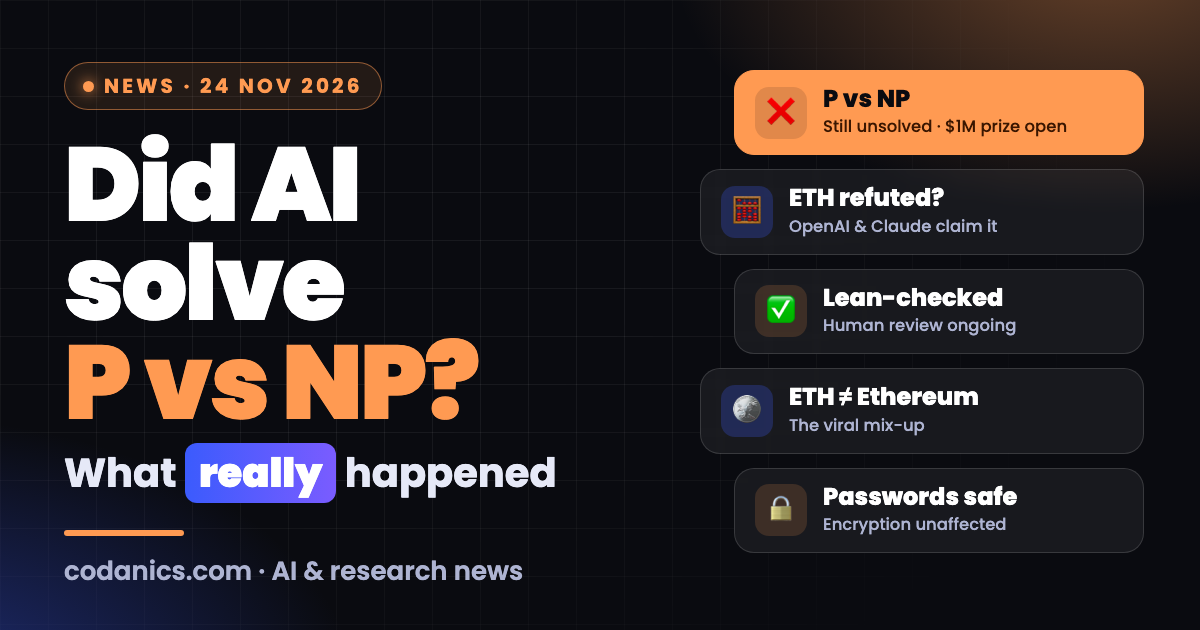
Did AI solve P vs NP? What really happened
Social media says AI just solved P = NP and broke encryption. It didn’t. But OpenAI and Anthropic’s Claude did produce something big: AI-written proofs that refute a 27-year-old assumption in computer science. Here is the full story, in plain words, and why your passwords are still safe.
P vs NP news in 30 seconds
No, AI has not solved P vs NP, and modern encryption is not broken. In late October 2026, OpenAI and Anthropic each released an AI-written paper claiming an algorithm for 3-SAT that runs in “subexponential” time. If correct, that refutes the Exponential Time Hypothesis (ETH), a 1999 conjecture. Both proofs passed the Lean proof checker, and a team led by Ryan Williams, Russell Impagliazzo and Ramamohan Paturi is examining them. However, a subexponential algorithm is still far from the polynomial-time algorithm that P = NP would need, so the P vs NP problem remains open.
- The real news: two AI systems independently found and formally checked a proof against ETH, a famous assumption about 3-SAT.
- The confusion: “ETH” was mistaken for Ethereum, and an essay by Emanuele Viola was read as “P = NP is proven”.
- The reality: P vs NP is unsolved, and the new algorithms only beat old ones on inputs far too large for any computer.
- The big shift: AI is now producing research-level mathematics that experts take seriously.
What happened: two AI labs say they refuted ETH
In the last week of October 2026, OpenAI released a 67-page paper titled “The Exponential Time Hypothesis is False”, written by an unnamed internal OpenAI model, together with a Lean proof. Hours later, Anthropic posted its own 49-page paper, “A 2o(n) Time Algorithm for 3-SAT”, credited to “Claude (Anthropic)” and discovered by an internal research Claude model, also with a Lean 4 formalization.
Both papers describe a deterministic algorithm that does more than solve 3-SAT: it counts every satisfying assignment, in time of roughly 2O(n log log n / √log n) for n variables. In other words, the work still grows very fast, but slower than any exponential 2cn. That is exactly what ETH said was impossible. Both companies say their models found the core idea on 16 October, and Anthropic says its model needed about 14 million output tokens and no human input for the algorithm.
Timeline: from a quiet discovery to a viral myth
- 1999Russell Impagliazzo and Ramamohan Paturi propose the Exponential Time Hypothesis, building on work with Francis Zane.
- 16 Oct 2026OpenAI and Anthropic both say their internal models found the core algorithm on this day.
- 17 OctOpenAI’s paper is dated, and its Lean formalization is completed; the paper is revised on 25 October.
- 26 OctImpagliazzo, Paturi and Williams post an open letter inviting the community to examine the claim. OpenAI’s paper goes public; Anthropic’s follows hours later.
- 28 OctComplexity theorist Lance Fortnow writes that ETH is “toast” on the Computational Complexity blog, while noting he has not verified the proof himself.
- 30–31 OctTwo arXiv papers calculate how big a formula must be before the new algorithms win; the answer is astronomically large.
- 2 NovThe MIT Hardness Group publishes “ETH is Dead, Long Live SH”, showing most old hardness results survive with a slightly weaker assumption.
- 17 NovEmanuele Viola’s essay in Communications of the ACM links the AI wave to his view that P may equal NP.
- 23 NovAnthropic posts a separate Claude proof claim, VP ≠ VNP, the algebraic cousin of P vs NP. “P = NP” starts trending.
What is the Exponential Time Hypothesis, in simple words?
3-SAT is a classic logic puzzle. You get a long list of rules, each with three true-or-false options, such as “x is true OR y is false OR z is true”. The question is whether some setting of all the variables satisfies every rule at once. With n variables there are 2n possible settings, so trying them all doubles the work with every new variable.
Clever algorithms have done better for years. Before October 2026, the best deterministic methods needed about 1.328n steps and the best randomized ones about 1.308n, according to Anthropic’s paper. However, they were all still exponential. ETH said this would always be true: no algorithm can solve 3-SAT in time 2o(n). Hundreds of results in graph theory, databases, biology and geometry assumed ETH to prove that other problems cannot be solved quickly.
See it yourself: how fast is “subexponential”?
Move the slider to change the number of variables n. The bars show how many decimal digits the number of steps has for each kind of algorithm. Constants are ignored, so treat this as a picture of growth, not exact running times.
Digits of steps: brute force 2n; best before 2026, 1.328n; new subexponential bound, about 2n/√log₂n; polynomial, n3. A number with 300,000 digits is still unimaginably large. Warning: dropping the constants makes the new bound look better than older methods far too early; with the real constants it only wins at astronomical sizes, as explained below.
So the new bound really is smaller than 2n in the long run, which is why ETH falls. Still, it stays enormous next to n3. Moreover, real constants matter: one analysis of OpenAI’s proof found that the running time its proof certifies beats brute force only when the formula has more than about 21,000,000,000 variables and clauses, and another paper estimated crossover points for Anthropic’s algorithm of 28.6 billion variables, even after improvements.
Why the buzzWhy everyone suddenly says “P = NP is solved”
The jump from “ETH is false” to “P = NP is solved” happened for two reasons.
Then, on 23 November, Anthropic posted a different Claude result that claims VP ≠ VNP, the algebraic version of P vs NP. Its own README says it “does not settle P vs NP”. I explain that claim in my Claude AI guide.
Fact checkIs P vs NP solved? No, and here is why
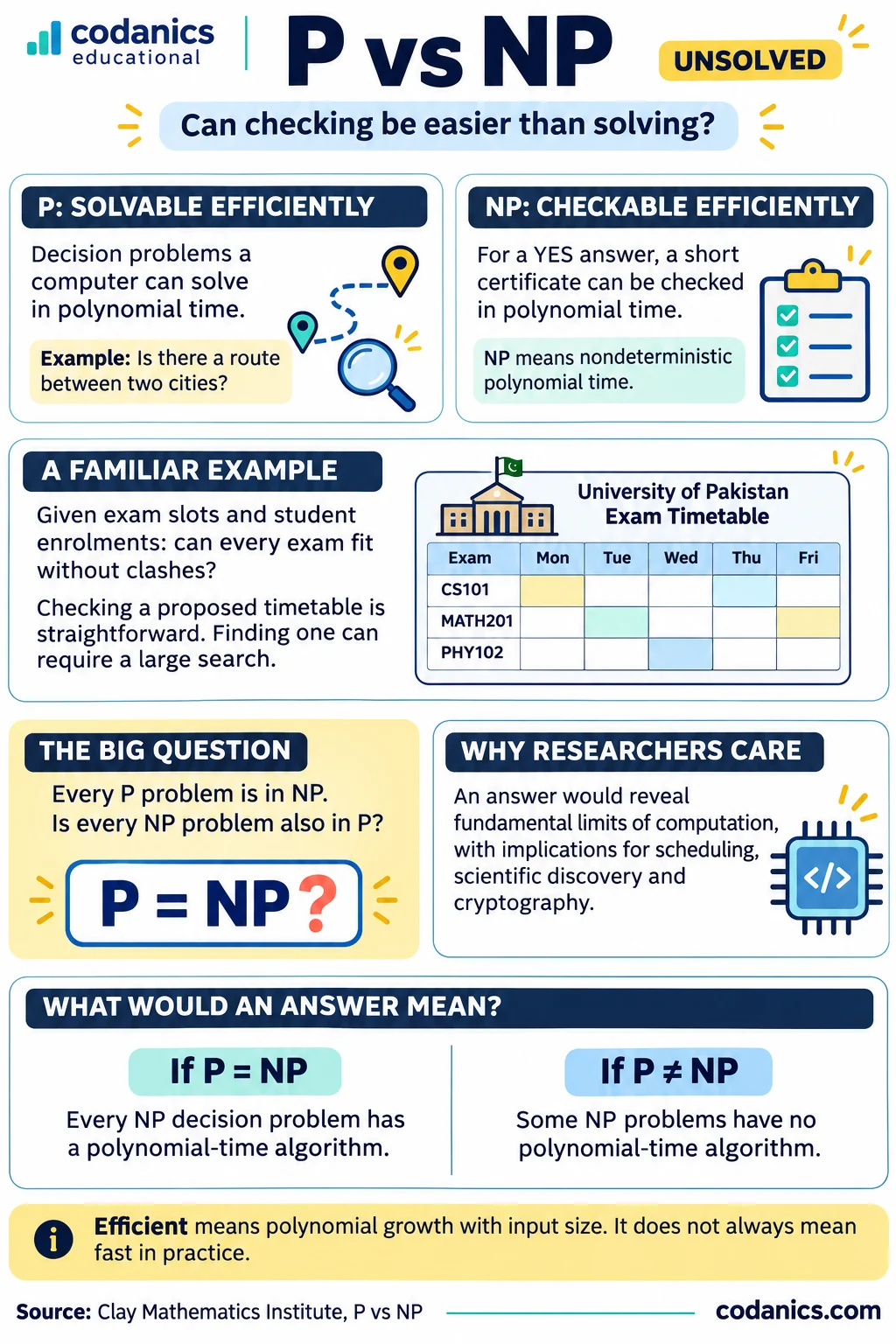
P vs NP is still unsolved. The Clay Mathematics Institute still lists it as an open Millennium Prize Problem with a $1 million reward. Proving P = NP would need a polynomial-time algorithm for an NP-complete problem, such as n3 steps, while the new algorithms take about 2n/√log n steps, which is far larger.
P is the set of problems a computer can solve quickly (in polynomial time). NP is the set of problems whose answers a computer can check quickly. For example, checking a finished exam timetable for clashes is easy, but finding a clash-free timetable can require a huge search. P vs NP asks whether every problem that is easy to check is also easy to solve.
The new results also do not help every NP problem. As Fortnow points out, they give nothing new for Subset Sum or the Travelling Salesman Problem, because turning those problems into 3-SAT adds too many variables. To get fast algorithms for all of NP, 3-SAT would need time like 2no(1), which these results do not come close to.
SecurityAre your passwords, bank accounts and crypto wallets safe?
Yes. Nothing about your bank account, passwords, RSA keys or crypto wallet changed. The new algorithms are purely asymptotic, they do not speed up real-world solvers, and they do not attack the maths behind RSA or elliptic-curve cryptography directly.
- Anthropic says so itself: its README calls the result “purely asymptotic” and says it “says nothing about solving formulas in practice”.
- The sizes are absurd: the proven bounds only beat older methods on formulas far too large to store on any computer.
- Encryption rests on other problems: RSA relies on factoring and many wallets on elliptic curves. Breaking them would need much more than a slightly subexponential 3-SAT algorithm.
- Researchers are watching: some experts say cryptographers should study the new techniques carefully, which is normal good practice, not a sign of danger today.
Who is checking the AI proofs, and what does Lean prove?
MIT’s Ryan Williams, together with Russell Impagliazzo and Ramamohan Paturi, the two researchers who proposed ETH, are organising an open, independent examination on the ETH discussion blog. In their letter they wrote: “Our involvement should not be taken as certification of the claim.” OpenAI agreed to publish its raw data, the reviewers work unpaid, and nobody signed a non-disclosure agreement, according to Decrypt.
Both proofs passed Lean, a proof assistant that checks every logical step by machine. However, Lean only checks that the proof matches the formal statement. Humans still have to confirm that the formal statement really says “3-SAT can be solved in this time”. Anthropic’s README is honest about this: no machine checks that its statement file says what the paper says. OpenAI notes that its Lean file proves a slightly weaker bound than its headline result, which would still refute ETH. In the latest public reports, no fatal error has been found, and mathematicians such as Ryan O’Donnell and Shiva Kintali have already posted simpler versions of the proof.
Why it mattersWhat it means for mathematics, AI and students
Even without breaking encryption, this is a turning point. Two AI systems, working separately, found and formalised a proof that had stumped experts for 27 years. OpenAI’s public math repository now lists 722 AI-generated manuscripts, and Anthropic’s formal-math repository holds several machine-checked results. Researchers are already calling it a “mathpocalypse”.
- For researchers: AI can now propose real proofs, but human checking, explanation and credit matter more than ever.
- For students in Pakistan and India: theoretical computer science, logic and proof assistants such as Lean are suddenly hot skills. Start with algorithms and Python, then explore formal proofs.
- For everyone: read past the headline. “AI disproved a hypothesis” is not “AI broke the internet”.
Quiz: myth or fact?
Test what you learned. Tap Myth or Fact for each claim you saw online.
1AI has proved that P = NP.
Myth. The AI results refute ETH, a different and weaker statement. P vs NP is still open.
2Two AI labs say their models refuted the Exponential Time Hypothesis.
Fact. OpenAI and Anthropic each released a paper and a Lean proof in late October 2026.
3"ETH is false" means Ethereum is in trouble.
Myth. ETH here is the Exponential Time Hypothesis, not the Ethereum coin.
4The new algorithms make SAT solvers faster today.
Myth. They only beat older methods on formulas far too large to store on any computer.
5Lean checked the proofs, but humans must still confirm the statements match the papers.
Fact. Lean checks proofs against formal statements; whether those statements say the right thing needs human review.
6Bank accounts, RSA keys and crypto wallets are now at risk.
Myth. Nothing in practical security changed.
7The Clay Institute's $1 million P vs NP prize is still unclaimed.
Fact. The Clay Mathematics Institute lists P vs NP as unsolved.
Answer the claims to see your score.
Flash cards: the story in 8 cards
Tap a card to flip it. Small cards also pop up as you read; switch them off at any time.
Video lessons from Codanics
New to algorithms? Start with the basics, then catch up on the latest Claude models, in Urdu/Hindi on the Codanics YouTube channel.

Read more on Codanics
- 🤖Claude AI: the complete guideModels, Claude Code and the VP ≠ VNP claim
- 🚀Learn Claude Code in 30 daysBuild a startup from A to Z
- 🎓AI tools for students and academicsUse AI in research the right way
- 📝Scientific writing guidePapers, theses and reviews
- 🤝11 AI agents in PythonFree source code
- ✍️Prompt engineering guideGet better answers from AI
- 🐍Python ka ChillaPython from zero to AI agents
- 🧑🏫Book a one-to-one sessionResearch, AI, PhD and career advice
P vs NP and the AI proofs: FAQ
The news: AI, ETH and P vs NP
Did AI solve P vs NP?
No. In October 2026, AI models from OpenAI and Anthropic produced proofs claiming that the Exponential Time Hypothesis is false, by giving a subexponential algorithm for 3-SAT. That does not solve P vs NP, which would need a polynomial-time algorithm. The Clay Mathematics Institute still lists P vs NP as unsolved.
What exactly did OpenAI and Anthropic prove?
Both papers describe a deterministic algorithm that counts the satisfying assignments of a 3-SAT (and k-SAT) formula in time of roughly 2^(O(n log log n / √log n)). This grows slower than any 2^(cn), so it refutes ETH. Both proofs were formalised in the Lean proof assistant.
Has the proof been verified?
The Lean proof checker accepts both formal proofs, but humans must still confirm that the formal statements match the papers' claims. Ryan Williams, Russell Impagliazzo and Ramamohan Paturi are organising an open, independent examination and have said their involvement is not a certification.
What did Emanuele Viola say?
In a Communications of the ACM essay published on 17 November 2026, Northeastern University computer scientist Emanuele Viola linked the wave of AI results to his long-held view that P may equal NP. It is an opinion piece, not a proof; most researchers still expect P is not equal to NP.
What is VP vs VNP?
VP vs VNP is the algebraic analogue of P vs NP, posed by Leslie Valiant in 1979. On 23 November 2026 Anthropic posted a Claude-written proof claim that VP is not equal to VNP. Anthropic says it does not settle P vs NP, and no human mathematician has checked it yet.
Basics and safety
What is the Exponential Time Hypothesis (ETH)?
ETH, proposed by Russell Impagliazzo and Ramamohan Paturi in 1999, says that 3-SAT cannot be solved in time 2^o(n), where n is the number of variables. In other words, no algorithm can beat exponential time for 3-SAT. Hundreds of hardness results relied on it.
What is the difference between P and NP?
P is the set of problems a computer can solve quickly, in polynomial time. NP is the set of problems whose answers can be checked quickly. P vs NP asks whether every problem that is easy to check is also easy to solve.
Is ETH related to Ethereum?
No. ETH in these papers stands for the Exponential Time Hypothesis, a computer-science conjecture from 1999. Some crypto traders confused it with the Ethereum coin.
Is encryption broken? Are my passwords safe?
Yes, they are safe. The new algorithms are purely asymptotic and only beat older methods on inputs far too large for any computer. They do not directly attack RSA or elliptic-curve cryptography, so bank accounts, passwords and crypto wallets are unaffected.
Why does this matter if encryption is safe?
Because two AI systems independently found and formally verified a proof that researchers had not found in 27 years. It shows AI can now contribute to research-level mathematics, which changes how proofs are discovered, checked and credited.
No questions match. Try another word.
Follow AI and research news in plain words
Get explainers like this one, plus free courses in Urdu/Hindi, on the Codanics channels.
Sources
- OpenAI: The Exponential Time Hypothesis is False (preprint, revised 25 Oct 2026)
- OpenAI: Lean proof documentation
- OpenAI: Working with academic communities to build scientific understanding
- OpenAI math repository
- Anthropic formal-math: A 2^o(n) Time Algorithm for 3-SAT (paper and Lean proof)
- Anthropic formal-math: VP ≠ VNP over every field
- Impagliazzo, Paturi and Williams: ETH refutation examination and discussion
- Lance Fortnow, Computational Complexity blog: The Exponential Time Refutation (28 Oct 2026)
- Dias and Lima: Limits and Constants of OpenAI's Claimed ETH Refutation (arXiv:2611.00517)
- Majdoddin: Lowered crossover points of Anthropic's subexponential 3-SAT algorithm (arXiv:2610.41622)
- MIT Hardness Group et al.: ETH is Dead, Long Live SH (arXiv:2611.02650)
- Ryan O'Donnell: exposition of the ETH refutation
- Emanuele Viola, Communications of the ACM: What Happened in Fall 2026: AI and P vs NP
- Decrypt: OpenAI Proves ETH Is False, and Crypto Twitter Has Questions
- Dataconomy: OpenAI and Anthropic claim AI disproved the exponential time hypothesis (4 Nov 2026)
- Impagliazzo and Paturi: Complexity of k-SAT (CCC 1999)
- Clay Mathematics Institute: P vs NP
- Exponential time hypothesis (Wikipedia)
This is a developing story. The claims in both papers were still under independent review on 24 November 2026; we will update this article when the reviewers report.
About the author. Dr. Muhammad Aammar Tufail is the founder of Codanics. He teaches AI, data science, Python and scientific writing in Urdu and Hindi.
Codanics is not affiliated with OpenAI, Anthropic or the Clay Mathematics Institute. This article is educational and is not financial or security advice.
