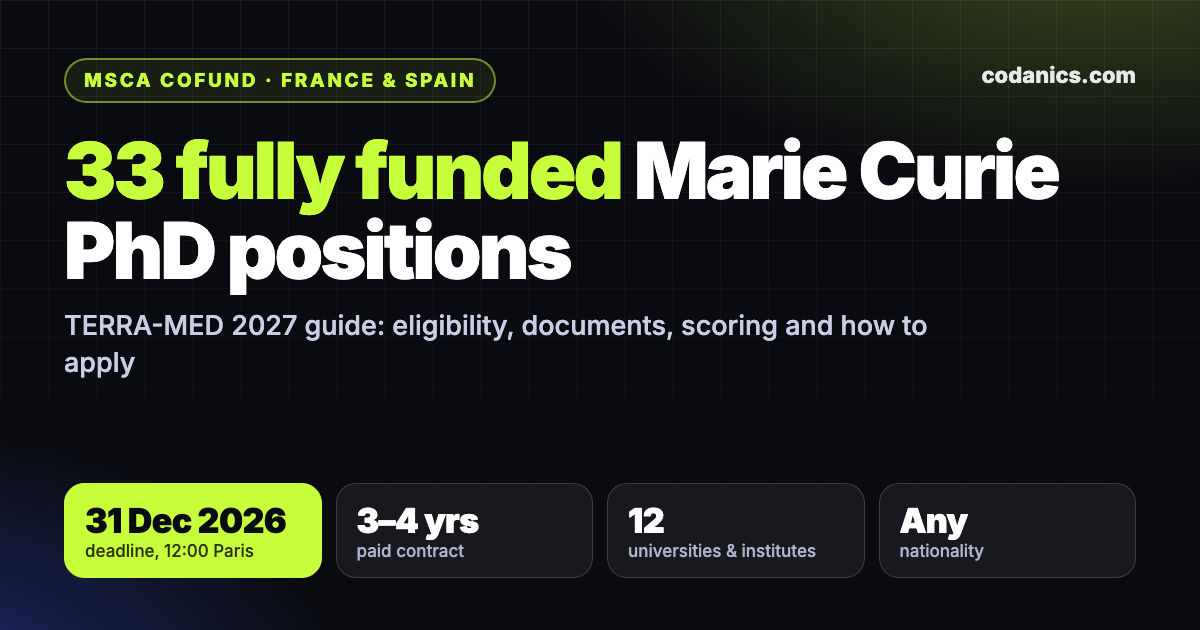
33 fully funded Marie Curie PhD positions in France and Spain: the TERRA-MED 2027 guide
The TERRA-MED doctoral programme has published 33 PhD offers on water, environment, food and energy across Occitanie, Catalonia and the Balearic Islands. Applications are open until 31 December 2026. This guide shows you who can apply, how to prepare every document, how candidates are scored, and how to find the right position.
📅 Free online info session: 25 November 2026, 14:00–15:30 (Paris time), on the administrative and legal side of applying. Register here ↗
TERRA-MED is a Marie Skłodowska-Curie COFUND doctoral programme that recruits 33 PhD candidates of any nationality for 3- or 4-year paid contracts at 12 universities and research centres in France and Spain. To apply you need a master’s degree by 31 December 2026, no PhD, English at B2 level, and no more than 12 months spent in the host country (France or Spain) in the last three years. You apply online by 31 December 2026 at 12:00 Paris time with a narrative CV, a cover letter, a short essay on the research topic, your degree and transcripts, English evidence and proof of residence.
| Programme | TERRA-MED, the Euroregional PhD Program in Science and Environment, coordinated by the Euroregion Pyrenees–Mediterranean |
|---|---|
| Funding | Co-funded by the European Union, Marie Skłodowska-Curie Actions COFUND (HORIZON-MSCA-2025-COFUND-01, Grant Agreement 101261763) |
| Positions | 33 PhDs: 15 in Catalonia, 14 in Occitanie, 4 in the Balearic Islands (19 in Spain, 14 in France) |
| Research areas | The Water–Land–Energy nexus: water, environment and biodiversity, food and agriculture, energy and hydrogen, chemistry and materials, digital and societal transitions |
| Contract | Full-time employment contract of 3 or 4 years, gross salary above the MSCA COFUND minimum, full social security, tuition and visa fees covered |
| Who can apply | Early-stage researchers of any nationality with a master’s by 31/12/2026, no PhD, English B2 and the mobility rule met |
| Deadline | 31 December 2026, 12:00 noon (Paris time), on the official application portal |
| Start | September/October 2027 |
| Official documents | Guide for Applicants (PDF) · the 33 PhD offers · FAQ · questions: terramed@euroregio-epm.eu |
33 PhD positions now published: applications open on 15 October 2026
The wait is over for early-career researchers looking for their next academic challenge. The 33 fully funded PhD positions of the TERRA-MED doctoral programme are now published on the TERRA-MED website, so you can explore every project in detail and find the one that best matches your background and research interests. The call opened on 15 October 2026 and closes on 31 December 2026 at 12:00 noon (Paris time).
Each PhD offer gives you what you need to decide: the research topic, the host institution and research unit, the supervisor and co-supervisor, the research disciplines and keywords, and the partner institutions involved. Read the full description of a position before you write your application, because your essay must show that you understand that specific project.
The positions cover a wide range of fields, from water management and treatment, environment and biodiversity and food and agriculture to energy, hydrogen and decarbonisation, plus chemistry, materials and digital transitions. They are hosted by universities and research institutes in France and Spain, and every project is cross-border: you work with a supervisor in one region and a co-supervisor in another.
TERRA-MED timeline: from the call to your first day
The selection takes about six months, and contracts start in September or October 2027. The black line marks today.
Source: Guide for Applicants (version of 14 October 2026), sections 3 and 12. Dates after the deadline are indicative.
ChartsThe TERRA-MED call in numbers
Water and energy offer the most positions, Spain hosts slightly more than France, and the Université de Toulouse is the largest single host. Click a bar to see those positions in the explorer below.
Positions by research theme
33 positions in 6 themes · click a theme to filter
By region
By country
Positions by host institution
Blue = France, orange = Spain · click an institution to filter
Interactive map of the TERRA-MED consortium
TERRA-MED connects 12 employing universities and research centres across the Euroregion Pyrenees–Mediterranean, coordinated from Perpignan. Bigger dots host more positions. Click a dot to see its projects, or pick an institution from the list.
The programme also has 14 associated (non-academic) partners, such as companies, agencies and public administrations, which host the 3–6 month secondments. See the official consortium map for the full list.
Find your PhDExplore and filter the 33 TERRA-MED PhD positions
Search by keyword, city, institution or supervisor, and filter by theme or country. Each card links to the official offers page, where you can open the full PDF for that position.
No positions match your search. Try another word, or reset the filters.
Titles are shortened. Always read the full offer on the TERRA-MED website, including the salary, the duration (36 or 48 months), and the planned mobility and secondment.
Who can applyTERRA-MED eligibility criteria and the mobility rule
TERRA-MED is open to early-stage researchers of any nationality. Four conditions decide whether your application is even evaluated. They are checked in January 2027, and an application that fails one of them is rejected without being scored.
The mobility rule, explained
The rule applies to the country of the position, not to Europe as a whole. For a position hosted in France, only time in France counts; for a position hosted in Spain, only time in Spain counts. Time as a tourist, as a refugee or in national service does not count as residence. So a candidate who did a master’s in Spain can still apply to the 14 French positions.
For the application you prove your main country of residence for 2024, 2025 and 2026 with documents such as utility bills, rental contracts, university registrations or work contracts, all combined in one PDF.
Check your eligibility in 30 seconds
How to prepare your TERRA-MED application documents
You submit six items through the portal. Three are written directly in the portal (CV, cover letter, essay) and three are PDF uploads. Tick each one as you finish it; your progress is saved in this browser.
1. The narrative CV: show potential, not a long list
TERRA-MED asks for a narrative CV: instead of listing everything you have done, you explain your path and your best work in sentences. Evaluators score education (up to 40 points) and research and working experience (up to 35 points) mostly from this CV, so it carries most of your remote-evaluation score.
- Academic education: degrees, institutions, dates and specialisation. Add your grade or class rank if it is strong, and your master’s thesis title.
- CV summary (maximum 2 pages): your research story in short paragraphs, covering what you studied, the skills you built, the labs and countries you worked in, and where you want to go.
- Up to 5 relevant contributions: papers, your master’s thesis, conference talks or posters, datasets, software, technical reports, patents, outreach or awards. Choose the five that best match the project, not simply the five most recent.
Template: one “relevant contribution” (click to open, then copy)
Title and reference:
[e.g. Master's thesis "Removal of microplastics in constructed wetlands", University of X, 2025, grade 18/20] or [Author A, You B (2025). Title. Journal, 12, 45–60]

Description and relevance (3–4 sentences):
[What the work was about and what you found, in plain words.]
[Why it matters for the TERRA-MED project you are applying to: the method, system or question it shares.]

Your role:
[What YOU did: designed the experiment, collected samples, analysed data in R, wrote the first draft, presented the poster…]

Link:
[DOI or URL, if available]
🧰 Draft the content first with the free academic CV builder and publication list formatter, then rewrite it as narrative text in the portal. Cut filler with the wordiness checker and count words with the academic word counter.
2. The cover letter: motivation, fit and career goals
The cover letter is worth up to 25 points and covers your interest and motivation to join the programme, your choice of PhD project and your career objectives. It is written in the portal, as answers to the motivation questions.
Outline: TERRA-MED cover letter in five paragraphs
1. Who you are (2–3 sentences)
   Your degree, institution and the research question that drives you.

2. Why this project (4–5 sentences)
   Name the offer (reference + title), the problem it tackles and the specific part that excites you.
   Show you read the description: mention one method, site or question from the offer.

3. Why you (4–6 sentences)
   Two or three concrete achievements that prepare you for THIS project (methods, field work, data, papers).
   Link each one to a task in the project.

4. Why TERRA-MED (3–4 sentences)
   The cross-border co-supervision, the 9–12 month stay in the other region, the non-academic secondment,
   the training schools. Say what you want to learn from each.

5. Career goal (2–3 sentences)
   Where you see yourself in 5 years (academic, industry, policy) and how this PhD gets you there.
🧰 Structure it with the motivation letter builder or cover letter builder, then check it with the SOP checker. The CV, motivation letter, SOP and LOR guide has full examples.
3. The research topic essay: prove you understand the project
This short essay shows that you understand the research topic: its broader context, its key challenges and its scientific relevance. It is also the place for your related research experience, conferences and international programmes. Write it for the specific offer you choose.
Outline: research topic essay
Title: [Offer reference] – [Offer title]

1. Context (1 paragraph)
   The big problem in the Mediterranean (water scarcity, wildfires, decarbonisation…) with 1–2 recent facts and references.

2. State of knowledge and gap (1–2 paragraphs)
   What recent studies (last 3–5 years) show, and what is still unknown. Cite 4–8 key papers,
   including at least one from the supervisor or co-supervisor.

3. Key challenges (bullet points or 1 paragraph)
   The scientific and practical difficulties the project must solve (methods, data, scale, cross-border aspects).

4. Scientific relevance and impact (1 paragraph)
   Why answering this matters for science, for the Water–Land–Energy nexus and for society.

5. Your fit (1 paragraph)
   Your relevant experience, skills, conferences, summer schools or exchange programmes, and what you would
   contribute in the first year.

References: [5–10, one consistent style]
🧰 Map the literature with the literature review matrix, format references with the citation generator, and sharpen the research question with the hypothesis and objectives builder. The PhD research proposal guide explains how to find a real research gap.
4–6. Degree, English and residence proof: the PDF uploads
- Degree and transcripts: scan in colour, upload as PDF, and put the informal English translation in the same file. If you are still finishing, ask your university now for an official completion certificate dated before 31 December 2026.
- English: if you have no certificate, the Duolingo English Test (score 100 or more) can be taken online and results usually arrive within a few days. Book it early in December at the latest.
- Mobility proof: collect one or more documents per year for 2024, 2025 and 2026, add translations, and merge them into one PDF.
🧰 Combine and shrink files privately in your browser with merge PDF, images to PDF (for phone photos of documents) and compress PDF. Convert grades with the grade converter and test scores with the IELTS to TOEFL converter.
How TERRA-MED candidates are selected and scored
Selection runs in four phases. After the eligibility check, the selection committee scores your written application; the best candidates are interviewed; and the final ranking decides the offers.
- Application and eligibility check15 Oct – 31 Dec 2026, check in January 2027
- Remote evaluationFebruary – April 2027: CV, experience and cover letter scored out of 100
- Preselection and interviewsApril – May 2027: 25-minute online interview in English
- NotificationJune 2027: results by email and on the website
Remote evaluation: 100 points, threshold 70
Candidates with at least 70/100 are eligible for ranking; the highest scorers are invited to interview.
- Education (0–40, priority 1): excellence of your bachelor’s and master’s and how well they fit the project.
- Research and working experience (0–35, priority 2): previous research in different labs, mobility, publications and awards, conferences, international programmes such as Erasmus.
- Cover letter (0–25, priority 3): interest and motivation, your choice of project, career objectives.
Interview: 100 points, threshold 75
25-minute online interview in English: your presentation, then questions and answers.
- Presentation and research skills (0–50): scientific excellence, motivation, potential as a future lead researcher, quality of answers, fit for the position and career plans.
- Interpersonal skills (30): professional attitude, teamwork, reliability, motivation.
- Communication (20): English and oral communication.
How to prepare for the 25-minute TERRA-MED interview
The interview is online and in English. You present your academic background, research experience and motivation, then answer questions on your understanding of the project and what you could contribute. If you are not currently doing research, you are encouraged to share experiences and skills that show your scientific potential.
- Prepare an 8–10 minute talk with 5–7 slides: who you are, your best research result, why this project, your first-year plan, and your career goal.
- Read the supervisors’ recent papers, and be ready to say how your skills connect to them.
- Practise out loud in English, timed, and record yourself once. Half of the points are for presentation and research skills, and a fifth for communication.
- Prepare answers for: Why this project? Why cross-border research? What would you do if your main experiment failed? Where do you see yourself in five years?
- Check your setup: quiet room, good light, stable internet, camera at eye level, and slides ready to share.
🧰 Practise with the free PhD interview questions tool, and time your slots with the Pomodoro timer.
Your contractTERRA-MED contract, salary, supervision and mobility
Fellows are hired on a full-time employment contract of 3 or 4 years, depending on the host institution, with a gross monthly salary above the MSCA COFUND minimum, full social security (pension, health, parental leave, accident, unemployment and disability), paid annual leave, and university tuition and visa fees covered. Candidates from outside the EU get the same conditions as local researchers, with help on permits, social security and tax.
Your supervision team and mobility
The TERRA-MED training programme
Each fellow completes about 180 hours of training: courses at the host doctoral school, plus five 5-day network events shared by all 33 fellows.
Within three months of starting, you and your supervisors agree a Career Development Plan with key performance indicators, reviewed every year, and a Data Management Plan.
Your planA 6-week plan to submit before 31 December 2026
- Week 1 · 20–26 NovChoose and check. Read the Guide for Applicants, shortlist 2–3 offers, run the eligibility checker above and join the 25 November info session.
- Week 2 · 27 Nov – 3 DecCollect documents. Degree or completion certificate, transcripts, residence proof for 2024–2026, translations. Book an English test if you need one.
- Week 3 · 4–10 DecNarrative CV. Write the summary and pick your five best contributions for the chosen project.
- Week 4 · 11–17 DecResearch topic essay. Read the supervisors’ papers and write the essay for your first-choice offer.
- Week 5 · 18–24 DecCover letter and feedback. Answer the motivation questions and ask a supervisor or friend to review everything.
- Week 6 · 25–29 DecFinal check and submit. Merge and compress the PDFs, check every field, and submit by 29 December, not at noon on the 31st.
🧰 Track every task and document with the free scholarship and application tracker, and compare your shortlisted offers with the programme comparison matrix.
QuizTest yourself: are you ready to apply to TERRA-MED?
Ten quick questions on the rules that most often make applications ineligible. Click an answer to see the explanation.
More free Codanics quizzes for your application
See all free Codanics quizzes.
LearnVideos to help you apply
Free lessons from the Codanics YouTube channel on Marie Curie positions, documents and proposals, in Urdu/Hindi. Videos load only when you press play.


Free tools for your TERRA-MED application
Free, no login, and everything runs in your browser. See all Codanics tools
- 📋Scholarship and application trackerDeadlines and documents in one place
- 📄Academic CV builderDraft your education and contributions
- ✉️Motivation letter builderStructure for the cover letter questions
- ✅SOP and motivation letter checkerCatch vague and generic sentences
- 📚Literature review matrixFor the research topic essay
- 🔖Citation generatorReferences in one consistent style
- 📧Email to professor generatorA polite first email to a supervisor
- 🎤PhD interview questionsPractise for the 25-minute interview
- 🧮Grade converterExplain your grades to European evaluators
- 🔁IELTS to TOEFL converterCheck your English score level
- 📎Merge PDFOne PDF for your residence proof
- 🗜️Compress PDFKeep uploads small
- 🖼️Images to PDFTurn phone scans into a PDF
- 💶Study abroad cost calculatorBudget for France or Spain
Related guides on Codanics
- 🇪🇺All Marie Curie PhD positions 2026–27More funded MSCA PhDs across Europe
- ✈️Study abroad and PhD research guideFrom choosing a country to the visa
- 📝CV, motivation letter, SOP and LOR guideTemplates and real examples
- 🔬How to write a PhD research proposalFor the research topic essay
- 🎓Erasmus Mundus master’s 2027 guideNot ready for a PhD yet? Start here
- 🔎Successful scholarship huntingWhere and how to find funded positions
- ✍️Scientific writing complete guideWrite clearly for evaluators
- 🤝LinkedIn networking guideContact supervisors professionally
- 🧪Postdoc Guide 2027The next step after your PhD
- 🏫Scholarships and Fellowships in Europe (course)Step-by-step application support
Official TERRA-MED links
- 🌐TERRA-MED websiteNews, events and contacts
- 📑The 33 PhD offersFull descriptions and PDFs
- 📘Guide for Applicants (PDF)The official rules of the call
- 🧭How to applyDocuments and portal
- ✔️MSCA conditions and eligibilityMobility and language rules
- ❓Official FAQUpdated regularly
TERRA-MED FAQ
What is TERRA-MED?
TERRA-MED (Euroregional PhD Program in Science and Environment) is a doctoral programme coordinated by the Euroregion Pyrenees–Mediterranean and co-funded by the EU's Marie Skłodowska-Curie Actions COFUND. It recruits 33 PhD candidates to work on the Water–Land–Energy nexus and climate resilience in Occitanie, Catalonia and the Balearic Islands.
How many PhD positions are there, and where?
There are 33 fully funded positions: 15 in Catalonia, 14 in Occitanie and 4 in the Balearic Islands (19 hosted in Spain and 14 in France), at 12 universities and research centres such as the Université de Toulouse, Université de Montpellier, Universitat de Girona and Universitat de les Illes Balears.
What is the TERRA-MED application deadline?
The call opened on 15 October 2026 and closes on 31 December 2026 at 12:00 noon Paris time. Late or incomplete applications, and applications sent by email or post, are not considered.
Who can apply to TERRA-MED?
Early-stage researchers of any nationality who will hold a master's degree or equivalent by 31 December 2026, do not hold a PhD, can show English at B2 level, and meet the mobility rule for the country of the position.
What is the TERRA-MED mobility rule?
You must not have lived or carried out your main activity (work, studies) in the employing country for more than 12 months between 31 December 2023 and 31 December 2026. For French positions only time in France counts, and for Spanish positions only time in Spain. Time as a tourist, refugee or in national service does not count.
Can I apply if I finish my master's in December 2026?
Yes, if your master's is completed by 31 December 2026 and you can provide an official certificate from your university confirming completion, with your transcripts and other supporting documents. The rule is strictly enforced whatever the PhD start date.
What English level do I need?
English at B2 level (CEFR). You can show it with TOEFL, TOEIC, IELTS, Cambridge, the Duolingo English Test (score 100 or more) or another recognised test, a university letter confirming your master's was taught entirely in English, or other official proof. Native speakers and graduates of master's degrees in the UK, Ireland, Canada, the USA, Australia or New Zealand are exempt. English is also assessed at the interview.
Which documents do I need to apply?
A narrative CV and a cover letter written in the portal, a short essay on your understanding of the research topic, your master's degree (or completion certificate) and transcripts, English B2 evidence, and proof of your main country of residence for 2024, 2025 and 2026 in one PDF. Documents not in English need an informal translation in the same PDF.
Do I need reference letters for TERRA-MED?
The Guide for Applicants does not list reference letters among the required documents. Follow the list in the application portal and the official FAQ.
How much is the TERRA-MED salary?
Fellows get a full-time employment contract of 3 or 4 years with a gross monthly salary above the MSCA COFUND minimum, full social security, paid leave, and tuition and visa fees covered. The exact gross salary is stated in each PhD offer; net pay depends on the country, the host and your personal situation.
How are TERRA-MED candidates selected?
After an eligibility check, the selection committee scores your application out of 100: education up to 40, research and working experience up to 35, and the cover letter up to 25, with a threshold of 70. The best candidates have a 25-minute online interview in English, scored out of 100 with a threshold of 75. Results are expected in June 2027.
Can I apply to more than one TERRA-MED position?
The Guide for Applicants does not state a limit, so check the application portal and the official FAQ. The selection committee may also invite strong candidates to interview for another project than the one they first chose.
Will I get a double doctoral degree?
Every fellow is co-supervised by academics in two regions and spends 9–12 months at the co-supervising institution. Where the institutions approve it, the PhD can lead to a double doctoral degree from France and Spain; otherwise you graduate from your employing university.
Is there an industry placement?
Yes. Every fellow does a 3–6 month secondment with a non-academic organisation, such as a company, public administration or NGO, and has a non-academic mentor.
No questions match. Try another word, or check the official FAQ.
Ready to apply? Go to the official TERRA-MED website
Read your chosen offer in full, check the latest rules, and submit your application only through the official portal.
About the author. Dr. Muhammad Aammar Tufail is the founder of Codanics and completed his PhD in a Marie Skłodowska-Curie programme. He helps students prepare PhD and fellowship applications and teaches research, AI and data science in Urdu and Hindi.
This guide is based on the TERRA-MED website and the Guide for Applicants (version of 14 October 2026). Rules can change; always check the official documents and the offer you apply to before you submit. Codanics is not part of the TERRA-MED consortium.
