Review Paper vs Research Paper: 12 Key Differences, With a Table and Quiz
A short, clear comparison of a review paper vs research paper for BS, MS and PhD students. See how they differ in purpose, data, structure, length and references, which one to write first, and test yourself with a quick quiz.
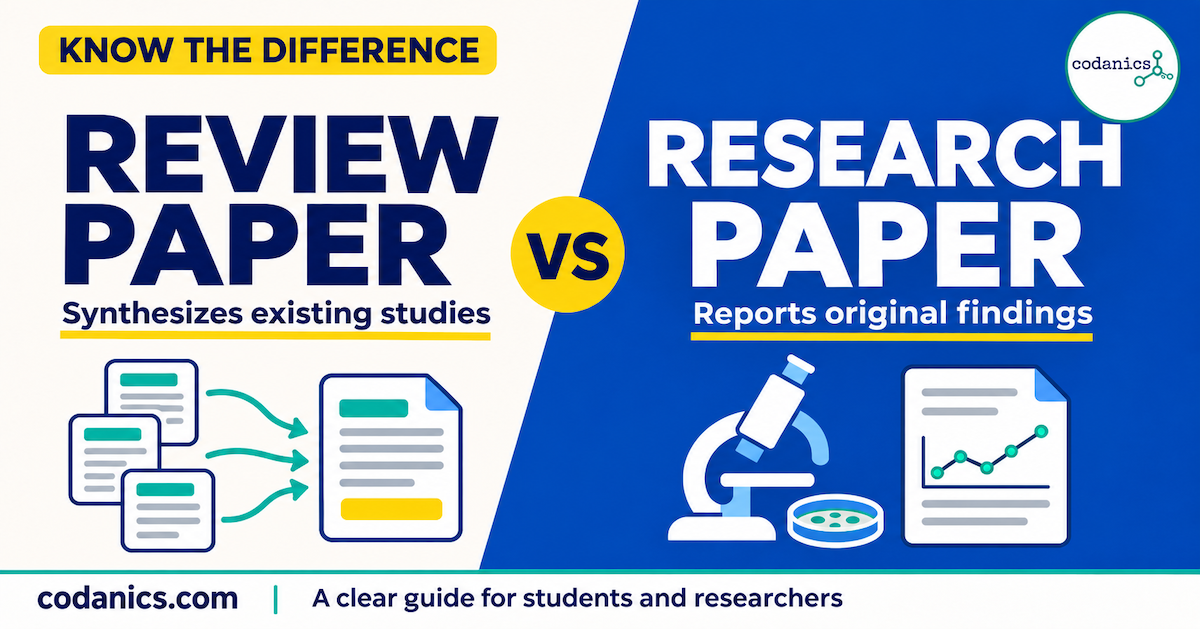
Subscribe on YouTubeThe main difference in review paper vs research paper is the source of the data. A research paper reports a new study: the authors collect their own data, analyse it and present new findings in the IMRaD format. A review paper collects, compares and evaluates studies that others have already published, so it creates no new data. In other words, a research paper is primary literature and a review paper is secondary literature. As a result, a research paper answers one specific question. A review paper, in contrast, maps a whole topic, shows what is known and points out the research gap.
Review paper vs research paper at a glance
Students often ask me which one they should write first, and how a review article really differs from a research article. This quick guide answers both questions in about ten minutes. First, read the comparison table. Then see the structure of each paper, the types of review and the most common mistakes. Finally, take the quiz. If you want the full method, read my complete scientific writing guide afterwards.
Review paper vs research paper: comparison table of 12 key differences
This table is the heart of the review paper vs research paper comparison. Each row shows one difference.
Purpose, data and method
| Difference | Research paper | Review paper |
|---|---|---|
| Main purpose | Reports a new study and its findings | Summarises, compares and evaluates published studies on a topic |
| Type of literature | Primary literature | Secondary literature |
| Source of data | New data you collect: experiments, surveys, field trials, models or analyses | Published papers are the data; no new data are collected |
| Research question | One specific question or hypothesis | A broad topic (narrative review) or one focused question (systematic review) |
| Structure | IMRaD: Introduction, Methods, Results, Discussion | Themed sections; a systematic review uses an IMRaD-like structure |
| Methods section | Always: how you did the study | Systematic and scoping reviews: search, screening, appraisal. Narrative reviews: brief or none |
Size, time and impact
Word counts and reference numbers are typical values. Your target journal’s guide for authors always decides.
| Difference | Research paper | Review paper |
|---|---|---|
| Typical length | About 3,000–6,000 words | About 5,000–10,000 words; mini reviews are shorter |
| Typical references | About 30–60 | About 80–200 or more |
| Figures and tables | Your results: graphs, statistics, maps and images | Summary tables, conceptual frameworks, PRISMA flow diagrams and forest plots |
| Time to complete | Months to years, including the study itself | Weeks to months for a narrative review; often a year or more for a systematic review |
| Who writes it | The people who did the study: students, supervisors and teams | Experts, often invited by journals; students too, with a supervisor |
| Citation impact | Depends on the findings and the field | On average higher; reviews are overrepresented among the most cited papers |
- A research paper creates new data; a review paper uses published studies as its data.
- A research paper follows IMRaD; a review paper is organised by themes, or by methods and results if it is systematic.
- Reviews are usually longer, cite more references and, on average, attract more citations.
What is a research paper?
A research paper, also called an original article or primary research article, reports a study that the authors designed and carried out themselves. It explains the question, the methods, the new results and what they mean.
Think of a research paper as a report of your own experiment, survey, field trial, model or data analysis. For example, “Effect of biochar on wheat yield under drought stress in Punjab” is a research paper. The authors grew the wheat, measured the yield and analysed the data. Most research papers follow the IMRaD structure: Introduction, Methods, Results and Discussion. In fact, IMRaD became the standard in medical journals in the late 20th century (Sollaci and Pereira, 2004).
Common types of research paper
- Original research article: the full report of a new study.
- Short communication or letter: a brief report of new, important findings.
- Case report: a detailed description of one patient, site or event.
- Methods or protocol paper: a new method, tool or planned study design.
Not sure which type fits your work? Try the free Article Type Selector. Then outline your research paper with the Manuscript Outline Generator and write a strong opening with the CARS Introduction Builder.
What is a review paper?
A review paper, also called a review article or literature review, collects, compares and evaluates studies that others have already published on one topic. It creates no new data. Instead, it shows what is known, where studies disagree and what research is still needed.
A good review paper is more than a summary. It organises the evidence, compares methods and results, judges the quality of the studies and ends with a clear research gap. For example, “Biochar and crop yield under drought: a review of field studies” is a review paper. The authors compared published field studies instead of growing any crops. Because of this, reviews are popular. A 2018 study found that review papers are overrepresented among the most cited papers (Miranda and García-Carpintero, 2018).
The first step of any review is a good literature search. My guide on how to use Google Scholar for literature search shows every search method. The free Literature Review Matrix helps you compare the papers you find.
Practise this step free: 🧮 Literature Review Matrix · 🧭 Review Type Selector · 🧠 Research Methods & Scientific Writing Quiz All writing tools →
Structure of a review paper vs research paper, side by side
The structure is the second big difference in review paper vs research paper writing. Both start with a title, an abstract and keywords, and both end with references. However, the middle is very different.
| Part | Research paper (IMRaD) | Narrative review paper | Systematic review paper |
|---|---|---|---|
| Introduction | Background, gap, aim and hypothesis | Why the topic matters and the aim of the review | Background, rationale and a focused question (often PICO) |
| Methods | Design, materials, sampling, procedures and statistics | Often brief or absent; good reviews still say how papers were found | Protocol, databases, search strings, screening, data extraction and risk of bias (PRISMA 2020) |
| Main body | Results: your new data in tables and figures | Themed sections, for example by method, crop, region or mechanism | Results: PRISMA flow, study characteristics and synthesis (meta-analysis if possible) |
| Discussion | Meaning of your results compared with other studies | Critical synthesis, controversies and the research gap | Certainty of evidence, limitations and implications |
| End | Conclusion and future work | Conclusions and future research directions | Conclusions for practice and research |
Practise this step free: 🗂️ Manuscript and Thesis Outline Generator · 🧭 CARS Introduction Builder · 💬 Discussion Section Builder · 🧠 IMRaD & Scientific Paper Structure Quiz All writing tools →
Six types of review paper
“Review paper” is a family name. In fact, one well-known typology describes 14 types of review (Grant and Booth, 2009). Students usually meet these six:
| Review type | What it does | Typical guideline |
|---|---|---|
| Narrative review | Summarises and discusses a topic broadly; author chooses the papers | SANRA quality scale |
| Mini review | A short narrative review of a narrow or new topic | Journal word limit |
| Systematic review | Answers a focused question with a reproducible search, screening and appraisal | PRISMA 2020 |
| Meta-analysis | Pools the numbers from several studies statistically | PRISMA 2020 |
| Scoping review | Maps how much research exists and where the gaps are | PRISMA-ScR |
| Umbrella review | Reviews existing systematic reviews | PRIOR |
To choose the right review type for your question, answer seven questions in the free Review Type Selector. For the full method, read my systematic review and meta-analysis guide.
Practise this step free: 🧭 Review Type Selector · 🔀 PRISMA Flow Diagram Generator · ☑️ CONSORT and PRISMA Checklist Tool · 🧠 Systematic Review & Meta-analysis Quiz All writing tools →
Review paper vs research paper: which one should you write first?
If you already have data from your thesis or project, write the research paper. If you do not have data yet, a review of your thesis topic is often the best first paper. Your literature review chapter is already half of it.
- You have finished your experiment, survey or analysis.
- Your results answer a clear question.
- Your supervisor agrees the data are complete.
- You are early in your MS or PhD and have read many papers.
- Your topic has many studies but no recent review.
- You can add a critical view, not only a summary.
However, check two things before you start a review. First, search Google Scholar and Scopus for a recent review on your topic. If one appeared in the last two or three years, narrow your angle. Second, check the journal: some journals invite reviews only from experts, so read the guide for authors. My PhD students usually publish a review from their literature chapter first and a research paper from their data later. Planning a PhD? See my PhD research proposal guide.
Practise this step free: 🗂️ Article Type Selector · 🗓️ Research Gantt Chart Maker · 🧠 Thesis Writing Quiz All writing tools →
Five common mistakes in review and research papers
- Calling a summary a review. A review paper must compare, judge and synthesise studies. A list of “Author A found… Author B found…” is not enough.
- Adding a review inside a research paper. The introduction of a research paper should be short and focused on your gap, not a mini review of the whole field.
- No search method in a review. Even a narrative review is stronger when it says which databases, keywords and years you used (SANRA, 2019).
- Repeating an existing review. Many reviews on the same question add little value (Ioannidis, 2016). Find your new angle first.
- Citing AI-invented or retracted papers. Check every reference with the free Reference Checker before you submit.
- Choose the paper type from your data: new data means a research paper, published studies mean a review paper.
- A strong review is critical and has a clear search method.
- Check for recent reviews and journal rules before you write.
Quiz: is it a review paper or a research paper?
Test what you learned about review paper vs research paper. Click an answer to see if you are right and why. Then try the longer Codanics quizzes below.
Part 1: spot the paper type
1The authors grew wheat in 30 plots, measured the yield and compared two fertilisers.
They collected new data from their own experiment, so it is a research paper (primary literature).
2The authors searched Scopus and PubMed, screened 1,200 records and pooled the results of 25 studies.
They used published studies as data and pooled them, so it is a review paper: a systematic review with a meta-analysis.
3Which one is primary literature?
A research paper reports original work, so it is primary literature. Reviews and textbooks are secondary.
4Which structure is typical of a research paper?
Research papers usually follow IMRaD: Introduction, Methods, Results and Discussion.
5A paper has the sections "Production", "Effects on soil", "Effects on crops" and "Future research", and no methods section.
Themed sections without a reproducible search method are typical of a narrative review.
Part 2: structure, reviews and your first paper
6Which review answers a focused question with a reproducible search, screening and quality appraisal?
A systematic review uses a planned, reproducible method and is reported with PRISMA 2020.
7Which paper usually has the longer reference list?
A review must cover the important studies on its topic, so it usually cites many more references.
8A team surveyed 400 university students about how they use AI tools.
A survey collects new data, so this is a research paper.
9Which type of review paper reviews existing systematic reviews?
An umbrella review (an overview of reviews) brings together the findings of existing systematic reviews.
10You are in the first year of your PhD. You have no data yet, but you have read 150 papers on your topic. What is often the best first paper?
Without data you cannot write a research paper yet. A review built from your literature chapter is often the best first paper, if no recent review covers the same angle.
Want more practice? Take the free IMRaD and Scientific Paper Structure Quiz, the Systematic Review and Meta-analysis Quiz or the Scientific Writing Master Quiz.
Video lessons on review papers and research papers
Now watch the difference explained in class. Start with the full Marathon class on research paper vs review paper, then watch the short lessons on review types.

Short lessons on review types


Write your paper or review step by step


Learn to write review and research papers with me
Reading about review paper vs research paper is the first step. Writing one with feedback is what gets you published.
- Research paper vs review paper, and how to choose your first paper
- Literature search with Google Scholar and AI tools
- Every section, from title and abstract to discussion and submission
- A writing task on your own manuscript in every class
Prefer to start free? Take the free course Using AI tools in Scientific Writing, or watch the free Scientific Writing Master Class. For systematic reviews, the Systematic Review & Meta-analysis course takes you from question to a publishable review.
Free tools and quizzes for review and research papers
- Article Type SelectorAnswer six quick questions to find the right article type for your work.Free tool
- Review Type SelectorChoose a narrative, scoping, systematic or umbrella review, or a meta-analysis, with its guideline.Free tool
- Manuscript and Thesis Outline GeneratorOutline an IMRaD paper, a review or a thesis chapter.Free tool
- Literature Review MatrixCompare the papers you read by aim, method, findings, limitations and gap.Free tool
- CARS Introduction BuilderBuild a research paper introduction move by move.Free tool
- Discussion Section BuilderWrite your discussion in the proven order.Free tool
- PRISMA Flow Diagram GeneratorMake a PRISMA 2020 flow diagram for a systematic review.Free tool
- CONSORT and PRISMA Checklist ToolTick off the reporting checklist for your trial or review.Free tool
- Research Gantt Chart MakerPlan your paper, thesis or review with a Gantt chart.Free tool
- Reference CheckerCatch fake, AI-invented and retracted references.Free tool
- IMRaD & Scientific Paper Structure QuizTitles, abstracts and the IMRaD structure.Free quiz
- Systematic Review & Meta-analysis QuizProtocols, PRISMA, screening and pooling.Free quiz
- Research Methods & Scientific Writing QuizStudy designs, sampling and writing basics.Free quiz
- Thesis Writing QuizChapters, word budgets and the literature review chapter.Free quiz
- Scientific Writing Master QuizEvery step from question to publication.Free quiz
All scientific writing tools and quizzes →
Latest from Codanics on research and writing
- 1
- 2How to Write a Systematic Review and Meta-Analysis: Step-by-Step GuideSystematic ReviewMeta-analysis
- 3
- 4
- 5
- 6
Updated automatically from codanics.com · All guides on the Codanics blog →
Links and sources
- 1A typology of reviews: 14 review typesGrant & Booth, Health Info Libr J 2009;26:91–108
- 2The IMRaD structure: a fifty-year surveySollaci & Pereira, J Med Libr Assoc 2004;92:364–367
- 3Overcitation of review papersMiranda & García-Carpintero, J Informetrics 2018
- 4SANRA: quality of narrative reviewsBaethge et al., Res Integr Peer Rev 2019;4:5
- 5The PRISMA 2020 statementPage et al., BMJ 2021;372:n71
- 6Time needed for systematic reviewsBorah et al., BMJ Open 2017;7:e012545
- 7Redundant systematic reviewsIoannidis, Milbank Q 2016;94:485–514
- 8PRISMA websiteChecklists and flow diagrams, including PRISMA-ScR
- 9Scientific Writing MarathonLive online classes: write your paper or review
- 10Using AI tools in Scientific WritingFree course with certificate
- 11Systematic Review & Meta-analysis courseSelf-paced, in Urdu/Hindi
- 12Book a one-to-one sessionConsultancy with Dr. Aammar Tufail: research, thesis, PhD, data science
Related guides on Codanics
- 1Scientific writing complete guideTheses, papers, reviews and meta-analysis
- 2Systematic review and meta-analysis guideFrom PICO question to PRISMA 2020
- 3Google Scholar for literature search12 search methods for your review or paper
- 4PhD research proposal guidePlan and write a strong proposal
- 5Postdoc research proposal guideProposals for fellowships and grants
- 6AI tools for students and academicsTools for research and study
- 7Conference posters with AI toolsPresent your research
- 8Scientific writing tools and quizzesFree tools for every step
Frequently asked questions about review paper vs research paper
The basic differences
What is the main difference between a review paper and a research paper?
A research paper reports a new study with data the authors collected themselves, usually in the IMRaD format. A review paper collects, compares and evaluates studies that others have already published, so it creates no new data. A research paper is primary literature; a review paper is secondary literature.
Is a systematic review a research paper or a review paper?
A systematic review is a review paper, because it uses published studies as its data. However, it follows a planned, reproducible method, so it is often called secondary research. A meta-analysis adds a statistical pooling of the results.
Does a review paper have a methods section?
Systematic, scoping and umbrella reviews always have a methods section that describes the search, screening and appraisal. Narrative reviews often have a short or no methods section, but a brief description of the databases, keywords and years makes them stronger.
Is a literature review chapter the same as a review paper?
Not exactly. A literature review chapter in a thesis supports your own study and ends with your research gap. A review paper is a stand-alone article for a journal, written for a wider audience. You can often turn the chapter into a review paper after updating the search and adding a critical synthesis.
Writing, citations and help
Is a review paper easier to write than a research paper?
Not really. A review paper needs no experiments, but it needs a careful literature search, critical reading of many papers and a clear synthesis. A systematic review can take a year or more. A review is easier to start, because you only need access to the literature.
Can MS or PhD students write a review paper?
Yes. Many MS and PhD students publish a narrative or systematic review from their thesis literature chapter, with their supervisor as co-author. First, check that no recent review covers the same angle, and read the journal's guide for authors, because some journals publish invited reviews only.
Which gets more citations, a review paper or a research paper?
On average, review papers get more citations, and they are overrepresented among the most cited papers. However, an important research paper can be cited far more than a weak review.
How many references does a review paper need?
There is no fixed number. Typical review papers cite about 80 to 200 or more references, while research papers often cite about 30 to 60. Always follow the limit in your target journal's guide for authors.
Where can I get help to choose and write my first paper?
Join the Scientific Writing Marathon on Codanics for live classes on writing research papers and reviews, or book a one-to-one session with Dr. Muhammad Aammar Tufail about your research project, thesis or PhD at mentorship.codanics.com/book.
About the author
Dr. Muhammad Aammar Tufail. Dr. Muhammad Aammar Tufail is the founder of Codanics and completed his PhD in a Marie Skłodowska-Curie programme. He has trained hundreds of students in scientific writing, literature search, systematic reviews and meta-analysis, and teaches research, AI, data science and bioinformatics in Urdu and Hindi.
See his research on Google Scholar and ResearchGate, and follow him on LinkedIn.
One-to-one sessions: you can now book consultancy sessions with Dr. Aammar Tufail about data science, your research project, mentorship, your PhD and Master’s thesis and much more at mentorship.codanics.com/book.
Last updated 24 November 2026. Word counts and reference numbers are typical values; always follow your target journal’s guide for authors.
