25 Marie Curie postdoc fellowships in cleantech: the C4W 2027 guide (Mons & Vaasa)
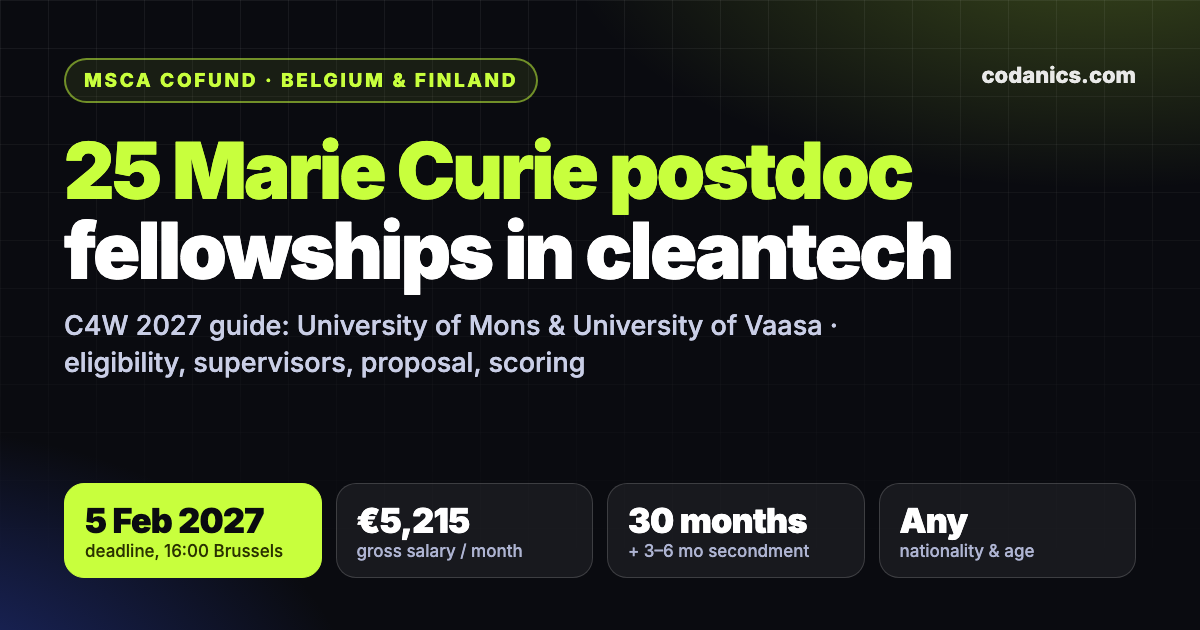
Cleantech4Wallonia/Vaasa (C4W) funds 30-month postdoctoral fellowships at the University of Mons in Belgium and the University of Vaasa in Finland, with a €5,215 monthly gross salary, a €15,000 research budget and a compulsory industry or academic secondment. Call 1 closes on 5 February 2027. This guide shows you who can apply, how to choose a supervisor, how to write each part of the 10-page proposal, and how the evaluators score it.
C4W is a Marie Skłodowska-Curie COFUND programme that funds 25 postdoctoral fellowships of 30 months in cleantech research: 15 at the University of Mons (Belgium) and 10 at the University of Vaasa (Finland). You can apply with a PhD of any nationality and at any career stage, as long as you have not lived or worked in the host country for more than 12 months between 5 February 2024 and 5 February 2027. You choose a supervisor from the C4W list and submit one 10-page proposal with a CV, your PhD degree and an ethics self-assessment by 5 February 2027 at 16:00 Brussels time.
| Programme | Cleantech4Wallonia/Vaasa (C4W), run by the University of Mons (coordinator) and the University of Vaasa |
|---|---|
| Funding | Co-funded by the European Union, Horizon Europe Marie Skłodowska-Curie Actions COFUND (Grant Agreement 101261746), a €6.27M programme |
| Fellowships | 25 in two calls (15 UMONS, 10 UVAASA); up to 13 in Call 1 and up to 12 in Call 2 |
| Research field | Any cleantech topic in three families: energy transition, sustainable resource management, and transforming economic and social sectors |
| Contract | 30-month full-time fixed-term contract, €5,215 gross per month, €500 net monthly mobility allowance, €350 net monthly family allowance if eligible, full social security |
| Who can apply | Experienced researchers of any nationality and age with a PhD by 5/2/2027, fluent in English, meeting the mobility rule |
| Deadline | Call 1: 5 February 2027, 16:00 Brussels time · Call 2 (planned): 15 September – 15 December 2027 |
| Start | Call 1 fellowships start between July and September 2027 |
| Official documents | Guide for Applicant (PDF) · mandatory proposal template (PDF) · evaluators’ code of conduct (PDF) · FAQ · C4W@umons.ac.be |
C4W in brief: what makes this postdoc fellowship different
C4W (Cleantech4Wallonia/Vaasa) launched its first call on 5 November 2026. It is jointly run by two mid-sized universities with around 1,500 senior researchers and 950 doctoral candidates between them, and both belong to the EUNICE European University alliance. You get one fellowship but access to two innovation ecosystems: Heart for Cleantech in Cœur du Hainaut (Wallonia) and Energy Transition Valley around the EnergyVaasa cluster in Finland.
C4W timeline: Call 1 and Call 2
From the deadline to the result takes about four months. The black line marks today. If you miss Call 1, or are not funded, you can apply again in Call 2.
Sources: Guide for Applicant (3 November 2026), section 1.2 and section 4, and the C4W call information page. Durations after the deadline are approximate; Call 2 dates are planned.
ChartsC4W in numbers
UMONS hosts 15 of the 25 fellowships and lists more supervisors. Supervisors are spread fairly evenly across the three cleantech families. Click a family to see its supervisors in the explorer below.
Supervisors by cleantech family
56 supervisors listed on 20 November 2026 · click a family to filter
Fellowships by host
Supervisors by university
What one fellowship is worth over 30 months
Per fellow, from the Guide for Applicant section 6.2. The family allowance applies only if you have a partner or dependent children; seed funding is competitive.
Map: Mons, Vaasa and the EUNICE alliance
The two big dots are your possible employers. The small dots are the eight other universities of the EUNICE alliance, whose joint seminars C4W fellows may join. Click a dot for details, or pick a place from the list.
Find your C4W supervisor among 56 PIs
Your Principal Investigator must come from the official list, and their university becomes your employer. Search by keyword, unit or name, and filter by cleantech family or university. The ideas shown are shortened from each supervisor’s “envisaged research project”.
No supervisors match your search. Try another word, or reset the filters.
Read the full profiles, contact details and project ideas on the official Our supervisors page. The list can change, so check it before you submit. Your Co-PI does not have to be on the list, and you may combine a PI at one university with a Co-PI at the other.
Who can applyC4W eligibility criteria and the mobility rule
C4W is open to experienced researchers of any nationality and any age, with no limit on the number of years since your PhD. An independent institution, the University of Luxembourg, double-checks eligibility and the cleantech topic in the week after the deadline.
The mobility rule, explained
The rule applies to the country of your recruiting host, which is the university of the PI you choose. If you have spent two years in Belgium, you cannot pick a UMONS PI, but you can still apply with a PI at the University of Vaasa. Short stays such as holidays do not count, and nor does time spent in a procedure to obtain refugee status.
In the online form you list every period and country where you lived or had your main activity in those three years. You do not upload proof at this stage, but HR may ask for contracts or residence certificates at any time before you sign.
Check your eligibility in 30 seconds
C4W documents and the online form
You submit one proposal per call through the C4W platform. It accepts the application only when every required field and file is there, but it does not check the content. Tick each item as you finish it; your progress is saved in this browser.
Submission helper: file names and character limits
Every file must be named Firstname_SURNAME_ACRONYM_DocumentName. Type your details to get the exact names, then paste your abstract, breakthrough statement and keywords to check them against the limits.
Your file names
Nothing you type leaves your browser. Choose keywords carefully: they decide which experts evaluate you.
How to write the C4W research proposal (10 pages)
The proposal follows the structure of a Marie Curie Postdoctoral Fellowship, with two extra demands: the cleantech dimension must be central, and evaluators look hard at valorisation and entrepreneurial potential. For a full walkthrough with examples, read our postdoc research proposal guide; the Postdoc Guide 2027 explains how MSCA fellowships work.
A suggested page budget for the 10 pages
Our suggestion, matched to the weights: Excellence and Impact count 40% each, Implementation 20%. The template does not fix page counts per section.
1. Excellence (40%, threshold 4.0 out of 5)
- 1.1 Objectives and state of the art: introduction, the research questions, methodology (with Open Science and FAIR data), preliminary results that show feasibility, and why the work goes beyond the state of the art. Mention the gender dimension if relevant.
- 1.2 Relevance to cleantech: name the environmental problem and show how your results lead to a cleaner or more resource-efficient solution, with measurable indicators such as lower emissions, energy, water or material use.
- 1.3 Secondment: what you will do there, why that host, and the intersectoral, interdisciplinary and international value.
- 1.4 Training and two-way transfer of knowledge: what you will learn from the hosts, and what you bring to them.
- 1.5 Quality of the researcher: why your background makes the project feasible, and how the fellowship makes you an independent researcher. It is read together with your CV.
Template: section 1.2, relevance to cleantech (click to open, then copy)
Cleantech family: [Energy transition / Sustainable resource management / Transforming economic and social sectors]

Environmental problem (2–3 sentences):
[e.g. Producing green hydrogen still relies on scarce platinum-group catalysts, which raises costs and the
material footprint of electrolysers in Europe.]

Our contribution (3–4 sentences):
[What the project develops (process, material, model, business model, policy tool) and how it reduces the problem.]

Measurable indicators (as a short list):
- [e.g. Target: 30% lower catalyst cost per kW compared with the 2026 benchmark]
- [e.g. Target: zero critical raw materials in the anode]
- [e.g. Life-cycle assessment of CO2-eq per kg H2 in WP3]

Sustainable conduct of the research (1–2 sentences):
[e.g. Green lab practices, train travel where possible, MSCA Green Charter principles.]
2. Impact (40%, threshold 3.5 out of 5)
- 2.1 Career prospects: how the project, training and secondment fit your CV and career goals inside or outside academia.
- 2.2 Scientific, economic and societal impact: specific effects of your project, not of the field in general, with target groups and links to the UN Sustainable Development Goals.
- 2.3 Valorisation and entrepreneurial potential: the main exploitable results, possible IP, licensing or spin-off, the proof of concept still needed, prior-art checks, and an industry collaboration plan.
- 2.4 Dissemination and communication: who hears about the results (peers, industry, policy makers) and how the public will understand them. Put every activity in the Gantt chart.
Template: section 2.3, valorisation and exploitation table
| Exploitable result | Users / market | Form of exploitation | Maturation still needed | IP strategy | When (WP, month) |
|---|---|---|---|---|---|
| R1: [new catalyst formulation] | [electrolyser makers] | [patent + licence] | [stability tests at pilot scale] | [prior-art search with KTO, M6; filing decision M18] | [WP2, M24] |
| R2: [open techno-economic model] | [regions, investors] | [open-source tool] | [validation with secondment host] | [open licence after KTO review] | [WP3, M27] |

Industry collaboration plan: [who, what they bring, how often you meet, what happens after the fellowship]
Link to entrepreneurship training: [Entrepreneurial Pathway modules, seed-funding application, market analysis]
3. Implementation (20%, threshold 3.5 out of 5)
- 3.1 Work plan: work packages, deliverables, milestones and the secondment in a Gantt chart over 30 months.
- 3.2 Risk management: a table of risks per work package with level and mitigation, including scientific, technical, cleantech-performance, IP, market, regulatory and scale-up risks.
Template: work packages for 30 months
WP1 Management, training and career development (M1–M30)
  D1.1 Data Management Plan (M6) · D1.2 Individual Development Plan (M3) · M1.1 mid-term review (M15)
WP2 [Research objective 1] (M1–M14)
  D2.1 [dataset / prototype / model] (M12) · M2.1 [go/no-go decision] (M10)
WP3 [Research objective 2] (M10–M26)
  D3.1 [validated result] (M24)
WP4 Secondment at [host] (3–6 months, between M6 and M24, e.g. M16–M20)
  D4.1 [market-oriented mini-project report] (M21)
WP5 Valorisation, dissemination and communication (M1–M30)
  D5.1 [patent decision / spin-off plan] (M24) · D5.2 [open-access papers, public event] (M30)

Risk table: | Risk | WP | Likelihood/impact (H/M/L) | Mitigation |
🧰 Map the state of the art with the free literature review matrix, sharpen objectives with the hypothesis and objectives builder, format references with the citation generator, and cut filler with the wordiness checker.
4. CV (max 5 pages) and the generative AI rules
The CV is part of the template and is read with section 1.5. List your five most important publications with a short note on their impact (citations without self-citations), plus patents, invited talks, funding, supervision, teaching and any career breaks. Mark entries that do not apply as “not applicable”.
Template: generative AI disclosure for the cover page
Use of generative AI
Tools used: [e.g. ChatGPT (GPT-x), DeepL Write, Grammarly]
How they were used: [e.g. language editing of sections 1.1 and 2.4; no AI-generated scientific content or references]
Verification: I checked all generated text and every citation against the original sources and corrected errors.
Sources: [list sources used to generate content or citations, or "No content or citations were generated by AI"]
Intellectual property: I checked that no substantial text from other authors was reproduced.
Limitations: I am aware that these tools can produce biased, incorrect or incomplete content; I take full
responsibility for the whole proposal.
🧰 Build the CV with the academic CV builder and publication list formatter, and check length with the academic word counter.
Contacting a C4W supervisor and choosing a secondment
You may contact potential supervisors, but only about science: the research topic, their expertise and the available infrastructure. They cannot draft or review your proposal, and no pre-approval exists or is needed. It is your job to confirm that the equipment and resources your project needs will be available.
Template: first e-mail to a C4W supervisor (scientific only)
Subject: C4W Call 1 – scientific question about [topic] in your unit

Dear Professor [Surname],

I am a [postdoc / researcher] in [field] at [institution], and I plan to apply to C4W Call 1 with a project on
[one-line idea], within the [cleantech family] family.

Your envisaged project on [their topic from the C4W page] and your work on [one specific paper] are close to my
expertise in [method/system]. Before writing my proposal, I would like to ask two scientific questions:
1. Is [specific equipment, software or dataset] available in your unit for a 30-month project?
2. Would [specific research direction] fit the current activities of your group?

I attach my CV and a half-page summary of the research idea. I understand that supervisors cannot help draft the
application; I only wish to check scientific fit and infrastructure.

Kind regards,
[Name] · [ORCID] · [website]
🧰 Write a polite first message with the email to professor generator, and keep your contacts and deadlines in the application tracker.
SelectionHow C4W proposals are evaluated and scored
- Eligibility checkAbout 1 week after 5 Feb, cross-checked by the University of Luxembourg
- Peer review and consensus3 external experts per proposal, about 10 weeks
- Ethics review and shortlistAbout 4 weeks; the top 25 proposals meeting all thresholds
- Interview and decision20-minute online interview; results by the end of May 2027
| Criterion | What evaluators look at | Threshold | Weight |
|---|---|---|---|
| 1. Excellence | Quality, rigour, relevance and novelty of the objectives; relevance to cleantech; the secondment; training and two-way knowledge transfer; your publication and patent record and potential to become independent | 4.0 | 40% |
| 2. Impact | Career value of the fellowship (fit with your CV, networking plan, mobility and secondment); scientific, societal and economic impact (patents, spin-off potential, industry plan, market fit, sustainability); valorisation; dissemination and communication | 3.5 | 40% |
| 3. Implementation | Clarity, coherence and feasibility of the work plan and timeline; available resources; risk mitigation | 3.5 | 20% |
Try it: your C4W score calculator
Move the sliders to see how the thresholds and weights combine. The final score is 80% proposal + 20% interview.
If two proposals tie, the one with the higher Excellence score ranks first, then Impact, then Implementation. Everyone receives an Evaluation Summary Report with scores, strengths and weaknesses, which helps if you re-apply in Call 2.
What the evaluators’ code of conduct means for you
How to prepare for the 20-minute C4W interview
The 25 shortlisted applicants are interviewed online by the same three evaluators who scored the proposal: a 5-minute pitch followed by 15 minutes of questions. They give a score from 0 to 5, worth 20% of your final score.
- Pitch in five slides, five minutes: the environmental problem, your idea and breakthrough, the work plan with the secondment, the impact and valorisation route, and why you.
- Read your Evaluation Summary Report critically: the panel already knows your proposal’s weaknesses, so prepare answers to them.
- Expect questions on measurable cleantech indicators, IP and spin-off potential, the secondment host’s role, risks and plan B, and your career plan after 30 months.
- Rehearse out loud in English with a timer, and test your camera, microphone and screen sharing the day before.
🧰 Practise with the free research interview questions tool and time your pitch with the Pomodoro timer.
Your contractC4W salary, research budget and career support
Fellows sign a 30-month full-time fixed-term employment contract with UMONS or UVAASA, using the same template and salary scale at both universities. Social security covers health, unemployment and pension under Belgian or Finnish law, and paid leave is 25 days in Belgium or 30 days in Finland.
Gross salary is before tax and social contributions; allowances are paid net. Your take-home pay depends on Belgian or Finnish tax rules.
Career development in C4W
An 11-week plan to submit before 5 February 2027
- Week 1 · 20–26 NovRead and check. Read the Guide for Applicant and the template, run the eligibility checker above, and pick your cleantech family.
- Weeks 2–3 · 27 Nov – 10 DecChoose a PI. Shortlist 2–3 supervisors in the explorer, read their recent papers, and send a short scientific e-mail.
- Week 4 · 11–17 DecFix the idea. Objectives, research questions, acronym, Co-PI, and a first contact with a secondment host.
- Weeks 5–6 · 18–31 DecWrite Excellence. Sections 1.1–1.5 with the cleantech indicators, plus your 5-page CV.
- Week 7 · 1–7 JanWrite Impact. Career value, impact narrative, valorisation table and dissemination plan.
- Week 8 · 8–14 JanWrite Implementation. Work packages, Gantt chart with the secondment, and the risk table.
- Weeks 9–10 · 15–28 JanEthics, AI and feedback. Ethics self-assessment, AI disclosure and online fields. Get feedback from a mentor or colleague (not your C4W PI), then trim to 10 pages.
- Week 11 · 29 Jan – 3 FebSubmit early. Final PDFs with correct file names, submit by 3 February, and re-submit if you improve anything before 16:00 on 5 February.
Test yourself: are you ready to apply to C4W?
Ten quick questions on the rules that most often cost applicants their fellowship. Click an answer to see the explanation.
More free Codanics quizzes
See all free Codanics quizzes.
LearnVideos to help you apply
The official programme overview from the University of Mons, plus free lessons from the Codanics YouTube channel on Marie Curie applications and proposals, in Urdu/Hindi. Videos load only when you press play.



Free tools for your C4W application
Free, no login, and everything runs in your browser. See all Codanics tools
- 📚Literature review matrixState of the art for section 1.1
- 🎯Hypothesis and objectives builderClear, testable objectives
- 🔖Citation generatorReferences in one consistent style
- 📄Academic CV builderDraft your 5-page CV
- 📑Publication list formatterA complete, tidy publication list
- ✂️Wordiness checkerFit everything into 10 pages
- 🔢Academic word counterCheck section lengths
- 📧Email to professor generatorA polite first e-mail to a PI
- 🎤Research interview questionsPractise for the 20-minute interview
- 📋Application trackerDeadlines, contacts and documents
- 📎Merge PDFCombine the diploma and its translation
- 🗜️Compress PDFKeep the degree under 10 MB
- 🖼️Images to PDFTurn scans into a PDF
- 💶Study abroad cost calculatorBudget for Mons or Vaasa
Related guides on Codanics
- 🧪Postdoc Guide 2027: find a funded postdoc and win the MSCA Postdoctoral FellowshipThe complete postdoc roadmap
- 📝How to write a postdoc research proposal: step-by-step guide and templateExcellence, Impact and Implementation in detail
- 🇪🇺TERRA-MED: 33 Marie Curie PhD positions in France and SpainAnother MSCA COFUND call, for PhD candidates
- 🎓All Marie Curie PhD positions 2026–27Funded MSCA PhDs across Europe
- 🔬How to write a research proposalFind a real research gap
- ✍️Scientific writing complete guideWrite clearly for evaluators
- 📄CV, motivation letter, SOP and LOR guideTemplates and real examples
- 🔎Successful scholarship huntingWhere to find funded positions
- 🤝LinkedIn networking guideReach supervisors professionally
- 🏫Scholarships and Fellowships in Europe (course)Step-by-step application support
Official C4W links
- 🌐C4W websiteNews, timeline and contact
- ♻️What’s C4WSecondment, entrepreneurship, cleantech definition
- 📅Call informationAgenda, eligibility and documents
- 👩🔬Our supervisorsProfiles and envisaged projects
- 📘Guide for Applicant (PDF)The official rules of Call 1
- 🧾Research proposal template (PDF)Mandatory layout and sections
- ⚖️Evaluators’ code of conduct (PDF)Independence, conflicts and confidentiality
- ❓Official FAQUpdated during the call
C4W FAQ
What is C4W?
C4W (Cleantech4Wallonia/Vaasa) is a Marie Skłodowska-Curie Actions COFUND programme co-funded by the EU under Horizon Europe (Grant Agreement 101261746). It is run by the University of Mons in Belgium, as coordinator, and the University of Vaasa in Finland, and funds 25 postdoctoral fellowships of 30 months in cleantech research through two calls.
When is the C4W deadline?
Call 1 opened on 5 November 2026 at 09:00 and closes on Friday 5 February 2027 at 16:00 Brussels time (UTC+1). The platform closes automatically, and no extension is given except for a technical failure of the platform. Call 2 is planned to open on 15 September 2027 and close on 15 December 2027.
How many C4W fellowships are available?
25 in total: 15 hosted by UMONS and 10 by UVAASA. Up to 13 are offered in Call 1 and up to 12 in Call 2.
Who can apply to C4W?
Experienced researchers of any nationality and any age who hold a doctoral degree at the call deadline, are fluent in English, meet the MSCA mobility rule, and propose a 30-month cleantech project with a 3–6 month secondment. There is no limit on the number of years since the PhD.
What is the C4W mobility rule?
You must not have resided or carried out your main activity (work, studies) in the country of your recruiting host for more than 12 months between 5 February 2024 and 5 February 2027. The country is Belgium if your PI is at UMONS and Finland if your PI is at UVAASA, so a researcher based in one host country can still apply to the other. Short stays such as holidays and time in a refugee-status procedure do not count.
Can I apply if I have defended my PhD but have not received the diploma?
Yes, if you upload an official statement that gives the date of the defence and confirms that the PhD has been granted unconditionally, with no major or minor corrections or other conditions remaining. If you are unsure whether your document qualifies, contact the helpdesk at C4W@umons.ac.be before the deadline.
Which documents do I need?
The online administrative form with your places of activity for the last three years, a copy of your PhD degree, a research proposal of at most 10 pages on the mandatory template, a CV of at most 5 pages with a full publication list, and an ethics self-assessment. In the form you also give an acronym and title, a cleantech family, an abstract of up to 1,000 characters, a 600–800 character breakthrough statement, 5–7 keywords, your PI and Co-PI, your secondment host, and up to five excluded evaluators.
How much is the C4W salary?
The monthly gross salary is €5,215, plus a net mobility allowance of €500 a month for every fellow and a net family allowance of €350 a month for fellows with a spouse, recognised partner or dependent children. Each fellow also has a €15,000 research budget, a €3,000 travel allowance and a €2,800 external training envelope.
How are C4W proposals evaluated?
Three external experts score each proposal from 0 to 5 on Excellence (threshold 4.0, weight 40%), Impact (threshold 3.5, weight 40%) and Implementation (threshold 3.5, weight 20%). The top 25 proposals that meet all thresholds are interviewed online for 20 minutes, a 5-minute pitch and 15 minutes of questions. The final score is 80% proposal and 20% interview.
Can my supervisor help me write the proposal?
No. You may contact potential supervisors about the research topic, their expertise and the available infrastructure, but they cannot draft or review the application, and no pre-approval is needed. Your PI must be on the C4W list of supervisors; your Co-PI does not need to be.
Can I submit more than one proposal?
No, one proposal per call. You can edit and re-submit it as many times as you need before the deadline, and only the last version counts. If you are not funded in Call 1, you can apply again in Call 2.
Do I need reference letters?
No. The C4W FAQ states that letters of recommendation are not required.
Do I need an English certificate?
The Guide for Applicant asks applicants to be fluent in English but does not request a certificate. The proposal, the online form and the interview are all in English.
Can I use ChatGPT or other AI tools for my proposal?
You may, but you remain fully responsible for the content. On the cover page you must disclose which tools you used and how, confirm you checked the content and citations, list the sources, check that no text was copied from other authors, and acknowledge the tools' limitations.
What is the secondment?
Every fellow spends 3 to 6 months at an academic or non-academic organisation, ideally in another country, between months 6 and 24 of the fellowship. It can be split into shorter periods. At application you name the host and the secondment supervisor; no letter of support is required.
No questions match. Try another word, or check the official FAQ.
Ready to apply? Go to the official C4W website
Download the mandatory template, check the latest guide and supervisor list, and submit your proposal only through the official platform.
About the author. Dr. Muhammad Aammar Tufail is the founder of Codanics and completed his PhD in a Marie Skłodowska-Curie programme. He helps researchers prepare PhD, postdoc and fellowship applications and teaches research, AI and data science in Urdu and Hindi.
This guide is based on the C4W website and the Guide for Applicant (version 1.0, 3 November 2026), the proposal template and the evaluators’ code of conduct. Rules and the supervisor list can change; always check the official documents before you submit. Codanics is not part of the C4W programme.
