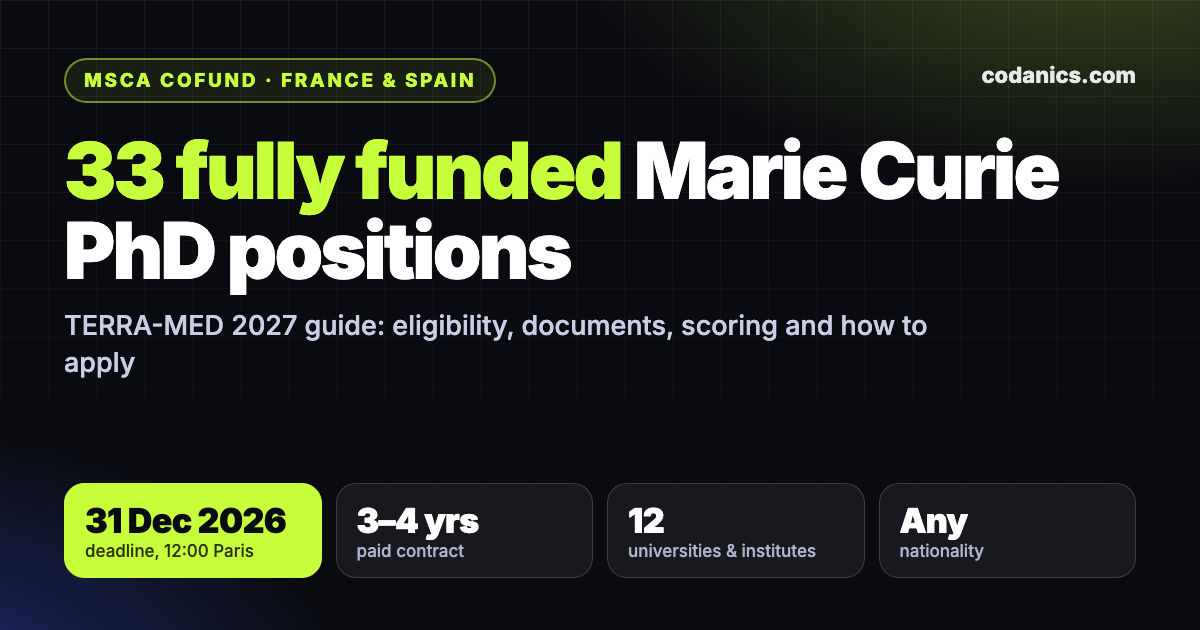
Applications open · MSCA COFUND · France & Spain 33 fully funded Marie Curie PhD positions in France and Spain: the TERRA-MED 2027 guide The TERRA-MED doctoral programme has published 33 PhD offers on water, environment, food and energy across Occitanie, Catalonia and the Balearic Islands. Applications are open until 31 December 2026. This guide shows you who can apply, how to prepare every document, how candidates are scored, and how to find the right position. Apply on the TERRA-MED portal ↗ Explore the 33 positions ↓ Check your eligibility ↓ Time left to applyDeadline: 31 Dec 2026, 12:00 Paris –days–hours–min–sec 📅 Free online info session: 25 November 2026, 14:00–15:30 (Paris time), on the administrative and legal side of applying. Register here ↗ 33fully funded PhD positions 12universities and research centres 3–4 yrsemployment contract (36 or 48 months) 3regions: Occitanie, Catalonia, Balearic Islands 2supervisors from two regions, plus a mentor 9–12 mostay at your co-supervising institution ~180 hof training, including five 5-day schools Anynationality, with a mobility rule By Dr. Muhammad Aammar TufailCodanicsUpdated 20 November 2026About 20 min read The short answerTERRA-MED is a Marie Skłodowska-Curie COFUND doctoral programme that recruits 33 PhD candidates of any nationality for 3- or 4-year paid contracts at 12 universities and research centres in France and Spain. To apply you need a master's degree by 31 December 2026, no PhD, English at B2 level, and no more than 12 months spent in the host country (France or Spain) in the last three years. You apply online by 31 December 2026 at 12:00 Paris time with a narrative CV, a cover letter, a short essay on the research topic, your degree and transcripts, English evidence and proof of residence. Key facts: TERRA-MED call for PhD candidates 2026–2027 ProgrammeTERRA-MED, the Euroregional PhD Program in Science and Environment, coordinated by the Euroregion Pyrenees–Mediterranean FundingCo-funded by the European Union, Marie Skłodowska-Curie Actions COFUND (HORIZON-MSCA-2025-COFUND-01, Grant Agreement 101261763) Positions33 PhDs: 15 in Catalonia, 14 in Occitanie, 4 in the Balearic Islands (19 in Spain, 14 in France) Research areasThe Water–Land–Energy nexus: water, environment and biodiversity, food and agriculture, energy and hydrogen, chemistry and materials, digital and societal transitions ContractFull-time employment contract of 3 or 4 years, gross salary above the MSCA COFUND minimum, full social security, tuition and visa fees covered Who can applyEarly-stage researchers of any nationality with a master's by 31/12/2026, no PhD, English B2 and the mobility rule met Deadline31 December 2026, 12:00 noon (Paris time), on the official application portal StartSeptember/October 2027 Official documentsGuide for Applicants (PDF) · the 33 PhD offers · FAQ · questions: terramed@euroregio-epm.eu In this guide 33 PhD positions now published Timeline: from the call to your first day The call in numbers (charts) Interactive map of the consortium Explore and filter the 33 positions Eligibility and the mobility rule (with checker) How to prepare each document How candidates are scored The 25-minute interview Contract, salary and mobility Training programme A 6-week plan to the deadline Test yourself: 10-question quiz Videos, tools and guides FAQ News 33 PhD positions now published: applications open on 15 October 2026 The wait is over for early-career researchers looking for their next academic challenge. The 33 fully funded PhD positions of the TERRA-MED doctoral programme are now published on the TERRA-MED website, so you can explore every project in detail and find the one that best matches your background and research interests. The call opened on 15 October 2026 and closes on 31 December 2026 at 12:00 noon (Paris time). Each PhD offer gives you what you need to decide: the research topic, the host institution and research unit, the supervisor and co-supervisor, the research disciplines and keywords, and the partner institutions involved. Read the full description of a position before you write your application, because your essay must show that you understand that specific project. The positions cover a wide range of fields, from water management and treatment, environment and biodiversity and food and agriculture to energy, hydrogen and decarbonisation, plus chemistry, materials and digital transitions. They are hosted by universities and research institutes in France and Spain, and every project is cross-border: you work with a supervisor in one region and a co-supervisor in another. What each offer showsBefore you applyTopic and description, host institution and unit, supervisor and co-supervisor, disciplines and keywords, partner institutions, and indicative mobility and secondment plans. Where to applyOnline portal onlyApplications sent by email, post or any other channel are not considered. Use the TERRA-MED portal. LanguageEverything in EnglishAll sections and documents must be in English. Add informal translations for degrees, transcripts, certificates and proof of address. Join the info session. The TERRA-MED team runs a free online session on 25 November 2026, 14:00–15:30 (Paris time) about the administrative and legal side of applying, with live questions. It does not cover scientific questions about individual offers; for those, read the offer and contact the supervisor. Register for the info session. Key dates TERRA-MED timeline: from the call to your first day The selection takes about six months, and contracts start in September or October 2027. The black line marks today. Source: Guide for Applicants (version of 14 October 2026), sections 3 and 12. Dates after the deadline are indicative. Charts The TERRA-MED call in numbers Water and energy offer the most positions, Spain hosts slightly more than France, and the Université de Toulouse is the largest single host. Click a bar to see those positions in the explorer below. Positions by research theme33 positions in 6 themes · click a theme to filter By regionBy country Positions by host institutionBlue = France, orange = Spain · click an institution to filter Map Interactive map of the TERRA-MED consortium TERRA-MED connects 12 employing universities and research centres across the Euroregion Pyrenees–Mediterranean, coordinated from Perpignan. Bigger dots host more positions. Click a dot to see its projects, or pick an institution from the list. Load the interactive map All🇫🇷 Occitanie🇪🇸 Catalonia🏝️ Balearic Islands Occitanie (France)Catalonia (Spain)Balearic Islands (Spain)CoordinatorLocations are approximate (main campus). Map data © OpenStreetMap contributors. The programme also has 14 associated (non-academic) partners, such as companies, agencies and public administrations, which host the 3–6 month secondments. See the official consortium map for the full list. Find your PhD Explore and filter the 33 TERRA-MED PhD positions Search by keyword, city, institution or supervisor, and filter by theme or country. Each card links to the official offers page, where you can open the full PDF for that position. Search the 33 positions 🌍 Both countries🇫🇷 France (14)🇪🇸 Spain (19) No positions match your search. Try another word, or reset the filters. Titles are shortened. Always read the full offer on the TERRA-MED website, including the salary, the duration (36 or 48 months), and the planned mobility and secondment. Who can apply TERRA-MED eligibility criteria and the mobility rule TERRA-MED is open to early-stage researchers of any nationality. Four conditions decide whether your application is even evaluated. They are checked in January 2027, and an application that fails one of them is rejected without being scored. 1Master's degree by 31 Dec 2026A master's or equivalent diploma by the call deadline, and eligibility to enrol in a doctoral programme at the host institution. This is strictly enforced. If you finish by 31 December, an official completion certificate from your university can be accepted. 2No doctoral degreeYou must not already hold a PhD. 3Mobility rule: 12 of 36 monthsNo more than 12 months living or carrying out your main activity (work, studies) in the employing country between 31/12/2023 and 31/12/2026. 4English at B2TOEFL, TOEIC, IELTS, Cambridge or Duolingo (100+), a letter that your master's was taught in English, or other official proof. Expired certificates are accepted. The mobility rule, explained The rule applies to the country of the position, not to Europe as a whole. For a position hosted in France, only time in France counts; for a position hosted in Spain, only time in Spain counts. Time as a tourist, as a refugee or in national service does not count as residence. So a candidate who did a master's in Spain can still apply to the 14 French positions. Example: 10 months in Spain between 31/12/2023 and 31/12/2026 31 Dec 202336 months31 Dec 2026 10 of 36 months in Spain (green) is under the 12-month limit, so this candidate can apply to Spanish and French positions. With 13 months or more in Spain, only the French positions would be open. For the application you prove your main country of residence for 2024, 2025 and 2026 with documents such as utility bills, rental contracts, university registrations or work contracts, all combined in one PDF. Check your eligibility in 30 seconds 1. Will you hold a master's degree (or equivalent) by 31 December 2026? Yes, I already have it I will finish by 31 December 2026 (completion certificate) No, I will finish later 2. Do you already hold a PhD? No Yes 3. Months you lived, worked or studied in each country between 31/12/2023 and 31/12/2026 🇫🇷 France (months)🇪🇸 Spain (months) 4. Your English evidence B2 certificate (TOEFL, TOEIC, IELTS, Cambridge, Duolingo 100+) University letter: my master's was taught entirely in English Native speaker, or master's from the UK, Ireland, Canada, USA, Australia or New Zealand I don't have evidence yet Your application How to prepare your TERRA-MED application documents You submit six items through the portal. Three are written directly in the portal (CV, cover letter, essay) and three are PDF uploads. Tick each one as you finish it; your progress is saved in this browser. 1. Narrative CV (written in the portal)Academic education, a CV summary (maximum 2 pages) and up to 5 relevant contributions, each with title and reference, description and relevance, your role, and a URL or DOI.Not a Europass or standard CV. 2. Cover letter (motivation questions in the portal)Personal introduction, qualifications and achievements, career goals, and why TERRA-MED and this position.Worth up to 25 of 100 points in the remote evaluation. 3. Essay: understanding of the research topicThe broader context, key challenges and scientific relevance of the project, plus your related research and professional experience, conferences and international programmes. 4. Master's degree and transcripts (PDF)Copy of the degree (or official completion certificate) and the transcript of records, with informal English translations in the same PDF. 5. English B2 evidence (PDF)Certificate, English-taught master's letter or other official proof; not needed if you are exempt. Add a translation in the same PDF if it isn't in English. 6. Mobility rule proof: one PDF for 2024, 2025 and 2026Documents showing your main country of residence each year (bills, rental contract, university registration, employment contract), translated where needed.Merge everything into a single PDF. Late or incomplete applications are not considered, and you cannot add documents after the deadline. Plan to submit at least two days early: the deadline is at 12:00 noon Paris time on 31 December, not midnight. 1. The narrative CV: show potential, not a long list TERRA-MED asks for a narrative CV: instead of listing everything you have done, you explain your path and your best work in sentences. Evaluators score education (up to 40 points) and research and working experience (up to 35 points) mostly from this CV, so it carries most of your remote-evaluation score. Academic education: degrees, institutions, dates and specialisation. Add your grade or class rank if it is strong, and your master's thesis title. CV summary (maximum 2 pages): your research story in short paragraphs, covering what you studied, the skills you built, the labs and countries you worked in, and where you want to go. Up to 5 relevant contributions: papers, your master's thesis, conference talks or posters, datasets, software, technical reports, patents, outreach or awards. Choose the five that best match the project, not simply the five most recent. Template: one "relevant contribution" (click to open, then copy)CopyTitle and reference: [e.g. Master's thesis "Removal of microplastics in constructed wetlands", University of X, 2025, grade 18/20] or [Author A, You B (2025). Title. Journal, 12, 45–60] Description and relevance (3–4 sentences): [What the work was about and what you found, in plain words.] [Why it matters for the TERRA-MED project you are applying to: the method, system or question it shares.] Your role: [What YOU did: designed the experiment, collected samples, analysed data in R, wrote the first draft, presented the poster…] Link: [DOI or URL, if available] Weak"Master's thesis on wastewater. Used various lab techniques. Good results."Strong"In my master's thesis I measured pathogen removal in three pilot treatment wetlands over six months (qPCR, 120 samples) and modelled removal rates in R. This is the exact system studied in offer UT6, and I would bring hands-on sampling and modelling experience from day one." 🧰 Draft the content first with the free academic CV builder and publication list formatter, then rewrite it as narrative text in the portal. Cut filler with the wordiness checker and count words with the academic word counter. 2. The cover letter: motivation, fit and career goals The cover letter is worth up to 25 points and covers your interest and motivation to join the programme, your choice of PhD project and your career objectives. It is written in the portal, as answers to the motivation questions. Outline: TERRA-MED cover letter in five paragraphsCopy1. Who you are (2–3 sentences) Your degree, institution and the research question that drives you. 2. Why this project (4–5 sentences) Name the offer (reference + title), the problem it tackles and the specific part that excites you. Show you read the description: mention one method, site or question from the offer. 3. Why you (4–6 sentences) Two or three concrete achievements that prepare you for THIS project (methods, field work, data, papers). Link each one to a task in the project. 4. Why TERRA-MED (3–4 sentences) The cross-border co-supervision, the 9–12 month stay in the other region, the non-academic secondment, the training schools. Say what you want to learn from each. 5. Career goal (2–3 sentences) Where you see yourself in 5 years (academic, industry, policy) and how this PhD gets you there. 🧰 Structure it with the motivation letter builder or cover letter builder, then check it with the SOP checker. The CV, motivation letter, SOP and LOR guide has full examples. 3. The research topic essay: prove you understand the project This short essay shows that you understand the research topic: its broader context, its key challenges and its scientific relevance. It is also the place for your related research experience, conferences and international programmes. Write it for the specific offer you choose. Outline: research topic essayCopyTitle: [Offer reference] – [Offer title] 1. Context (1 paragraph) The big problem in the Mediterranean (water scarcity, wildfires, decarbonisation…) with 1–2 recent facts and references. 2. State of knowledge and gap (1–2 paragraphs) What recent studies (last 3–5 years) show, and what is still unknown. Cite 4–8 key papers, including at least one from the supervisor or co-supervisor. 3. Key challenges (bullet points or 1 paragraph) The scientific and practical difficulties the project must solve (methods, data, scale, cross-border aspects). 4. Scientific relevance and impact (1 paragraph) Why answering this matters for science, for the Water–Land–Energy nexus and for society. 5. Your fit (1 paragraph) Your relevant experience, skills, conferences, summer schools or exchange programmes, and what you would contribute in the first year. References: [5–10, one consistent style] 🧰 Map the literature with the literature review matrix, format references with the citation generator, and sharpen the research question with the hypothesis and objectives builder. The PhD research proposal guide explains how to find a real research gap. 4–6. Degree, English and residence proof: the PDF uploads Degree and transcripts: scan in colour, upload as PDF, and put the informal English translation in the same file. If you are still finishing, ask your university now for an official completion certificate dated before 31 December 2026. English: if you have no certificate, the Duolingo English Test (score 100 or more) can be taken online and results usually arrive within a few days. Book it early in December at the latest. Mobility proof: collect one or more documents per year for 2024, 2025 and 2026, add translations, and merge them into one PDF. 🧰 Combine and shrink files privately in your browser with merge PDF, images to PDF (for phone photos of documents) and compress PDF. Convert grades with the grade converter and test scores with the IELTS to TOEFL converter. Selection How TERRA-MED candidates are selected and scored Selection runs in four phases. After the eligibility check, the selection committee scores your written application; the best candidates are interviewed; and the final ranking decides the offers. Application and eligibility check15 Oct – 31 Dec 2026, check in January 2027 Remote evaluationFebruary – April 2027: CV, experience and cover letter scored out of 100 Preselection and interviewsApril – May 2027: 25-minute online interview in English NotificationJune 2027: results by email and on the website Remote evaluation: 100 points, threshold 70Candidates with at least 70/100 are eligible for ranking; the highest scorers are invited to interview. Education · 40Research & work experience · 35Cover letter · 25 Threshold 70 Education (0–40, priority 1): excellence of your bachelor's and master's and how well they fit the project.Research and working experience (0–35, priority 2): previous research in different labs, mobility, publications and awards, conferences, international programmes such as Erasmus.Cover letter (0–25, priority 3): interest and motivation, your choice of project, career objectives. Interview: 100 points, threshold 7525-minute online interview in English: your presentation, then questions and answers. Presentation & research skills · 50Interpersonal skills · 30Communication · 20 Threshold 75 Presentation and research skills (0–50): scientific excellence, motivation, potential as a future lead researcher, quality of answers, fit for the position and career plans.Interpersonal skills (30): professional attitude, teamwork, reliability, motivation.Communication (20): English and oral communication. TiesWho wins a draw?Tied candidates are separated by their research experience and technical skills score, then motivation, then academic background. Reserve listNot selected first time?A reserve list follows the final ranking. If a selected candidate declines, the next on the list gets the offer. The committee may also invite you to interview for another project. RedressThink there was an error?You have 10 working days after each result email to request a review at terramed@euroregio-epm.eu. Interview How to prepare for the 25-minute TERRA-MED interview The interview is online and in English. You present your academic background, research experience and motivation, then answer questions on your understanding of the project and what you could contribute. If you are not currently doing research, you are encouraged to share experiences and skills that show your scientific potential. Prepare an 8–10 minute talk with 5–7 slides: who you are, your best research result, why this project, your first-year plan, and your career goal. Read the supervisors' recent papers, and be ready to say how your skills connect to them. Practise out loud in English, timed, and record yourself once. Half of the points are for presentation and research skills, and a fifth for communication. Prepare answers for: Why this project? Why cross-border research? What would you do if your main experiment failed? Where do you see yourself in five years? Check your setup: quiet room, good light, stable internet, camera at eye level, and slides ready to share. 🧰 Practise with the free PhD interview questions tool, and time your slots with the Pomodoro timer. Your contract TERRA-MED contract, salary, supervision and mobility Fellows are hired on a full-time employment contract of 3 or 4 years, depending on the host institution, with a gross monthly salary above the MSCA COFUND minimum, full social security (pension, health, parental leave, accident, unemployment and disability), paid annual leave, and university tuition and visa fees covered. Candidates from outside the EU get the same conditions as local researchers, with help on permits, social security and tax. 1. Employer costThe total budget the project spends on you, including employer contributions.2. Gross salaryThe amount in your contract, before taxes and social contributions. This is the figure shown in each PhD offer.3. Net salaryWhat reaches your bank account after deductions; it depends on the country, the host and your situation. Compare offers by their gross salary, then estimate your net pay with the calculators linked in the Guide for Applicants (one for Spanish and one for French hosts). Plan your budget with the free study abroad cost calculator. Your supervision team and mobility 👩🔬 Main supervisorAt your employing institution, in one region. 🧑🏫 Academic co-supervisorIn another region. You spend 9–12 months at their institution. Where approved, this can lead to a double doctoral degree from France and Spain. 🏢 Non-academic mentorFrom a company, agency, NGO or administration, where you do a 3–6 month secondment for intersectoral experience. Mobility is mandatory. Be ready to spend long periods outside your host country. Also note that positions in French science and technology labs require security clearance, and if it is refused the application cannot continue. If you need a visa, start as soon as you are selected, because procedures can take months. Training The TERRA-MED training programme Each fellow completes about 180 hours of training: courses at the host doctoral school, plus five 5-day network events shared by all 33 fellows. 5 days · CataloniaWelcome workshopCareer Development Plan, climate change and the nexus, conducting a PhD, ethics and research integrity, gender and inclusion. 5 days · OccitanieWinter schoolOpen science and data management, AI in research, patents and IP, conflict management. 5 days · your trackResearch trainingWater in Girona (UdG), Territory in Palma (UIB) or Energy in Toulouse (UT). 5 days · Balearic IslandsPublic engagementScience communication in English, talks and publishing, social innovation and science diplomacy. 5 days · onlineCareer & entrepreneurshipCV and interviews, grant writing, technology transfer, start-ups, meeting companies. Within three months of starting, you and your supervisors agree a Career Development Plan with key performance indicators, reviewed every year, and a Data Management Plan. Your plan A 6-week plan to submit before 31 December 2026 Week 1 · 20–26 NovChoose and check. Read the Guide for Applicants, shortlist 2–3 offers, run the eligibility checker above and join the 25 November info session. Week 2 · 27 Nov – 3 DecCollect documents. Degree or completion certificate, transcripts, residence proof for 2024–2026, translations. Book an English test if you need one. Week 3 · 4–10 DecNarrative CV. Write the summary and pick your five best contributions for the chosen project. Week 4 · 11–17 DecResearch topic essay. Read the supervisors' papers and write the essay for your first-choice offer. Week 5 · 18–24 DecCover letter and feedback. Answer the motivation questions and ask a supervisor or friend to review everything. Week 6 · 25–29 DecFinal check and submit. Merge and compress the PDFs, check every field, and submit by 29 December, not at noon on the 31st. 🧰 Track every task and document with the free scholarship and application tracker, and compare your shortlisted offers with the programme comparison matrix. Quiz Test yourself: are you ready to apply to TERRA-MED? Ten quick questions on the rules that most often make applications ineligible. Click an answer to see the explanation. More free Codanics quizzes for your application 🧠 QuizStudy Abroad & Scholarships QuizFunding, applications and life abroad 🧠 QuizCV, SOP & Motivation Letter QuizWrite documents that get you shortlisted 🧠 QuizPhD Research Proposal QuizGaps, objectives and methods 🧠 QuizResearch Methods & Scientific Writing QuizFor the research topic essay 🧠 QuizEnglish Grammar QuizPolish your written English 🧠 QuizPostdoc & Marie Curie Fellowship QuizHow MSCA programmes work See all free Codanics quizzes. Learn Videos to help you apply Free lessons from the Codanics YouTube channel on Marie Curie positions, documents and proposals, in Urdu/Hindi. Videos load only when you press play. Apply for Marie Curie PhD & PostDoc in Europe: complete EURAXESS tutorial. How to search Marie Curie PhD positions and read an offer. How to apply for Marie Curie PhD and postdoc positions. The application steps for MSCA positions in a few minutes. Complete guide to scholarship documents: CV, SOP, motivation letter and LOR. Prepare every document an MSCA programme asks for. How to write a letter of motivation, SOP, cover letter and email. Turn your motivation into a letter evaluators remember. Write a winning PhD proposal for fully funded positions. Useful for the research topic essay. Find a research gap for your PhD or postdoc proposal. Show you understand where the project goes beyond current knowledge. Free tools for your TERRA-MED application Free, no login, and everything runs in your browser. See all Codanics tools 📋Scholarship and application trackerDeadlines and documents in one place 📄Academic CV builderDraft your education and contributions ✉️Motivation letter builderStructure for the cover letter questions ✅SOP and motivation letter checkerCatch vague and generic sentences 📚Literature review matrixFor the research topic essay 🔖Citation generatorReferences in one consistent style 📧Email to professor generatorA polite first email to a supervisor 🎤PhD interview questionsPractise for the 25-minute interview 🧮Grade converterExplain your grades to European evaluators 🔁IELTS to TOEFL converterCheck your English score level 📎Merge PDFOne PDF for your residence proof 🗜️Compress PDFKeep uploads small 🖼️Images to PDFTurn phone scans into a PDF 💶Study abroad cost calculatorBudget for France or Spain Related guides on Codanics 🇪🇺All Marie Curie PhD positions 2026–27More funded MSCA PhDs across Europe ✈️Study abroad and PhD research guideFrom choosing a country to the visa 📝CV, motivation letter, SOP and LOR guideTemplates and real examples 🔬How to write a PhD research proposalFor the research topic essay 🎓Erasmus Mundus master's 2027 guideNot ready for a PhD yet? Start here 🔎Successful scholarship huntingWhere and how to find funded positions ✍️Scientific writing complete guideWrite clearly for evaluators 🤝LinkedIn networking guideContact supervisors professionally 🧪Postdoc Guide 2027The next step after your PhD 🏫Scholarships and Fellowships in Europe (course)Step-by-step application support Official TERRA-MED links 🌐TERRA-MED websiteNews, events and contacts 📑The 33 PhD offersFull descriptions and PDFs 📘Guide for Applicants (PDF)The official rules of the call 🧭How to applyDocuments and portal ✔️MSCA conditions and eligibilityMobility and language rules ❓Official FAQUpdated regularly Want help with your Marie Curie application?Our course on scholarships and fellowships in Europe walks you through finding positions, writing motivation letters and preparing for PhD interviews, in Urdu/Hindi.See the course → TERRA-MED FAQ Search the FAQ What is TERRA-MED?TERRA-MED (Euroregional PhD Program in Science and Environment) is a doctoral programme coordinated by the Euroregion Pyrenees–Mediterranean and co-funded by the EU's Marie Skłodowska-Curie Actions COFUND. It recruits 33 PhD candidates to work on the Water–Land–Energy nexus and climate resilience in Occitanie, Catalonia and the Balearic Islands. How many PhD positions are there, and where?There are 33 fully funded positions: 15 in Catalonia, 14 in Occitanie and 4 in the Balearic Islands (19 hosted in Spain and 14 in France), at 12 universities and research centres such as the Université de Toulouse, Université de Montpellier, Universitat de Girona and Universitat de les Illes Balears. What is the TERRA-MED application deadline?The call opened on 15 October 2026 and closes on 31 December 2026 at 12:00 noon Paris time. Late or incomplete applications, and applications sent by email or post, are not considered. Who can apply to TERRA-MED?Early-stage researchers of any nationality who will hold a master's degree or equivalent by 31 December 2026, do not hold a PhD, can show English at B2 level, and meet the mobility rule for the country of the position. What is the TERRA-MED mobility rule?You must not have lived or carried out your main activity (work, studies) in the employing country for more than 12 months between 31 December 2023 and 31 December 2026. For French positions only time in France counts, and for Spanish positions only time in Spain. Time as a tourist, refugee or in national service does not count. Can I apply if I finish my master's in December 2026?Yes, if your master's is completed by 31 December 2026 and you can provide an official certificate from your university confirming completion, with your transcripts and other supporting documents. The rule is strictly enforced whatever the PhD start date. What English level do I need?English at B2 level (CEFR). You can show it with TOEFL, TOEIC, IELTS, Cambridge, the Duolingo English Test (score 100 or more) or another recognised test, a university letter confirming your master's was taught entirely in English, or other official proof. Native speakers and graduates of master's degrees in the UK, Ireland, Canada, the USA, Australia or New Zealand are exempt. English is also assessed at the interview. Which documents do I need to apply?A narrative CV and a cover letter written in the portal, a short essay on your understanding of the research topic, your master's degree (or completion certificate) and transcripts, English B2 evidence, and proof of your main country of residence for 2024, 2025 and 2026 in one PDF. Documents not in English need an informal translation in the same PDF. Do I need reference letters for TERRA-MED?The Guide for Applicants does not list reference letters among the required documents. Follow the list in the application portal and the official FAQ. How much is the TERRA-MED salary?Fellows get a full-time employment contract of 3 or 4 years with a gross monthly salary above the MSCA COFUND minimum, full social security, paid leave, and tuition and visa fees covered. The exact gross salary is stated in each PhD offer; net pay depends on the country, the host and your personal situation. How are TERRA-MED candidates selected?After an eligibility check, the selection committee scores your application out of 100: education up to 40, research and working experience up to 35, and the cover letter up to 25, with a threshold of 70. The best candidates have a 25-minute online interview in English, scored out of 100 with a threshold of 75. Results are expected in June 2027. Can I apply to more than one TERRA-MED position?The Guide for Applicants does not state a limit, so check the application portal and the official FAQ. The selection committee may also invite strong candidates to interview for another project than the one they first chose. Will I get a double doctoral degree?Every fellow is co-supervised by academics in two regions and spends 9–12 months at the co-supervising institution. Where the institutions approve it, the PhD can lead to a double doctoral degree from France and Spain; otherwise you graduate from your employing university. Is there an industry placement?Yes. Every fellow does a 3–6 month secondment with a non-academic organisation, such as a company, public administration or NGO, and has a non-academic mentor. No questions match. Try another word, or check the official FAQ. 🚀 Get PhD and Marie Curie calls on WhatsAppNew funded PhD positions, scholarship deadlines and application tips, straight to your phone.Join the WhatsApp channel Deadline: 31 December 2026, 12:00 Paris time Ready to apply? Go to the official TERRA-MED website Read your chosen offer in full, check the latest rules, and submit your application only through the official portal. Apply on the TERRA-MED portal ↗ Read the 33 PhD offers ↗ Guide for Applicants (PDF) ↗ 🌐 TERRA-MED website 🧭 How to apply ✔️ Eligibility conditions 📊 Call overview 🎓 Training programme 🗺️ Consortium map 📅 Info session (25 Nov) ❓ Official FAQ ✉️ terramed@euroregio-epm.eu About the author. Dr. Muhammad Aammar Tufail is the founder of Codanics and completed his PhD in a Marie Skłodowska-Curie programme. He helps students prepare PhD and fellowship applications and teaches research, AI and data science in Urdu and Hindi. This guide is based on the TERRA-MED website and the Guide for Applicants (version of 14 October 2026). Rules can change; always check the official documents and the offer you apply to before you submit. Codanics is not part of the TERRA-MED consortium.